



The United States is waging a maritime war against drug trafficking by destroying boats linked to drug trafficking. Military operations carried out in the Caribbean and the Pacific demonstrate the United States’ commitment to Latin America.
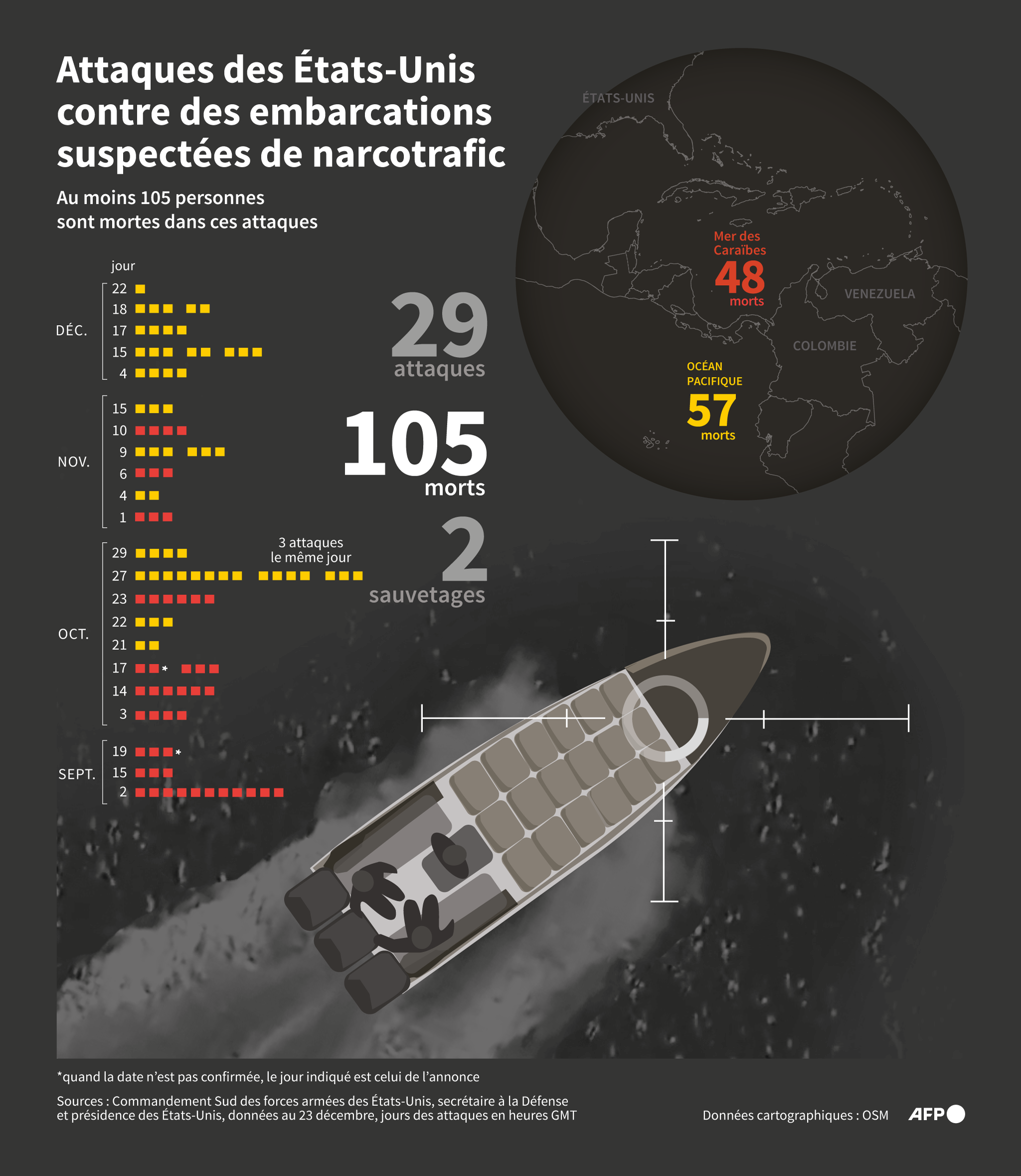
This map highlights the intensification of US military operations against vessels suspected of drug trafficking in the Caribbean Sea and the eastern Pacific Ocean. Between September and December 2025, these interventions resulted in 29 attacks, causing the deaths of at least 105 people in operations officially presented as part of the fight against drugs.
The geographical distribution of the deaths highlights two key areas. The Caribbean Sea accounts for 48 deaths, while the Pacific Ocean has an even higher death toll of 57. These areas correspond to the main maritime routes used by traffickers connecting South America, particularly Colombia and Venezuela, to North American markets. The map thus shows that the fight against drug trafficking is also a matter of controlling maritime areas on the immediate fringes of the United States’ strategic sphere of influence.
(c) AFP
The detailed chronology of the attacks reveals their regularity and sometimes their simultaneity, with up to three attacks on the same day. This frequency suggests a coordinated and sustained strategy rather than isolated actions. The low number of recorded rescues (2) contrasts sharply with the number of deaths.
The illustration of a speedboat being targeted by gunfire reinforces this impression of militarization. It serves as a reminder that these operations mobilize heavy resources: aerial surveillance, special forces, strike capabilities, usually associated with war contexts. Drug trafficking is treated here as a major security threat, justifying an extraterritorial armed response.
Beyond the figures, this map reflects the US determination to cut off maritime drug trafficking routes. It also raises the question of the long-term effectiveness of a strategy based on force in a region already marked by violence, instability, and inequality. The war on drugs thus appears less like a police operation than a discreet asymmetric conflict with very real consequences.