



Ceuta and Melilla are two Spanish enclaves claimed by Morocco.
Spain is weighing the question of their integration and of a possible withdrawal from its southern flank.
In August 2023, the Moroccan embassy in Madrid published a map of the Moroccan kingdom on which Ceuta and Melilla formed an integral part of the realm. This « reunification » was materialised by the disappearance of the borders (recognised, however, by the UN) between these two Spanish exclaves and the rest of Moroccan territory. Following Spanish diplomatic protests, the map was withdrawn — from the internet, at least. Nonetheless, these territorial disputes have persisted since the end of the French and Spanish protectorates over the Kingdom of Morocco in 1956.
While some newspapers speak of these two Spanish territories as a « strange legacy of colonial history » (Le Monde), it is worth looking briefly at the key dates of Ceuta and Melilla to realise that this is quite another story… But since history alone is not enough to enlighten us on contemporary problems, we shall examine other aspects of these borders (legal, economic, political, social and geopolitical) in order better to grasp their particularities and to understand the Spanish-Moroccan relationship around these Spanish enclaves. In this way, we shall try to discern elements of an answer as to a possible Spanish withdrawal from the African continent — which is assuredly not for tomorrow. We shall see, however, that Morocco holds the initiative and reveals to us a strategy deliberately designed to avoid armed confrontation and to avoid breaking with international law, while giving itself the means to contest these borders.
The historicity of the borders: a Spanish presence dating from the 15th century, prior to the rise of the Sharifian empire
Melilla was conquered by the Spanish in 1497 and Ceuta by the Portuguese in 1415, before being transferred to Spain in 1640 when Portugal regained its independence from the Spanish crown after a brief sixty-year union. Although these conquests are often assimilated to the general movement of the Reconquista, these strategic seizures answered above all a need to secure the maritime routes and the Mediterranean coasts, so often prey to conflict and to the Barbary raids of the slave-trading Arab caliphates. The Portuguese also held ports on the Atlantic seaboard of North Africa (Mazagan, Safi and Agadir) until 1769.
For Spain, then, these two enclaves have been Spanish since the 15th century. Yet the Sharifian empire (the sharif being a descendant of the Prophet) claimed by the present Kingdom of Morocco emerged only in 1554, with the capture of Fez by the Arab Saadi dynasty. Today it is the Arab Alaouite dynasty that has reigned over Morocco since 1666, the year Moulay Rachid became sultan. In fact, the dynasty currently in power never reigned over these Mediterranean coastal towns, and no Arab dynasty has reigned over them since the Idrisids, from the 8th to the 10th century. In between, it was Berber dynasties that reigned over Morocco — the Almoravids, the Almohads, the Marinids and the Wattasids, the last of whom were definitively driven from the throne by the Saadis, in 1554. Today, the Moroccan constitution recognises the Amazigh (Berber) language as « the common heritage of all Moroccans » (Article 5) on the same footing as Arabic, allowing the kingdom and the ruling Alaouite dynasty to reaffirm their ties with Morocco’s rich history. Nonetheless, this constitutional argument — merely linguistic and not identity-based — is not enough to justify the Moroccan claim to sovereignty over Melilla and Ceuta in the face of centuries of Spanish presence on the coast.
Other witnesses to the historic Spanish presence along the Moroccan coasts, the Kingdom of Spain holds « plazas de soberanía »: the islet of Perejil, the Alhucemas Islands, the Chafarinas Islands and the Peñón de Vélez de la Gomera (linked to the Moroccan coast by a narrow isthmus 85 metres long), conquered for the most part during the 16th century. Today, military forces are stationed on some of these Spanish possessions and, though less well known to the general public, they too generate friction between the two kingdoms, as the military incident over the islet of Perejil in 2002 attests.
A border legal status on three scales
Melilla and Ceuta are enshrined in the Spanish Constitution of 1978 as forming an integral part of the kingdom’s territory. Their status as autonomous cities, granted in 1995, confirms this constitutional predisposition, placing them almost on an equal footing with the autonomous communities (Andalusia, the Basque Country, Catalonia, etc.).
The European Union (EU) considers any dependency of a member state (overseas territories, for example) as a European dependency and, since Spain’s entry into the Union in 1986, has allocated European structural funds to the two Spanish municipalities, greatly favouring their development. Ceuta and Melilla were originally free ports (a special status favouring their economic development), but had to adapt their special regime to certain European rules in order to keep their status. Thus the two Spanish cities are excluded from the Customs Union and from the Common Agricultural Policy (CAP; although the surface areas of the two enclaves do not allow for significant cultivation), so as not to create distortion of competition within the EU. Following Spain’s accession to the Schengen agreements in 1991, the borders of Ceuta and Melilla became two external European borders. Besides the signs reading « municipality of Europe » at the entrance to the two territories, European funds are allocated to them to combat illegal immigration. However, a visa waiver granted to Moroccans living in Nador (a town bordering Melilla) and in Fnideq or Tétouan (towns bordering Ceuta) so that they may work in these enclaves makes this notion of border subjective, and helps to make these Spanish and Moroccan cities « urban doublets », according to Mohammed Berriane, emeritus professor at the Mohammed V University of Rabat.
As for the UN, the organisation recognises these Spanish borders and does not place the two enclaves on the UN list of non-self-governing territories (« whose peoples do not yet fully govern themselves » and destined to be « decolonised »), thereby ruling out any prospect of Spanish retrocession under international law.
Economic practices induced by the existence of these borders, or when the border line generates interdependence
Borders are spaces liable to develop dynamics of cooperation and of conflict simultaneously — a paradox that makes them spaces of encounter and of separation. Thus « legal and illegal » exchanges accompany the building of a border: they persist because they existed before the marking of the border line, or they are induced by its layout. Cross-border dynamics are certainly observable between Ceuta, Melilla and the rest of Moroccan territory. However, if we were to take the definition of Marie-Christine Fourny and Anne-Laure Amilhat-Szary, describing these cross-border dynamics as « what happens at the border when the dividing line no longer claims to block practices and the feeling of belonging », we would erase the strong Hispanic sentiment of the two Spanish cities, which resists the intense economic relations that Ceuta and Melilla maintain with their Moroccan counterparts. We shall return to this later, when dealing with political and social dynamics.
Economically, the Spanish cities depend heavily on Nador, Fnideq and Tétouan, and thousands of Moroccans work in these enclaves (20,000 Moroccans cross the Melilla border daily). Besides these thousands of Moroccans dependent on the economic opportunities of these landlocked Spanish territories, a genuine cross-border economy is in place, one that would not have such scale were there no border: importers and exporters profit from price differences, from the exchange rate between the euro and the dirham, and from the economic opportunities created by legislation in force that differs on each side of the border. The setting-up of storage warehouses along the edges of the borders is a perfect illustration of these commercial practices. Moreover, this profound difference (economic and in market opportunities) induced by the existence of these borders favours, as at every border in the world, an informal economy (whose activity is neither monitored nor regulated by the state, yet is a vector of growth through consumption and is counted in the measurement of GDP), also known as the underground economy.
Since food products and basic necessities imported from the Iberian peninsula are lightly taxed on entering the enclaves, these Spanish goods generated smuggling flows irrigating northern Morocco and affected Morocco’s productive fabric, according to the Moroccan authorities. This is why they decreed the closure of the border post « reserved for porters » at the entrance to Ceuta, at the end of 2023. The combination of the health crisis in early 2020 and the repeated diplomatic crises of recent years had kept the borders closed, at one point provoking demonstrations by Moroccan smuggling workers such as the « mule women » (mujeres mulas). Their comings and goings had nonetheless been tolerated, since no tax was applied to their goods — hence this border post « reserved for porters », which heightened the competitiveness of these products. Naturally, the closure of the border post has a considerable impact on prices, and therefore on purchasing power, in the Moroccan town of Fnideq bordering Ceuta, but also in Tétouan, 40 km from Ceuta. On the Spanish side, unsold goods pile up for want of an outlet. According to the head of Moroccan customs, Nabyl Lakhdar, the smuggling market between Ceuta and Fnideq represented annually between 6 and 8 billion dirhams (€570 to €750 million). This closure of the borders may well form part of a Moroccan strategy of asphyxiating the Spanish cities, or at least of reducing economic exchanges, since in parallel the Moroccan kingdom is creating an economic activity zone at Fnideq and building a major port at Nador. This is a point we shall develop later.
According to Mohammed Berriane, the existence of these borders also favours conventional economic exchanges between these neighbouring cities, so that today « each of the elements of the two pairs [can] scarcely live without the other ». Still according to the emeritus professor of the Mohammed V University of Rabat, commerce and tertiary activities employ about 76% of the working population of each of the two Spanish cities and provide 85% of their GDP. Moroccan migration is therefore a central source of labour for this economic model. Through their port economies, these two cities constitute « links in [a] much wider space », being situated between Barcelona and Amsterdam on one side, Nador and Fnideq on the other. These two Moroccan cities are in their turn links between these two port cities and the Moroccan cities of Casablanca and Agadir. The Moroccan professor speaks of a « process of integration from below » initiated by licit — but also illicit — exchanges, the latter being tolerated for the sake of « social peace ».
The professor offers here a very pertinent analysis of the economic dynamics that tend towards cross-border, even regional, integration. However, the internal political and social dynamics teach us quite another reality: internal frictions, certainly, but no calling into question of these deeply marked borders.
Of these Spanish-Moroccan borders, what political stakes inside the enclaves?
Although the community of Moroccan origin and Muslim faith today represents between 40% and 50% of the two cities’ populations, the community of peninsular origin and Catholic faith remains the majority, making up 50% of Melilla’s population and 59% of Ceuta’s. This community diversity is undeniable, and all political parties, whatever their leanings, know it is a central factor to take into account. This community diversity is, moreover, deceptive, since in 1977 the Spanish Communist Party (PCE) campaigned in Melilla in favour of returning the territories to Morocco and was credited with a stinging 5% (of the vote), forcing the PCE to change its strategy as early as 1979 by recognising the « Spanishness » of the two territories.
According to Alicia Fernández García, doctor of Letters, Foreign Languages and Civilisations and author of several works and studies on the two Spanish enclaves, these two territories assert themselves as Spanish, but the desire for local autonomy there is strong. From the municipal elections of 1987 onwards, a proliferation of local political formations was observed — a consequence of the growing distrust of Ceutans and Melillans towards the national political parties. Indeed, despite its omnipresence in the political life of the two enclaves between 1977 and 1987, the Spanish Socialist Party (PSOE) left its mark through its hesitations and reversals over the status of the two cities and their future within the Spanish nation. At the Suresnes congress in 1974 (a meeting of the Spanish socialist party in exile), the PSOE came out in favour of their retrocession before shifting on the question, while trying to attract the votes of Spaniards of Moroccan origin. Thus, in the local elections of 1992, the PSOE absorbed the list of the community party GIHB, which wished to institutionalise inter-community conflicts by recognising the Moroccan-Berber minority. Moreover, it was Felipe González’s government (PSOE) which, from Madrid, carried the Aliens Act (Ley de Extranjería) of 1986, allowing the naturalisation of 6,342 Moroccans by origin in Ceuta and 6,542 in Melilla. At the time, the reaction of the populations was mixed and a source of strong social tension around the notion of the inhabitants’ « Hispanicity ». Besides the considerable improvement in living conditions for the beneficiaries of the law, these Muslim populations have since constituted a substantial voting reservoir relative to the two cities’ populations (83,000 and 84,000 respectively). This law was promulgated a few months before the regional elections, and the PSOE was finally ousted from the governments of these two territories from 1987.
As we saw above, Ceuta and Melilla have been enshrined in the Spanish Constitution since 1978. However, the PSOE’s hesitations at federal level preserved a legal blur until the granting of their official status as « autonomous cities » in 1995, prompting years of debate over their sovereignty. First excluded from the map of autonomous communities, then attached, in a « half-official, half-unofficial » way, to the autonomous community of Andalusia, it was only in 1985 that a preliminary draft by the central socialist government granted them a « limited » autonomy devoid of legislative power. However, this incomplete status, far from the expectations of the local populations, only marked the territories’ differences from the rest of Spain’s regions more sharply. Faced with the fear of a Spanish abandonment, one observed in the wake the emergence of local initiatives, such as the creation of an Autonomist Platform by all the local political parties in Ceuta — with the exception of the PSOE — as well as by trade unions and social organisations, with the exception of the Muslim associations.
We understand, then, why the political history of the two enclaves is marked by instability. Thus, until the 2003 elections, political alternation was at work, whether with national or local parties, except for the PSOE which, as we wrote above, no longer formed part of a local government from 1987, despite its national dominance. National and local alike, no political party called into question the two cities’ belonging to the Spanish nation after the failure of the communist discourse in 1977. Since then, both local and national parties campaign for greater autonomy for the local governments, on the model of the Iberian peninsula’s « autonomous communities ». The objective is to obtain legislative power, which has remained in Madrid despite the creation of the « autonomous cities » status in 1995.
Since 2003, the People’s Party (PP) has dominated Ceutan and Melillan political life, having managed to mobilise nationalist and sovereigntist discourse, cutting the ground from under the local nationalist parties, and having managed to position itself against the relative abandonment by the central state, broadly dominated by the PSOE since 1983 (26 years in power since 1983 against 14 years for the PP). This local adaptation of the PP and its lasting entrenchment despite political changes at national level leads Alicia Fernández García to speak of the conservative party’s « branch-office model » (sucursalismo). Moreover, at the early regional elections of 2023, the PP won the majority of votes in Ceuta and brought down the left-wing coalition in Melilla — a four-year parenthesis in the PP’s crushing hegemony since 2003. Thus the PP deputy Juan José Imbroda rose once more to the head of Melilla after an absence of one term that had ended 18 years at the head of the city. In Ceuta, Juan Jesús Vivas (PP) confirms his uninterrupted presidential hegemony since his election in 2001.
Marked ethnic and religious borders within the enclaves
As we mentioned above, the Muslim communities of the two Spanish entities are growing — but what do they want?
We have just seen that the Ceutan and Melillan populations seem to express, in the majority, an attachment to Spain. Yet, since the naturalisation law « Ley de Extranjería » of 1986, not only did the social and economic condition of the Muslim inhabitants improve, but they thereafter acquired a political existence. Whereas we might have thought they would turn to pro-independence parties, it turned out quite otherwise. Indeed, the left-wing political parties Ceuta Ya! and Coalición por Melilla (CpM) — the latter enjoying the support of the Islamic Commission and using the political slogan « Inshallah » in 2011, gathering the majority of the Muslim vote — call for greater autonomy (obtaining legislative power), agreeing on this subject with the other dominant parties, without however carrying separatist demands or a union with Morocco.
While everyone agrees on Ceuta and Melilla’s attachment to the Spanish nation, the political cleavage between the different segments of the populations lies rather in the question of the cities’ Hispanicity (« españolidad »), defended by some and rejected by others — mostly Muslims — who claim a Hispano-Berber heritage. Given that the change in the Muslim share of the Ceutan and Melillan populations is considerable since 1987 (22.5% in Ceuta and 32.5% in Melilla in 1987, against 40% to 50% today), it is normal that identity-related problems should arise and take political shape. According to Alicia Fernández García, the concerns of Muslims revolve around better social integration, demands in terms of housing, as well as access to work and the fight against poverty « very high compared with local and national indicators ». While 15,000 Moroccans reside legally in Melilla out of a total population of 84,000, a Spanish law prohibits foreigners from acquiring property. These inequalities and the high unemployment rate make certain neighbourhoods « hard cores of jihadist recruitment », according to the researcher (an unemployment rate of 27% in Melilla and 25.8% in Ceuta according to Eurostat — among the highest in the European Union).
Thus, the territorial conflict pitting the Spanish and Moroccan kingdoms against each other cannot be reduced to a dispute founded on a « strange legacy of colonial history ». This biased approach ignores the particularities of these two territories, induced by more than five centuries of Spanish presence. These anti-colonial discourses are generally based on the notion of the right of peoples to self-determination — a notion readily flouted in the case of Melilla and Ceuta. This stance could result from a rush in handling the subject, a wholly classic symptom, in sum, of ideological discourses that carry ideas beyond the concerns of the populations involved.
However, since the interests of states are not necessarily those of populations, the Moroccan kingdom fully intends to go beyond the stage of diplomatic claims and to push Spain towards withdrawal by all permitted means.
What do the border tensions tell us about each state’s strategy?
Through this brief political history of Ceuta and Melilla we can glimpse Spanish strategy since the advent of the parliamentary monarchy. Between hesitations, short-termism and a generalised abandonment by the central state — apart from a few sudden bursts, such as during the Perejil islet crisis of 2002, in which the Spanish government (then led by the PP) showed firmness towards Morocco — the Spanish kingdom seems to bank on a wait-and-see position that forces cooperation and a policy founded on reaction. Nicolas Klein speaks of the traditional Spanish « irenicism », which shows its limits in the face of Moroccan activism. For its part, the Moroccan kingdom holds the initiative and deploys a multidimensional strategy that destabilises Spain and the socialist government.
Let us begin with the most heavily publicised of the subjects of discord:
The migratory crises at the Spanish borders, or one facet of an overall Moroccan strategy
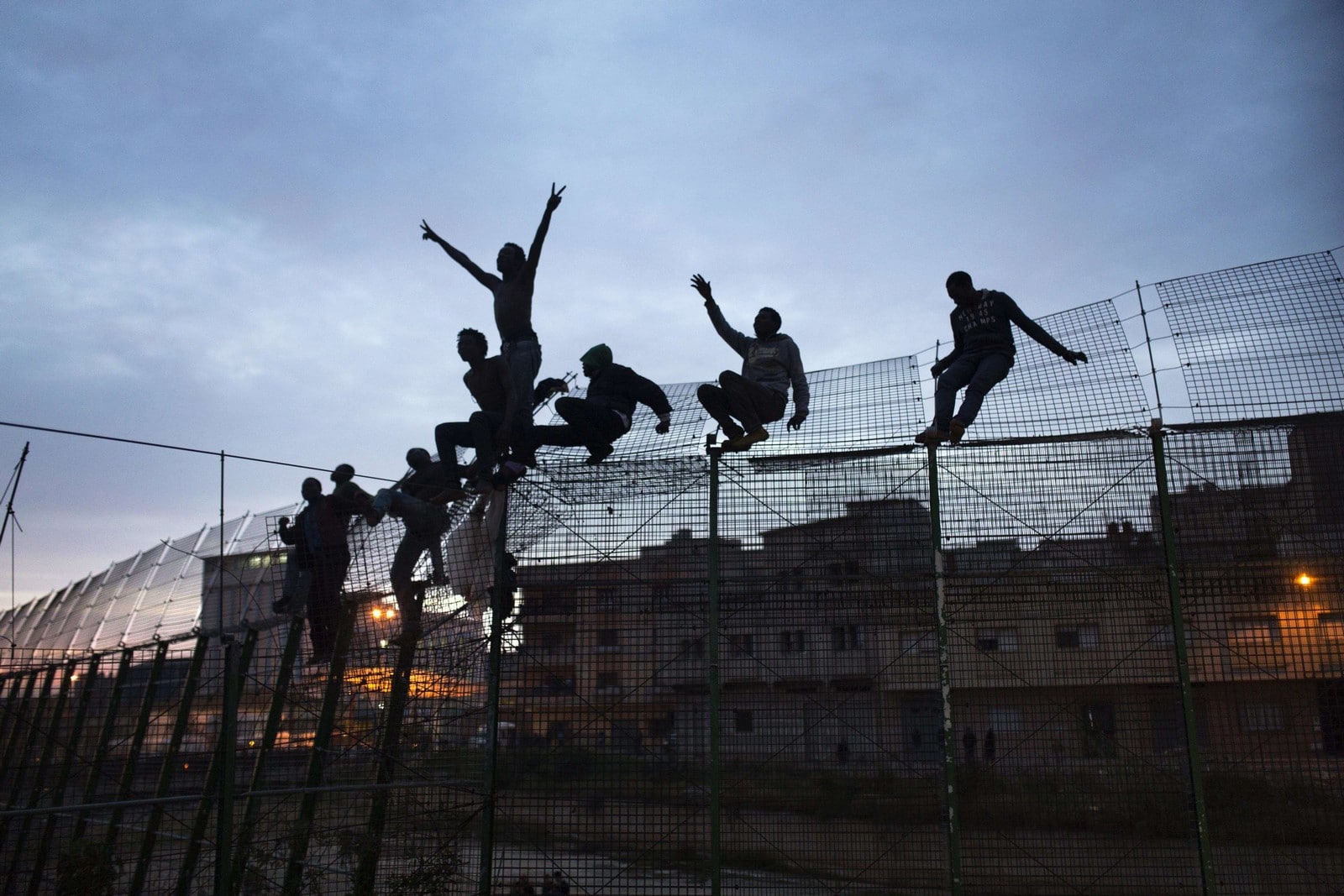
Tragic events multiply at the borders (in 2018, 7,000 people had managed to cross the border, and in 2022 a major influx of migrants at Melilla caused 23 deaths in clashes with border guards) and seem to be correlated with the emergence of disagreements or diplomatic crises between the two countries. The most striking example is the crisis of 30 May 2021. On that day, nearly 9,000 people (including 1,200 unaccompanied minors) crossed the border illegally to reach the city of Ceuta — nearly the equivalent of 10% of its total population.
This mass immigration that Ceuta and Melilla undergo in fits and starts differs from the transnational economic and social practices of the thousands of workers we described above. This mass, sudden immigration of 31 May 2021 involved thousands of clandestine migrants seizing the opportunity of a border unusually stripped of its Moroccan border guards in order to reach Spanish — and therefore European — territory, so as to lodge an asylum application. That these people risk their lives to reach these territories stems from two things: the unfortunate appeal of their status as external European borders located on the African continent, and then the migratory channel maintained by « militant associations » at European scale, which increases the appeal of these borders.
The lawyer Philippe Fontana, author of La vérité sur le droit d’asile (Éditions de l’Observatoire, 2023), describes the political, ideological and protest role of many associations. They intervene in the asylum application, like the Cimade, the Gisti, France terre d’asile (French) or Solidarity Wheels (based in Melilla, which intends to « challenge the EU’s border policies »), or in the migratory journey, like Sea-Eye (German), Médecins sans frontières (French) or SOS Méditerranée (European status, though originally French), which regularly assist migrants off Libya and sometimes in Libyan waters, according to the statements of the spokesman of the Libyan navy, Brigadier General Ayoub Kacem. Indeed, these associations are regularly denounced as « accomplices » of the smugglers in the « trafficking of migrants [which] takes place in all regions of the world and generated income of $7 billion for the traffickers », according to the study by the United Nations Office on Drugs and Crime (UNODC), published in 2016.
The cases of Melilla and Ceuta also crystallise debates, so regularly do international NGOs mobilise their influence networks at the EU, with the UN and in the press, to « denounce » borders that are « hermetic » and « with no kind of access to asylum whatsoever » (the NGO Solidary Wheels). The French association Gisti speaks of a « war on migrants », while its compatriot La Cimade, with the Asociación Pro Derechos Humanos de Andalucía (APDHA), takes part in drawing up reports such as « Ceuta and Melilla: open-air sorting centres at the gates of Africa? ». Human Rights Watch made a grave accusation that Spain and Morocco had conducted « flawed » and « insufficient » investigations following the 2022 tragedy, while Amnesty International called for the deployment of international observers in the enclaves. This international activism denies the very notion of state sovereignty and of state responsibility in the management of sovereign missions on their territories, whose borders are recognised by the UN. This is indeed an « ideological role » that the lawyer Philippe Fontana says is « the most serious, in refusing borders ». Alicia Fernández García also mentions the active role of politicised Ceutan and Melillan associations in the naturalisation process of the thousands of foreigners of Moroccan origin in the two Spanish enclaves during the 1980s.
It is on this appeal of the European borders and on the tensions generated by European associative activism that Morocco relies when it wishes to put political pressure on Spain.
In this sense, European Parliament resolution 2022/C 67/11, voted on 9 June 2021, informs us about the crisis of 30 May 2021. This resolution states « that the crisis was triggered by Morocco because of a political and diplomatic crisis » between Morocco and Spain, and that, according to the wishes of the Moroccan foreign minister himself as well as « the official Moroccan statements of 31 May 2021, the bilateral crisis was not linked to the migration issue […] (but) stemmed directly from the fact that the head of the Polisario Front had been received in Spain », and was a consequence of « Spain’s position, deemed ambiguous, on Western Sahara ». The accusations are grave and humiliating, for the resolution denounces « the instrumentalisation of minors by the Moroccan authorities in the migration crisis at Ceuta », in that « most of the children believed they were taking part in a simple school outing to Ceuta and that they could watch, free of charge, a football match with famous players ».
The European Parliament resolution readily passes over the fact that hundreds of Moroccans were fleeing difficult living conditions in the north of Morocco (the Oriental region and that of Tangier-Tétouan-Al Hoceima), a region historically poorer and less developed, with an unemployment rate nearly twice as high as in the rest of the country — consequences of a historically conflictual relationship with the Makhzen. Under the reign of King Hassan II, the Rif was deliberately kept in a state of underdevelopment and under close surveillance in order to ward off any inclination to revolt (such as the Rif War of 1921-1926 and the uprising of 1958-1959). Today, King Mohammed VI and the Moroccan central authorities are deploying investment in the region: development of the ports of Tangier and Nador, of infrastructure at Fnideq, decriminalisation of cannabis cultivation, promotion of the Berber language and arts… However, the closure of the borders with the Spanish enclaves affects the region’s income and could well reawaken the resentments that had triggered the « Rif Hirak » in October 2016, which started in the city of Al Hoceima.
Once the crisis had passed, the vast majority of these « migrants » had returned to Morocco. In fact, a Spanish law specific to Ceuta and Melilla allows pushbacks of migrants without formalities or delay. The effectiveness of this legal specificity lies in the signing of a « provisional readmission agreement » signed in 1992 between Spain and Morocco. Although it was not implemented until 2004, the signing of a « readmission agreement » in 2007 confirmed Spain’s ability to repatriate, without delay or procedure, Moroccan migrants as well as migrants from third countries. Concerning Moroccan minors, an agreement was signed in 2004 to authorise their repatriation to Morocco, coupled with a youth partnership agreement to finance their reintegration and their training, and a cooperation agreement for the prevention of the emigration of unaccompanied minors. These agreements appear, moreover, contradictory in the face of Moroccan territorial claims.
Indeed, the Moroccan position of proclaiming its sovereignty over these cities is paradoxically weakened by its collaboration with Spain (the border police cooperate) and the European Union (European financial aid to Morocco) to regulate immigration at the borders. In addition to their « readmission agreement » and the « youth partnership », a neighbourhood treaty was ratified in 1993, favouring the recognition of common stakes and cooperation between the two countries. Nonetheless, this interweaving of economic and political interests can represent, for Morocco, an effective means of pressure on Spain and the European Union to negotiate an ever more advantageous economic rapprochement, despite the EU-Morocco association agreement already signed in 2000.
Another significant example of the Moroccan strategy: the economic asphyxiation of the Spanish enclaves, which do not intend to let it happen.
Morocco closes the borders; Ceuta and Melilla open towards other horizons
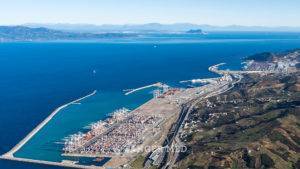
The Moroccan kingdom seems willing to use other means of pressure on the Spanish crown. Besides the use of the migratory lever — a practice that may fall under « hybrid warfare » — the Moroccan kingdom wishes progressively to asphyxiate the economy of these two Spanish enclaves by cutting the smuggling flows and by banking on the development of competing Moroccan ports in the region, such as the Nador West Med port, which intends to draw inspiration from the success of Tanger Med (19th in the world ranking of container ports). Without the Moroccan economic outlets, the historic commercial practices of the two Spanish enclaves could be seriously threatened. However, this Moroccan strategy is double-edged. As we wrote above, northern Morocco could be seriously affected by the border-closure measures.
The cessation of the smuggling economy at the Spanish borders, combined with the development of two poles of economic attractiveness at the two ends of Morocco’s Mediterranean coast (Tangier and Nador), considerably affects the other cities of the Mediterranean rim (Fnideq, Tétouan, Al Hoceima and Nador itself, pending the commissioning of the new port complex). Let us recall that, according to the IMF, the informal economy represented on average 34% of Moroccan GDP between 1991 and 2015. The question of internal migration arises for the workers, but is awkward in a traditional, deeply rooted northern society. Moreover, the impact of economic exchanges between Ceuta, Melilla and northern Morocco was considerable. Let us recall that the Ceuta-Fnideq smuggling exchanges alone represented annually between 6 and 8 billion dirhams (€570 to €750 million), or nearly 0.62% of Moroccan GDP ($133 billion in 2022, according to the World Bank). According to a study conducted in 2009 by the « Fundación para el Desarrollo Socioeconómico Hispano-Marroquí » (FHIMADES), « If the rate of increase of imports to Melilla rises by 1%, the growth rate of Moroccan GDP rises by about 0.20%. This means that purchases made by Melilla abroad favour Morocco’s economic growth. » This was considerable, given Melilla’s small population (80,000 in 2009) against the 32 million Moroccans at that time. The economic study underlines that the difference in economic level between the Spanish cities and their Moroccan surroundings is a factor favouring their commercial exchanges, where the benefits are mutual. And the study concludes that, thanks to certain economic development projects launched in the 1970s and favoured by its proximity to Melilla, the city of Nador increased its dynamism and turned into a pole of regional development. It is therefore on this existing regional dynamic that the port of Nador intends to rely in order to develop and emancipate itself from Melilla.
Aware of their vulnerability, the cities of Ceuta and Melilla could also multiply economic initiatives. In early 2024, the two cities and the autonomous region of Andalusia created a « Zona Económica Especial » (SEZ – Special Economic Zone) similar to the one in force in the Canary Islands. According to the Observatory of Ceuta and Melilla, this joint SEZ will allow the establishment of an « attractive tax regime for investment and the creation of [at least 1,000] jobs in the two autonomous cities, with an impact of €100 million ». This SEZ will thus face the new Moroccan free zone of the port of Nador. Yet, since the ports of Melilla and Nador are located in the same bay (further proof of the two cities’ interconnection), the Nador West Med complex is being built at a new location, on the bay of Betoya. This new Moroccan port will be deep-water and will be endowed with « significant capacities for container transhipment, [with] an energy hub (treatment, packaging and storage of hydrocarbons and derived products) and the handling of bulk products, notably coal ». The port of Melilla will not be able to compete with its new Moroccan counterpart, and this is why the local authorities are shaping quite another strategy. Miguel Marín Cobos, deputy president of Melilla, sets out in the columns of the newspaper Ceuta Actualidad a three-stage change of economic model: university development, with the aim of attracting 5,000 new students; tourism development (by promoting responsible, quality tourism, improving the potential of cruises and diving tourism); and the development of the technology industry. The analyst Sánchez de la Cruz, author of the report « Redefining the economy of the south: opportunities and challenges for the future in Ceuta and Melilla », tells the newspaper La Razón that the technological potential of the two enclaves is promising, in that « 30 major technology companies have landed [there] in recent years ». The tax attractiveness of the Spanish cities thanks to this new SEZ should favour the establishment of other firms focused on new technologies. The Canarian model inspires this initiative, for 270 active companies have set up there since the creation of its SEZ, generating €1.1 billion a year and 4,500 jobs.
However, the initiatives of the autonomous cities of Ceuta and Melilla alone, in the face of the Kingdom of Morocco, could not suffice. Moreover, the Spanish federal government approved, at the end of 2022, the « integral socio-economic development plans for the cities of Ceuta and Melilla » and the mobilisation of €711 million in investment between 2023 and 2026. While the Spanish government declares that « Ceuta and Melilla [are] more present than ever on the political and economic agenda » and prides itself on « clear support […] for economic development and social and territorial cohesion », this governmental initiative is really only the extension of the EU’s post-Covid recovery plan, known locally as the Recovery, Transformation and Resilience Plan (Plan de Recuperación, Transformación y Resiliencia), which concerns all Spanish regions. Nothing new in the South, then, except that promises of financing were made and that henceforth it is a matter of obtaining their disbursement — which is quite another story.
Finally, since the Moroccan strategy is multidimensional, the military aspect is assuredly not neglected by the Kingdom of Morocco.
An increase in Moroccan military capability closely watched in Madrid
In 2002, military tensions reached their peak during the dispute over the islet of Perejil. The Kingdom of Spain displayed the extent of its military power in the face of a Morocco forced to yield (28 commando units were deployed, as well as 6 air force and navy helicopters). In 2012, Spanish F-18 aircraft were stationed in the Canary Islands amid rising Spanish-Moroccan tensions over the delimitation of their respective EEZs in a maritime zone possibly rich in hydrocarbons.
Since the Perejil islet crisis, regular troops have been stationed there — « about thirty » army soldiers are, moreover, on each « Plaza de Soberanía », according to the newspaper La Razón. Two Spanish navy patrol boats operate from Ceuta and Melilla for maritime surveillance, the fight against trafficking and illegal immigration, and as support for the units deployed on the « plazas de soberanía ». In reality, these are small vessels — one of 62 tonnes and the other of 44 tonnes, each carrying a crew of 10 men. This is why larger vessels are regularly deployed for maritime missions. Attached to bases in continental Spain, they work in concert with the Ceutan and Melillan military authorities. Among them are the high-seas patrol vessel Atalaya P-74 (a versatile 1,100-tonne ship carrying out surveillance, maritime territorial defence and fisheries policing missions), but also the maritime-action vessel Rayo P-42, the amphibious ship Galicia (14,000 tonnes, carrying up to 6 helicopters and landing craft), and the frigates Reina Sofía F-84, Navarra F-85 and Canarias F-86, specialised in anti-aircraft warfare but endowed with anti-submarine and anti-surface capabilities (4,017 tonnes fully loaded, equipped with Mk 13 single-arm missile launchers firing SM-1MR surface-to-air missiles and long-range Harpoon anti-ship missiles, torpedoes and 12.7 mm machine guns, among others). This maritime presence allows the Iberian kingdom to assert its sovereignty over its Mediterranean possessions and to deter Morocco from any initiative similar to the one that provoked the Perejil islet crisis.
The Moroccan and Spanish armed forces are incomparable, so much better equipped and more powerful is that of King Felipe VI. In the 2024 Global Firepower ranking, Spain is the 20th most powerful army in the world, while the Kingdom of Morocco is 61st. For example, the Spanish Royal Navy today comprises 11 frigates (F100 and F80 classes, with 5 F110 under construction), two submarines (including one S80, with three others under construction), two landing-craft transport ships, a mixed amphibious flagship of the Juan Carlos I class (a helicopter and aircraft carrier) and 13 EAV-8B Harrier II ground-attack aircraft embarked, in addition to drones, helicopters and various patrol boats. The Moroccan Royal Navy has only 6 frigates, of which 2 are considered high-seas patrol vessels, some twenty patrol boats, but no submarines and no embarked attack aircraft.
Nonetheless, the developments of the Moroccan army — as of the Algerian one, moreover — are the object of every attention in Spain, because, according to Brigadier General Jérôme Pellistrandi, editor-in-chief of the Revue Défense Nationale, « strategic competition with the Maghreb also shapes Spain’s naval policy, with an ambiguous relationship with its southern neighbours ». While taking care to guard against a rise in power of the Algerian and Moroccan navies, the Spanish navy organises exercises with Morocco on one side and with Algeria on the other. Whereas the 2008 economic crisis resulted in a significant reduction of the resources allocated to Defence by Spain over the last ten years, on the Moroccan side the trend is towards modernisation and the development of its military capabilities. Between 2013 and 2018, the Moroccan Royal Navy acquired four frigates, including the multi-mission frigate Mohammed VI and three SIGMA frigates. Nonetheless, and according to the International Security Studies Group (GESI), these high-seas vessels could be still better armed, notably to face saturation air attacks or simple successive waves of attacks. The construction of the helicopters to be embarked on them is slow, limiting the vessels’ anti-ship and anti-submarine potential. Moreover, this problem of under-armament for ensuring the vessel’s anti-aircraft defence also concerns the French navy, as the recent engagement of the FREMM frigates Languedoc and Alsace of the Aquitaine class in the Red Sea against the Houthis demonstrated. All navies face the same challenges posed by the intensification of the use of armed drones and their qualitative development (increased endurance, payload capacity, etc.) at costs still derisory relative to the cost of building warships, their armament and their upkeep.
It is, moreover, on drones that Morocco is banking to strengthen its military arsenal, sourcing them from Israel, its new industrial and military partner. According to the media outlet El Español, the Moroccan authorities are said to be building a military base on Mount Gourougou overlooking Melilla, with the aim of stationing there drones and missiles (Sea Breaker) supplied by Israel. Furthermore, under the security cooperation agreement signed on 24 November 2021, the Kingdom of Morocco is said to be building kamikaze drones under Israeli licence on its own territory, according to the British media outlet Shephard. These drones, in addition to Israeli-made (PULS) and American-made (HIMARS) missile-launcher systems capable of striking targets 300 kilometres away, would allow Morocco to strike Spanish ships, but also targets in Spain. The Ukrainians’ use of long-range missiles and drones to fight the Russian military navy from their coasts — similar to that of the Houthis to target commercial and military ships in the Red Sea — illustrates the importance of these armaments and makes the Moroccan threat credible for the Spanish army. Israeli-Moroccan cooperation could also help improve the onboard armament of the new frigates and remedy the anti-aircraft defence weaknesses we mentioned above.
While Morocco’s military budget is rising ($12.1 billion for 2024-2025), so too is Spain’s (from €10.1 billion in 2022 to €12.8 billion in 2023), whose government aims to raise military spending to 2% of GDP by 2029 — an increase of €26 billion, according to the defence site Opex360. Thus the resolution of the border dispute should not come through arms. The Kingdom of Spain’s ability to defend its possessions in Africa will nonetheless depend on its doctrine of engagement in the zone, on its taking Moroccan military potential into account in the definition of its doctrine, and on the political will of Spanish governments. Also, Madrid tries in vain to obtain guarantees from NATO in order to protect Ceuta and Melilla in the event of attacks targeting the two cities. It is true that the North Atlantic Treaty does not mention these Spanish possessions, as it specifically mentioned the French department of Algeria before its secession in 1962. Article 6 of the treaty remains vague, mentioning « the islands under the jurisdiction of any of the parties in the North Atlantic area north of the Tropic of Cancer » — thus including the Canary Islands, but not the French possessions in the Indian Ocean — and mentioning « any other region of Europe in which occupation forces of any of the parties were stationed […] or found on the Mediterranean Sea ». However, the Spanish presence in Ceuta and Melilla has nothing to do with the deployment of the allies in Europe and elsewhere in the immediate post-1945 context. Since these two cities are considered an integral part of the Spanish nation and located above the Tropic of Cancer, Madrid demands guarantees from the Alliance that the United States refuses.
What to conclude?
We are here studying a territorial conflict between two states recognised by the UN, but one of which contests the borders sanctified by international law and the post-1945 world system, of which the UN precisely aims to be the guarantor. Here the two states are partners and members of shared international institutions, and the claimant state does not seem ready to change the status quo by force; the risks to its economy, on the path to global integration, are too great. Nonetheless, the military option remains a factor of pressure and an important element in any state strategy, lending credit in the context of diplomatic negotiations.
Thus, the Kingdom of Morocco steps up the pressure and, faced with its assertive attitude, the Spanish kingdom will have to emerge from its « traditional irenicism ». Nonetheless, the Spanish PSOE party’s compromise with pro-independence parties and imprisoned terrorists in order to hold on to power in Spain does not seem to carry this government towards a policy of sovereign assertion over the territories of the Spanish nation. The Spanish government’s passivity is materialised, among other things, by the illegal installation of a Moroccan company’s fish farms in the EEZ of the Chafarinas island (one of the « plazas de soberanía ») since 2021, still not removed despite the official protests of the Spanish foreign ministry. It was, moreover, a PP deputy who filed a complaint with the State Prosecutor’s Office to demand the removal of the farms, testifying to the conservative party’s activism. The fish farm seems still to be in place despite the Spanish protests, which ought to be followed by a show of force with a seizure or dismantling by the Spanish authorities. Yet these two Spanish exclaves enjoy a strategic location for Spain along the commercial maritime routes and would allow a rapid military deployment on the African continent in the event of a crisis. It was, moreover, from these two possessions that the Spanish military penetration set out to apply its protectorate over the Rif. These territories ought to be the object of Spain’s full attention.
It is nonetheless in Morocco’s interest to lay hands on these territories, for they hamper its deployment in the Mediterranean and encroach on its EEZ. In parallel, the two countries are already in diplomatic conflict over the layout of their respective EEZs on the Atlantic seaboard, where Spain holds the Canary Islands. The delimitation of the EEZs is important for these two countries — one the leading fishing nation of Europe, the other of Africa. Despite observable cross-border dynamics, economic ones at least, it must be acknowledged that the Ceutan and Melillan populations claim to be Spanish, beyond the identity and community conflicts that run through them. Here, « the dividing line » that is the border does indeed mark the « feeling of belonging » of the Spanish cities, and Moroccan irredentism could paradoxically strengthen it. If Morocco succeeds in rallying international support for its claim of sovereignty over Western Sahara, no country seems to back it in its position concerning Ceuta and Melilla.
Finally, the Moroccan discourse aiming to denounce vestiges of colonisation seems scarcely credible without a similar denunciation of its own borders inherited from French colonisation, which amputated territories from it in favour of Algeria and Mauritania, two countries created by France. Morocco recognised its borders with Algeria following the Sand War, and did the same with Mauritania in 1969, in a remarkable exercise of « political realism », in order to concentrate its efforts on recovering its sovereignty over Western Sahara — a territory occupied by Spain until 1973. We have here an indicative element from which Spain ought to draw inspiration: to negotiate a bilateral treaty sealing mutual recognition of their borders — Western Sahara in exchange for Ceuta and Melilla. However, in the wake of the 2022 diplomatic crisis between the two countries, Spain acted to recognise Moroccan sovereignty over Western Sahara without demanding any guarantee of Morocco’s respect for Spanish territorial integrity (i.e. its sovereignty over its territories in Africa), constituting a political blur that promises the eruption of new diplomatic — if not military — crises and tensions.
Thus, the status of these borders, which one might have thought irrevocable in a post-1945 world founded on international law, could well change over the next twenty years if Spain does not question its (lack of) strategy.
Bibliography
2024 Military Strength Ranking, Global Firepower, URL: https://www.globalfirepower.com/countries-listing.php
Abourabi Yousra, under the direction of Baudouin Dupret, Zakaria Rhani, Assia Boutaleb and Jean-Noël Ferrié, Le Maroc au présent. D’une époque à l’autre, une société en mutation, Éditions du Centre Jacques-Berque, 2015, 1017 pages, consulted online, URL: https://books.openedition.org/cjb/1086?lang=fr
Alicia Fernández García, « Partis politiques et représentation locale à Ceuta et Melilla (1977-2015) : nationalisation et clivages communautaires », Pôle Sud 2018/2 (no. 49), pp. 5-24, URL: https://www.cairn.info/revue-pole-sud-2018-2-page-5.htm
Alicia Fernández García, « Génération « 1986 » : l’essor d’une conscience nationale espagnole chez les immigrés marocains à Ceuta et Melilla », HispanismeS, Les générations dans le monde ibérique, URL: https://doi.org/10.4000/hispanismes.6688
Alonso Palacios, « Un patrullero vigila las plazas de soberanía españolas en el norte de África reclamadas por Marruecos », El Debate, 21 November 2023, URL: https://www.eldebate.com/espana/defensa/armada/20231121/patrullero-vigila-plazas-soberania-espanolas-norte-africa-reclamadas-marruecos_155102.html
Alonso Palacios, « Misiles con alcance a España: el rápido rearme de Marruecos y Argelia », El Debate, 8 November 2023, URL: https://www.eldebate.com/espana/madrid/20231008/rearme-acelerado-marruecos-argelia-pone-espana-alcance-misiles_145000.html
Ángel Luis de Santos, « La Armada vigila de cerca a Marruecos y protege las plazas de soberanía española en el Estrecho », La Razón, 5 July 2024, URL: https://www.larazon.es/espana/defensa/armada-vigila-cerca-marruecos-protege-plazas-soberania-espanola-estrecho_20240705668802aa099c890001b6f183.html
Berriane Mohammed, « Ceuta et Melilla, espace frontalier sous tension », Les Cahiers d’EMAM. Le Nord du Maroc. Intégration, inégalités et résistances, 2022, [online], consulted 11/01/2024, URL: https://doi.org/10.4000/emam.4361
Bousmid Rym, « Maroc-Espagne : cinq questions pour comprendre le bras de fer autour de Ceuta et Melilla », Jeune Afrique, 18 October 2022, [online], consulted 11/01/2024, URL: https://www.jeuneafrique.com/1385860/politique/maroc-espagne-cinq-questions-pour-comprendre-le-bras-de-fer-autour-de-ceuta-et-melilla/
De Alvear Pilar, « Las plazas de soberanía española en el Mediterráneo », Atalayar, 3 December 2020, [online], consulted 14/01/2024, URL: https://www.atalayar.com/articulo/reportajes/plazas-soberania-espanola-mediterraneo/20201203160138148704.html
« El Observatorio de Ceuta y Melilla propone estrategias para dinamizar la economía de estas ciudades », Ceuta Actualidad, 23 April 2024, URL: https://www.ceutaactualidad.com/articulo/la-ciudad/observatorio-ceuta-melilla-propone-estrategias-dinamizar-economia-ciudades/20240423074548197179.html
Heller Fernando, « L’Espagne s’indigne de la nouvelle carte officielle du Maroc, qui inclut Ceuta et Melilla », Euractiv, 23 August 2023, [online], consulted 11/01/2024, URL: https://www.euractiv.fr/section/international/news/lespagne-sindigne-de-la-nouvelle-carte-officielle-du-maroc-qui-inclut-ceuta-et-melilla/
Jérôme Pellistrandi, « Quelle stratégie navale pour l’Espagne ? », Fondation méditerranéenne d’études stratégiques, 10 December 2020, URL: https://fmes-france.org/quelle-strategie-navale-pour-lespagne/
Klein Nicolas, « L’Espagne face aux revendications territoriales marocaines et algériennes », Revue Conflits, 16 March 2020, [online], consulted 08/01/2024, URL: https://www.revueconflits.com/ceuta-melilla-espagne-maroc-migrations-nicolas-klein/
Laurent Lagneau, « La marine espagnole veut plus de frégates F-110 et de sous-marins S-80 », 2 February 2024, URL: https://www.opex360.com/2024/02/02/la-marine-espagnole-veut-plus-de-fregates-f-110-et-de-sous-marins-s-80/
Laurent Lagneau, « L’Espagne veut augmenter ses dépenses militaires de plus de 25% en 2023 », 10 October 2022, URL: https://www.opex360.com/2022/10/10/l-espagne-veut-augmenter-ses-depenses-militaires-de-plus-de-25-en-2023/
Mehdi Basset, « Espagne/Maroc. La mer d’Alboran et les territoires espagnols en Afrique », Projet Zomad de l’Université d’Angers, Un observatoire de la pratique des zones maritimes disputées, URL: https://zomad.eu/wp-content/uploads/2021/03/med04-20210318-spain-morocco.pdf
Mohamed Khachani, « Contribution de la société civile à la coopération UE-Afrique en matière de retour, de réadmission et de réintégration : le cas du Maroc », European Council on Refugees and Exiles (ECRE), URL: https://ecre.org/wp-content/uploads/2020/11/Les-accords-de-readmission.pdf
« Población de Ceuta », Datosmacro.com, URL: https://datosmacro.expansion.com/demografia/poblacion/espana-comunidades-autonomas/ceuta
European Parliament resolution of 10 June 2021 on the violation of the UN Convention on the Rights of the Child and the use of minors by the Moroccan authorities in the migratory crisis in Ceuta (2021/2747(RSP)), Official Journal of the European Union, URL: https://eur-lex.europa.eu/legal-content/EN/TXT/PDF/?uri=CELEX:52021IP0289
Samir El Ouardighi, « Forces et faiblesses de la marine royale selon un centre d’études espagnoles », Medias 24, 21 March 2018, URL: https://medias24.com/2018/03/21/forces-et-faiblesses-de-la-marine-royale-selon-un-centre-detudes-espagnoles/
« Sans les « femmes-mulets », l’économie entre le Maroc et Ceuta tourne au ralenti », Le Monde, URL: https://www.lemonde.fr/afrique/article/2020/02/03/sans-les-femmes-mulets-l-economie-entre-le-maroc-et-ceuta-tourne-au-ralenti_6028244_3212.html
Official website of the Nador West Med port complex, URL: https://www.nadorwestmed.ma/fr/accueil
Zurlo Yves, « Ceuta et Melilla : villes espagnoles ou dernières colonies en Afrique ? », Vie publique. Parole d’expert, 6 August 2016, [online], consulted 19/01/2024, URL: https://www.vie-publique.fr/parole-dexpert/23847-ceuta-et-melilla-villes-espagnoles-ou-dernieres-colonies-en-afrique
La Cimade, « Ceuta et Melilla : centres de tri à ciel ouvert aux portes de l’Afrique ? », URL: https://www.lacimade.org/publication/ceuta-et-melilla-centres-de-tri-a-ciel-ouvert-aux-portes-de-lafrique/