




-
Long a minor player, Turkey has, in a few years, risen among the world’s ten leading arms exporters.
-
Behind this success lies an original military-industrial complex, structured in five tiers and placed under the direct authority of the presidency.
-
Between a Western tropism, a Eurasian rapprochement and the conquest of new markets in Africa and the Middle East, the Turkish defence industrial base advances masked behind the myth of the « red apple ».
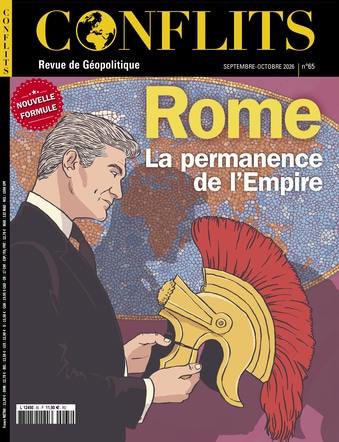
This article appears in Issue No. 65 — Rome: the permanence of the Empire.
Istanbul, May 2026. Thousands of visitors throng the aisles of the SAHA fair. Among the stands, that of the Ministry of Defence draws a veritable rush. The reason for this enthusiasm is simple: Turkey is exhibiting the full-scale model of its first intercontinental ballistic missile (ICBM), the Yıldırımhan. With a range of 6,000 km, the ICBM can strike Moscow, London, Paris, Nairobi, Tel Aviv… Even if the programme is only in its early stages, the message is clear. Not only can Turkey project its power on a planetary scale, but above all it is making a resounding entry into the very closed category of countries with long-range strategic deterrence capabilities. More than that, the missile reinforces, in the eyes of its public opinion, the narrative of a « Turkish century » that would close decades of humiliation. In essence, Turkey exports to 170 countries for a turnover of €8 billion. It is today on a par with South Korea.
Three thousand public and private companies form the backbone of the Turkish defence-industrial and technological base (BIDT). Three guiding ideas drive the Turkish president: to reduce external dependence, to increase strategic autonomy and to support his industry. Erdogan, of course, has in mind the unhappy experiences that punctuated the twentieth century: the Western allies’ embargo after the invasion of Cyprus (1974), the exclusion or limitation from certain European programmes in the 1990s and 2000s, and persistent technological dependence.
Read also: Turkey’s military capabilities. An interview with Tolga Bilener
From the armed Republic to the tech Republic
If the military are at the origin of the Republic, they are also, from the second half of the twentieth century, the forerunners of the military-industrial complex. For a long time, their reign was hegemonic. From budget lines to programmes, everything passed through them. But today, the sword has given way to the toga. The decision-making lift of the Turkish BIDT is organised in five tiers.
The presidency: it overhangs the chain of decision. It is the presidency that sets the political agenda and embodies the strategy of sovereignty. Following this logic, only the sovereign is legitimate to decide, for the simple reason that he is the supreme representative of the institution.
The Presidential Committee: it brings together the ministries, the general staff and the Defence Industry Directorate. It ranks priorities, selects programmes and arbitrates between research and procurement.
The Defence Industry Directorate (Savunma Sanayii Başkanlığı — SSB): it is the operative translation of the presidency. The beating heart of the complex, it is the SSB that launches the tenders, awards the contracts, supervises R&D and allocates the tasks.
The general staff of the armed forces and the ministries of Defence and the Interior: while the final decision is taken at the summit of the pyramid, it does not form in a vacuum. It falls to the military to feed their requests upward.
« Today, the sword has given way to the toga. »
The industrialists: each consortium develops its own expertise: ASELSAN dominates electronics, TUSAS carries aeronautics, ROKETSAN is in charge of missiles, HAVELSAN handles software. But these groups do not confine themselves to mere subcontracting. They are a driving force, anticipating needs, opening markets and thus creating political opportunities. One flagship group stands out from the pack: Baykar. Specialising in drone production, the company combines innovation, a sense of showmanship and direct access to the presidency, since its scientific director, Selçuk Bayraktar, is none other than Recep Tayyip Erdogan’s son-in-law.
Read also: The saga of the Bayraktar TB2 — Ankara’s secret weapon
Moreover, Baykar’s trajectory is symptomatic of the emergence of a new elite. These engineers, entrepreneurs and technopark directors combine patriotic fibre with scientific excellence. Neither frankly Kemalist nor truly Islamo-conservative, they associate in a single narrative the myth of Ergenekon, the six centuries of Ottoman grandeur and Mustafa Kemal’s war of national liberation. This rising elite abandons the rigid Kemalist state-centrism but regards mystical excesses with scepticism. It speaks the language of AI, of tech. It sees in globalisation the natural field of expansion of Turkish power.
Western technology, national spirit and world market
Despite the monolithic appearance of the Turkish BIDT, tensions surface. Never open, these conflicts have as their stakes prestige, prebends or access to the supreme authority. Naturally, the first line of fracture pits the military against the civilians. But, in twenty years of Islamo-conservative rule, the general staff has lost much of its lustre. Now deprived of its autonomy, the army endorses the SSB’s decisions. The second line of disagreement pits, in a heightened competition, the historic players of the BIDT (ASELSAN, ROKETSAN, TUSAS) against the newcomers (Baykar). These para-state companies are used to working over the long term for the national market, on complex projects. The very opposite of the new entrepreneurs, more agile at exporting, more able to produce quickly and to create a narrative intelligible to all.
The question of exports is the third bone of contention. Behind every sale there is also a maintenance and upgrade service. The firms cooperate with one another to access international markets, but come into rivalry as soon as it is a question of who will have pre-eminence in the signing of the final contract.
Geopolitics is the last watershed. Officially, the Turkish BIDT espouses the main lines of Ankara’s foreign policy. However, depending on the regional theatres, nuances exist. In the first place, Turkish industrialists wish to remain connected to the West. Partnerships are so many bridges thrown towards a grey matter that has long been lacking. All the more so as, in matters of engines, aeronautics and control systems, Ankara remains hard-pressed. This is the whole stake of the agreement concluded between Baykar and the Italian aircraft manufacturer Piaggio Aerospace. Paradoxically, the Turks seek, through this Euro-Atlantic tropism, the resources that will make it possible to carry the indigenisation of their industry through to completion — and thus to emancipate themselves from the West.
Read also: The foreign policy conducted by Erdogan
The rapprochement with Eurasia obeys the same logic. It makes it possible to reduce Euro-American dependence. In this way, Ankara signifies that it has alternatives and that it refuses to be treated as an eternal minor. If, in certain sectors (missiles, aerospace), the Russo-Chinese contribution brings added value, risks exist. Too open a tilt towards Eurasia would close the Western markets and complicate access to the indispensable strategic components.
South-East Asia, the Middle East and Africa constitute Ankara’s last field of expansion. Turkish companies, able to produce quickly and in quantity, meet countries wishing to extract themselves from the Washington-Moscow-Beijing triangle. The drone, because it is ostentatious, cheap and politically prestigious, leads the way. It draws in its wake a whole ecosystem: ROKETSAN munitions, ASELSAN sensors, training, maintenance.
« The drone, because it is ostentatious, cheap and politically prestigious, leads the way. »
Read also: The assault on Africa. The strategy of Turkish and Chinese drones
While each of these markets has its specificity, all share two fundamental points. Whatever the byways taken, they all converge towards power and thus towards independence. Finally, and above all, they remain subordinate to the presidential institution, primus inter pares. But, beyond pure technique, the Turks have understood that there is no national grandeur without myth. In each of Erdogan’s successes there is the shadow cast by the longest memory. Thus, Baykar’s choice to name its latest drone Kızıl elma (red apple) owes nothing to chance. The red apple is an ancestral myth. In Ottoman times, it designated an ideal garden of imprecise location: Vienna, Rome, the Atlantic — or perhaps even further west. When the Ottomans have reached this garden and picked this fruit, the world will have been subjugated…