





After months of American threats and Danish-Greenlandic resistance, a defence agreement was signed on 22 September in New York.
It preserves the sovereignty of Denmark and the Greenlanders’ right to decide their own future, while expanding American military options. Who won?
On 22 September 2026, Donald Trump, Danish Prime Minister Mette Frederiksen and the head of the Greenlandic government, Jens-Frederik Nielsen, signed in New York an agreement on the defence of Greenland. Its entry into force remains subject to the parliamentary procedures required in Denmark and Greenland. This document puts an end, at least provisionally, to a singular crisis in which, for months, the leading member of NATO demanded control of a territory belonging to another member of the Alliance.
The affair does not date from this year. As early as 2019, Donald Trump had floated the idea of buying Greenland. After his return to power, he took up this ambition with a new insistence, presenting possession of the island as a necessity for the national security of the United States. At the start of 2026, his remarks about a possible takeover, including by force, provoked a diplomatic riposte from Copenhagen and Nuuk. Denmark reinforced its military presence in the Arctic with the help of European allies. Trump threatened with tariffs the countries that opposed his plan. Then, at Davos, a discussion with the Secretary-General of NATO, Mark Rutte, made it possible to shift the debate. Henceforth it would no longer be a question of transferring Greenland’s sovereignty, but of strengthening the island’s security and reviewing the terms of the American presence. The compromise signed in September stems from this shift. But what did it change? And who won?
To know who won, one must distinguish what changes on the ground from what changes in the balance of power.
Before the agreement, the Americans were already there
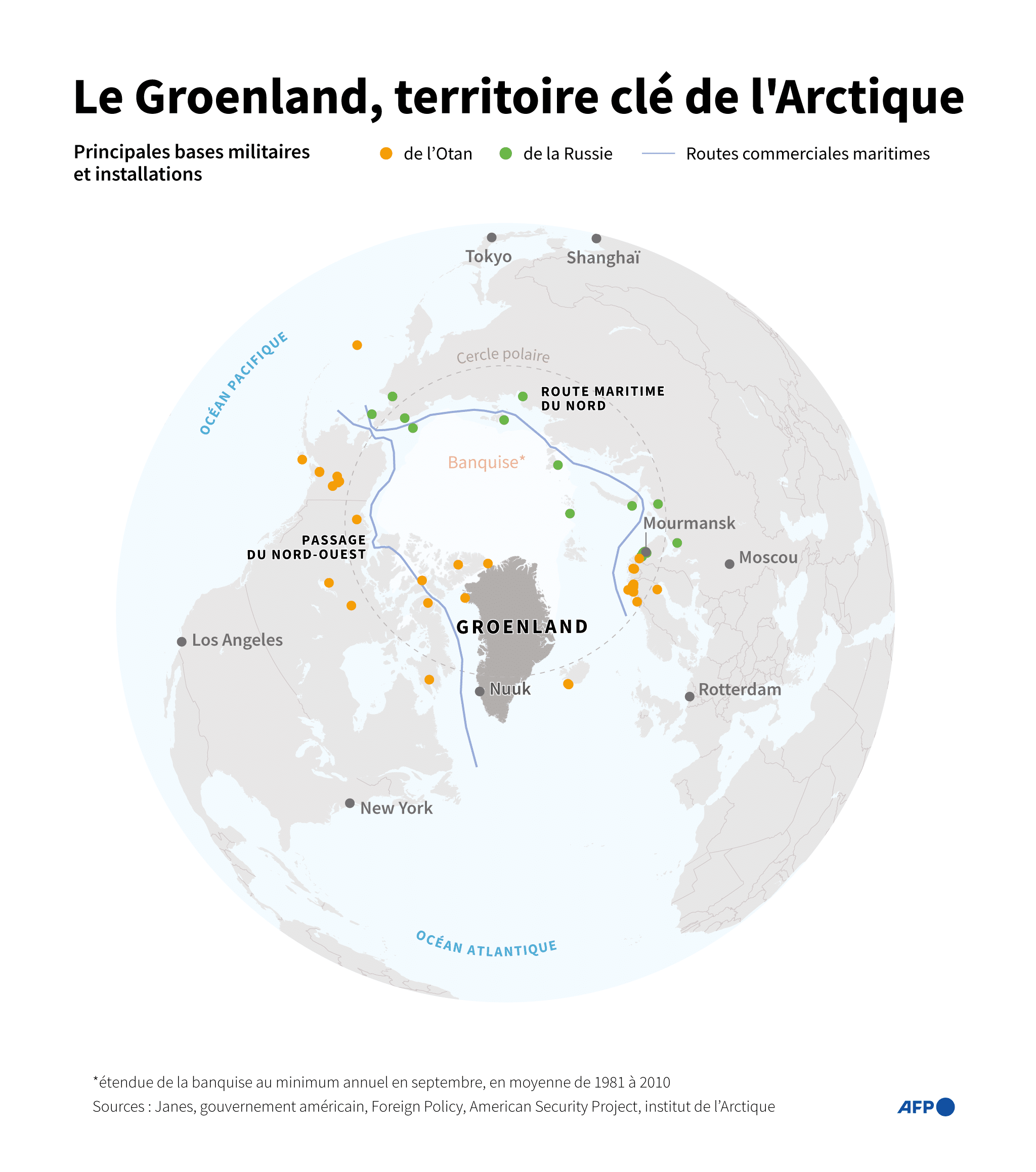
It must first be recalled that the American military presence in Greenland does not date from this agreement. As early as 1941, during the Second World War, a first agreement with Denmark allowed the United States to install air bases and weather stations there. The island then played a role in observing the weather over the North Atlantic. A treaty concluded in 1951 within the framework of NATO durably organised this presence. Its 2004 revision designated Thule, today Pituffik, as the sole American defence area. This base plays a role notably in early warning and space surveillance. The 2026 agreement goes further: it opens the way to new defence areas and expands the possibilities for the movement of American forces on the island. It remains to be seen what scale Washington will actually give to these rights.
Denmark, for its part, retained its sovereignty over the island and its responsibility for defence and foreign policy. Greenland enjoyed broad autonomy and the right to choose, in time, independence according to a procedure enshrined in the 2009 law. This situation left room for closer military cooperation with Washington, but did not give the United States the power to decide the island’s political status. Yet that was the heart of the crisis.
American concerns about the Arctic could be discussed with two partners already bound to the United States by a defence agreement. By claiming Greenland itself, Trump had transformed a strategic negotiation into a conflict of sovereignty.
The preamble of the new agreement first settles this political question. It reaffirms the sovereignty and territorial integrity of the Kingdom of Denmark and recognises the Greenlanders as a people endowed with the right to self-determination. It also recognises the « irreplaceable » role of American forces in the defence of the island. Thus Copenhagen and Nuuk retain the political decision while Washington sees its military role consecrated. But on the ground, the United States obtains more than a formula of recognition.
Article IV authorises the United States to modernise the Pituffik base and to develop its activities there. It also opens the possibility of creating new defence areas at Narsarsuaq and Mestersvig, the terms of which remain to be defined with Denmark and Greenland. Other areas may be proposed, but their location, size and activities will have to be the subject of an agreement between the parties. Washington thus obtains the possibility of extending its military presence, without being able to build bases at its sole discretion. The text finally provides that the contracts linked to these installations be awarded, as far as possible, to Greenlandic companies.
Article V provides for an accelerated review of American requests concerning unmanned military installations outside the bases — for example radars or antennas operated remotely. The text specifies, however, neither their number nor their exact function. Article VI grants American forces broad powers of movement between their installations, rights of overflight, landing and maritime access. These provisions have real operational scope on a territory that remains immense, even on the new maps of the world supposed to better respect the size of the continents. In this space, surveillance, communications and the freedom of movement of aircraft count at least as much as the troops permanently stationed there. The agreement specifies, however, that these rights must be exercised, as far as possible, with respect for the Greenlandic way of life, notably hunting and fishing.
The agreement explicitly mentions the American Golden Dome missile-defence project. It also strengthens NATO’s place in planning, exercises and intelligence in the Arctic. For Denmark, the stake is not to let the United States become solely responsible for the defence of Greenland. The agreement therefore gives more room to NATO and also provides that Copenhagen strengthen its own means of surveillance and defence in the Arctic — on land, at sea, in the air and in space.
| Agreement of 22 September 2026 | What it provides |
|---|---|
| Preamble | Danish sovereignty and Greenlandic self-determination reaffirmed; « irreplaceable » role of American forces recognised. |
| Article IV | Modernisation of Pituffik; possible new areas (Narsarsuaq, Mestersvig); contracts awarded, as far as possible, to Greenlandic companies. |
| Article V | Accelerated review of unmanned installations (radars, remote antennas). |
| Article VI | Freedom of movement, overflight, landing and maritime access, with respect for hunting and fishing. |
| Articles IX-X | Exclusion of forces of non-NATO states; screening of third-state investments (China, Russia) in strategic sectors. |
| Article XI | Continuity of American rights and continued NATO membership if Greenland becomes independent; no expiry date. |
China and Russia kept at a distance
Two provisions respond more directly to the American fear of rival powers gaining a foothold. Article IX excludes, save by agreement of the parties, the military installations and lasting presence of forces of non-NATO states. Article X targets investments coming from states that are neither members of NATO, nor of the European Union, nor partners of the Alliance, when they would give them control, significant influence or access to sensitive information in strategic sectors. Critical infrastructure and resource extraction are among the activities concerned.
The political scope of these clauses aims principally to prevent a Chinese or Russian foothold. However, the text does not give the United States a general veto over all foreign investment in Greenland, and the screening of investment is entrusted to the Greenlandic authorities, in close cooperation with the Danish authorities. It is the latter who have the obligation to consult Washington. The Americans therefore gain a guarantee written into the agreement and a place in the consultations, while the decision continues to be exercised within the Danish and Greenlandic framework.
The decisive point: the island’s independence
The most important clause is perhaps to be found at the end of the document. The agreement has no expiry date and can be modified only by mutual consent. Above all, its Article XI commits the Danish and Greenlandic governments, should Greenland become independent, to ensure that the new state takes over the rights and obligations provided for by the defence agreements. They also commit to its remaining in NATO, applying for membership if necessary. This provision does not, however, guarantee either the decision of a future independent state or its admission to the Alliance. Nonetheless, it shows what Washington is seeking beyond the additional bases — that is, to preserve its military rights even if Greenland’s status changes. The Greenlanders’ right to independence is expressly recognised, but the agreement already traces the security framework within which this independence would have to be exercised. However, a tension remains: the Greenlanders will decide their political future, while their current leaders commit to maintaining, as far as their means allow, a determined defence architecture.
Who won?
As for the assessment, one must first acknowledge the fact that Trump gave up his most spectacular objective, the takeover of Greenland. The document he signed explicitly recognises Danish sovereignty and Greenlandic self-determination. On this point, Copenhagen and Nuuk held firm. The United States nonetheless obtains strategic results: the possible extension of its installations, rights of movement, accelerated processing for certain infrastructure, commitments against adversary military footholds and a prospect of continuity of its rights if Greenland becomes independent. It is less dazzling than an annexation, but very useful to American defence.
« It is less dazzling than an annexation, but very useful to American defence. »
Denmark emerges from the crisis with its sovereignty confirmed and its Arctic role recognised. Greenland obtains a visible place at the signatories’ table, the explicit recognition of its right to decide its own future, and the promise of economic spin-offs linked to the military installations. None of these gains, however, erases the imbalance between an island of about 56,000 inhabitants (even backed by Denmark) and the world’s leading military power.
The agreement allows each party to claim a victory, but not on the same ground. Denmark and Greenland preserved their sovereignty and their right to decide the island’s future. The United States broadened its possibilities for military action and took steps to retain these rights if Greenland becomes independent. NATO, finally, put an end to a quarrel that pitted its members against one another over the fate of an Arctic territory.
One question remains before speaking of a « win-win » agreement: was this crisis necessary to arrive here? The United States already had military rights in Greenland, and Denmark was ready to discuss extending them. Trump’s pressure perhaps accelerated the negotiations. It also shook the trust between allies and forced Copenhagen and Nuuk to defend their sovereignty against the power supposed to contribute to their protection. The « art of the deal » produced an agreement, but it is too early to say whether the rights obtained are worth the mistrust it left behind.
« The ‘art of the deal’ produced an agreement, but it is too early to say whether the rights obtained are worth the mistrust it left behind. »
Read also: Why does Donald Trump want to conquer Greenland? An interview with James Jay Carafano
Read also: Greenland: the island that locks down the Arctic
Read also: Greenland: the people, a major stake
Read also: Nordic military cooperation in the Arctic in the Trump era