




An Industrial Ambition Born in the Sahel
In the African aviation imagination, Nouakchott rarely appears as a centre of gravity. Yet it is from this capital that Global Aviation has developed a project that goes far beyond air transport alone. The company does not seek the notoriety of historic hubs nor a battle over ticket sales, but rather full ownership of the aviation value chain: operations, maintenance, certifications and training. At the core of this strategy lies a simple yet demanding idea: to build a high value-added aviation industry in West Africa, designed for the region’s real operational constraints.
Seeing the Continent from the Cockpit
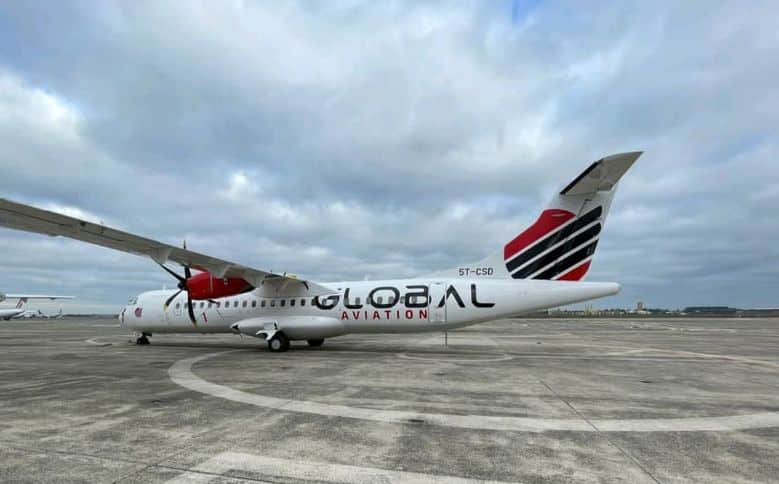
The starting point of the model is not institutional but geographical. Isolated mining sites, landlocked oil facilities, poorly connected capitals, degraded runways and complex borders: in West Africa, air mobility is first and foremost a logistical challenge rather than a commercial one. Where national carriers struggle and single African sky projects remain largely theoretical, Global Aviation has positioned itself within the invisible infrastructure that keeps the regional economy moving. The company transports personnel, critical spare parts and occasionally minerals for clients who cannot afford delays or uncertainty. Some aircraft operate up to ten segments per day. The fleet has been designed accordingly: Beechcraft 1900Ds for short and unpaved runways, Leonardo helicopters for specialised operations, ATR 72s for denser flows, and a Learjet 45 for long-range medical evacuations. Even more symbolic activities, such as overflights of the Guelb Er Richat, fit within this logic of controlled occupation of airspace.
The Founding Event
This project did not emerge from a passion for aviation, but from an accident. In 2012, an aircraft chartered to transport gold from the Kinross mine crashed, killing seven people, including two close collaborators of Yacoub Sidya. The event acted as a wake-up call: outsourcing aviation means accepting a loss of control over safety, maintenance and ultimately the fate of the business. The response was radical. Rather than switching service providers, Sidya chose to create his own airline and regain control over the entire chain of responsibility. The objective was not to own aircraft, but to master certifications, safety standards, maintenance and operational culture.
Building Rather Than Outsourcing
To accelerate this capability-building process, Yacoub Sidya acquired a Spanish company with several decades of experience. Its know-how was transferred to Mauritania. The move was as political as it was industrial: relocating skills, reducing dependence on European or Middle Eastern centres, and keeping expertise and foreign exchange on the continent. The first operations were modest: medical evacuations to Europe from 2019 onwards. The Covid crisis acted as a catalyst. Transfer volumes surged, procedures multiplied and the organisation professionalised rapidly. The project entered a new phase.
Existence Through Certification
From 2021, Global Aviation undertook the most demanding process in the sector: obtaining Air Operator Certificates. The first AOC was secured in Burkina Faso in December 2019 following rigorous audits. Mauritania, Mali, Guinea, Niger and Cabo Verde followed. Senegal is already engaged in the process. These AOCs are complemented by authorisations to operate in Europe under standards close to a European AOC, as well as highly stringent international certifications used in the oil and gas sector, such as the Basic Aviation Risk Standard. “We were congratulated twice for our level of compliance – that is not common,” notes Adama Sangaré. This accumulation of certifications imposes heavy and costly administrative discipline, but it aligns the company with standards comparable to major international operators, despite a fragmented regulatory environment.
© JBN
Flying for States Without Being a State
One of the most structuring aspects of the model lies in Global Aviation’s ability to operate on behalf of African national airlines. The principle is precise: the State retains its flag, traffic rights and symbolic visibility. Global Aviation provides aircraft, crews, maintenance and operational engineering. Once the AOC is obtained, the mechanism is swift: opening an office, deploying teams, positioning aircraft and launching flights, often on historically underperforming routes. For States, this offers a way to maintain air connectivity without bearing the full operational burden. For Global Aviation, it represents a shift in scale, positioning the company as a structuring actor within national aviation systems.
Nouakchott: A Technical Hub Rather Than a Passenger Hub
Mauritania was not chosen according to classic hub criteria. The domestic market is limited and passenger traffic modest. Instead, Global Aviation established its first full maintenance base there – the first private facility of its kind in the country and one of the few in the sub-region. Inspections, repairs, controls, documentation and relations with the civil aviation authority are now handled locally. Heavy maintenance is performed in-house, with only engines sent back to manufacturers. The challenge is substantial: sufficient volumes, rapid skills development and authorities capable of supporting the trajectory. If balance is achieved, Nouakchott and Ouagadougou could become regional technical anchors.
The Human Factor as a Strategic Lever
Reducing Global Aviation to its aircraft would miss the point. As with MSS Security or Phoenix Precious Metals, the company is rooted in a vision where success is also measured by human impact. The objective here is to train African pilots, engineers and managers in a sector largely dominated by expatriates. The team now brings together around a dozen nationalities. “It’s a company of all colours – we constantly learn from each other,” says Adama Sangaré. This diversity is not cosmetic; it accelerates skills transfer. Over the past two years, the company has actively financed technical training and full pilot training programmes. Several young Mauritanians are currently training in South Africa at Global Aviation’s expense, with a clear objective: future captains and maintenance managers should be predominantly West African. Adama Sangaré’s own career reflects this demanding culture. From mechanic to pilot, then ground operations manager in Nouakchott and dangerous goods instructor, he experienced intense pressure early on. “At the beginning, the pressure was very high. I sometimes felt I was being asked the impossible. In hindsight, that was the price to pay to progress quickly.” When his son asks whether he is tired from working nights and disappearing for days, he replies: “I don’t work, I take on challenges. As long as I enjoy those challenges, I continue.”
An Ecosystem and a Test of Endurance
Global Aviation forms part of a broader ecosystem that includes MSS Security, Phoenix Precious Metals and soon a medical complex in Nouakchott. This ecosystem remains strongly associated with the figure of Yacoub Sidya, which is an asset in terms of reputation, reinforced by international recognition. The economic model operates without a safety net: no public subsidies, no state guarantees. Each year, accounts are scrutinised, fleets adjusted and footprints refined. “Aviation is simple: if you are a billionaire and want to become a millionaire, go into aviation,” Yacoub Sidya quips. In a sector exposed to geopolitical shocks and fuel price volatility, it is sometimes necessary to sustain loss-making operations temporarily in order to preserve safety and credibility. Global Aviation is no longer merely a Mauritanian airline. It already serves as a full-scale laboratory for what a West African aviation ecosystem controlled by African actors across the entire value chain could look like. Whether the experience thrives or encounters its limits, it has demonstrated that from Nouakchott, it is possible not merely to join the game, but to help shape its rules.