
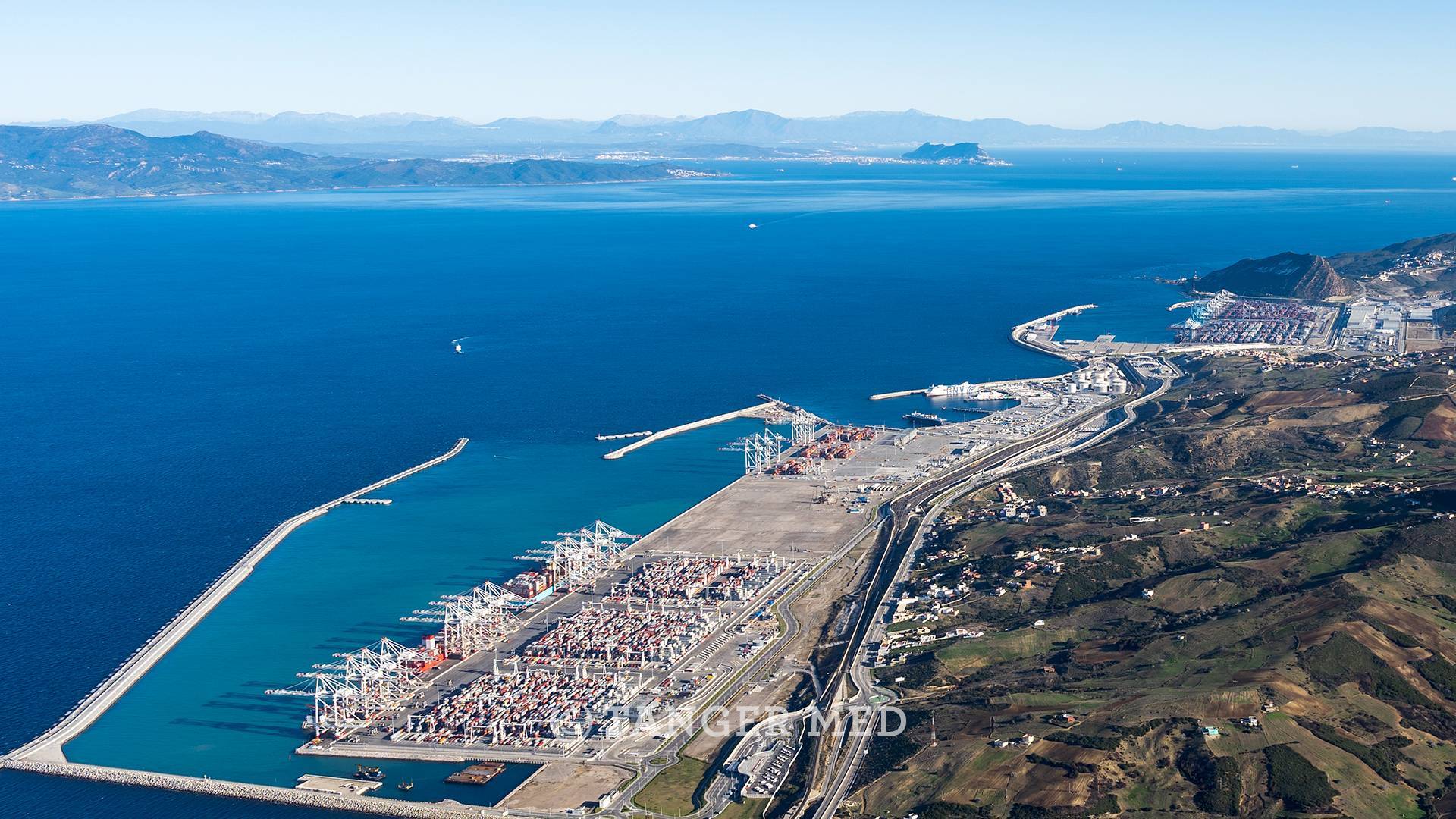




In less than twenty years, Tanger-Med has risen from 61st to 17th place in the world for container ports.
Willed by Mohammed VI, it is far more than a port: an integrated logistics and industrial complex, at the entrance to the Strait of Gibraltar.
Its repercussions are felt across the whole western Mediterranean — and up to the Euro-African scale.
International attention long focused on the vast migratory movement that converged on Ceuta. Yet the port of Tanger-Med, established a stone’s throw from the Spanish enclave and having risen from 61st to 17th place in the world for container ports, is part of the broader development of the Kingdom of Morocco. Its repercussions are felt across the whole western Mediterranean.
Conceived, chosen and launched by Mohammed VI, Tanger-Med is indeed far more than a mere port. It has become an integrated logistics and industrial complex, designed to take advantage of the exceptional position of northern Morocco, at the entrance to the Strait of Gibraltar. In a little under twenty years of operation, it has risen to become the leading port hub in Africa and the Mediterranean for container traffic.
The genesis: turning a geographical position into an industrial advantage
The founding idea dates back to the early 2000s. Morocco sought to take advantage of the Strait of Gibraltar, which concentrates a considerable share of trade between Asia, the Mediterranean, Northern Europe, the Atlantic and the Americas — around 70,000 ship passages a year, that is, 10 to 15% of world maritime traffic — by building an infrastructure capable of intercepting these flows. The Tanger-Med project was launched in the early 2000s, at the instigation of King Mohammed VI, eager to distinguish himself from his father’s image as a feudal sovereign by appearing as a modern, entrepreneurial leader.
It was he alone, according to the study by Michel Peraldi (Tanger Med Port-Royal, Éditions du Croquant, 2026), who settled on the Mediterranean coast, which he knew perfectly, whereas many of his advisers leaned towards the Atlantic coast. The aim was not simply to create a port for the needs of Tangier or northern Morocco, but to build an international transhipment hub: a gateway in and out for the Moroccan economy, industrial and logistics free zones, motorway and rail connections with the country’s interior, a new export-oriented industrial ecosystem.
The works, launched on 30 July 2002 with the support of the World Bank and the Gulf monarchies, were carried out in record time under the direction of the TMSA (Tanger Méditerranée Special Agency), a private-law company in which the state is a shareholder. Tanger-Med 1 was inaugurated in July 2007, with the arrival of the first container. In 2010 the great Tanger-Med industrial platform started up; the passenger and roll-on/roll-off port followed in 2012. Then a saturation much faster than expected led to the development of Tanger-Med 2, whose operations began from 2019-2020.
This was, as we can see, a rather atypical project: industry did not follow the port, it conceived it, designing the industrial zones, the logistics and the infrastructure as a single system. Linked to more than 180 ports in 70 countries, Tanger-Med posts indicative sailing times of about three days to Northern Europe, ten days to the Americas and twenty days to China; nearly 40 African ports, in 22 countries, are served.
This location allows a two-tier model. On the one hand, global flows: carried by large container ships on the Asia-Europe or transatlantic routes, they call at Tanger-Med, which then redistributes the containers to other ports. On the other hand, local flows: Moroccan factories use the port to export to Europe and the rest of the world. It is this combination that distinguishes Tanger-Med from a mere transhipment port.
« Industry did not follow the port: it conceived it, as a single system. »
One port complex, three large sets
The port complex, with its 1,000 hectares, comprises three large sets. The port of Tanger-Med 1 is divided into two parts: the historic core, which encompasses the container terminals TC1 and TC2, the rail terminal, the hydrocarbons terminal, the general-cargo facilities and a vehicle terminal. Tanger-Med 2, built immediately to the west of the first complex to increase container capacity, comprises TC3, operated by Tanger Alliance, and TC4, operated by APM Terminals; TC3 has about 800 m of quay, 36 ha of yard, 18 m of depth and an initial nominal capacity of about 1 million TEU.
Finally, the passenger and roll-on/roll-off port — a distinct infrastructure devoted to ferries, passengers and cars — is heavily used by what Rabat calls the MRE (Moroccans Residing Abroad), who come to see their families, as well as by the TIR lorries linking Morocco to Europe. Its nominal capacity reaches about 7 million passengers and 700,000 lorries a year.
The heart of the activity nonetheless remains the container, the field in which growth is most spectacular. The complex has four large terminals — TC1 to TC4 — for a historic nominal capacity announced at around 9 million TEU. But this was exceeded extremely fast. Tanger-Med now handles more containers than its historic nominal capacity, thanks to extensions, productivity gains and a very intensive operation of the terminals. Its problem is no longer to attract traffic, but to absorb its growth.
| Year | Containers handled (TEU) | Change |
|---|---|---|
| 2023 | 8.6 million | — |
| 2024 | 10.24 million | +18.8% |
| 2025 | 11.11 million (11,106,164) | +8.4% |
« Tanger-Med’s problem is no longer how to attract traffic, but how to absorb its growth. »
Tanger-Med, however, is not only a container port
The establishment of the automotive industry was one of the great successes of the model. In September 2007, Carlos Ghosn, then CEO of Renault, came to Morocco to sign with the king a protocol launching the Renault Dacia plant in Tangier-Tétouan: this was Tanger-Med’s second life. Completed in 2012 and inaugurated by Mohammed VI, the plant stands as the first car factory in Africa; it employs 6,000 people and makes 60 cars an hour: 299,400 rolled off the line in 2025.
The complex has a theoretical capacity of about 1 million vehicles a year. In 2025, it handled 526,862, after around 601,000 in 2024. The 2025 decline (-12%) is attributed notably to adjustments in automotive production and markets. The main flows come from Renault Tanger-Melloussa, SOMACA Casablanca, Stellantis Kénitra, as well as automotive transhipment activities. Moroccan automotive investment and Tanger-Med have thus become interdependent.
In 2025, the port handled 535,203 TIR lorries, up 3.6% year-on-year — growth sustained by industrial and agri-food exports (car parts, textiles, fruit and vegetables, agri-food products, industrial components). For these activities, Tanger-Med functions in a way as a Morocco-Europe maritime motorway. The same year, about 3.22 million passengers and 895,000 private vehicles used the port. Liquid bulk reached 8.64 million tonnes (+13%) and solid bulk around 522,000 tonnes; the oil terminal has a nominal capacity of about 15 million tonnes.
The industrial ecosystem around the port
This is probably the most important element for understanding Tanger-Med. A pure transhipment port depends on the decisions of the large shipping companies, which can change hub. Tanger-Med has therefore developed an immense economic platform, spread over more than 3,000 hectares of economic zones and hosting more than 1,500 companies in the automotive, aeronautics, textile, agri-food and logistics sectors. Among the main clusters: Tanger Free Zone, Tanger Automotive City, Renault Tanger-Med / Melloussa, Tetouan Park, Tetouan Shore and the Medhub logistics zone. In 2024, these zones already numbered about 1,400 companies and 130,000 cumulative jobs, with 99 new projects over the year.
With 11.1 million TEU in 2025, Tanger-Med has reached a scale comparable to that of the great international hubs. The question therefore arises of how far the productivity of the current facilities can be increased without a new major extension of the port being necessary. A significant share of the containers does not correspond to Moroccan foreign trade: they are transferred from one ship to another. This is an asset, for it gives Tanger-Med a global dimension; but it is also a vulnerability, for companies such as Maersk, CMA-CGM, MSC or Hapag-Lloyd can reconfigure their networks.
Tanger-Med’s response consists in developing captive industrial domestic flows. For the port’s strength does not rest solely on its location, close to the Strait of Gibraltar. The key to its success is the integration of the maritime, the rail, the road (with the arrival of the first African high-speed train, inaugurated in November 2018 in the presence of the king and Emmanuel Macron), industry, logistics and free zones within a single system.
Over the coming decade — beyond the football World Cup, and no doubt beyond the upheavals in relations between Spain and Morocco and the start of work on the Gibraltar tunnel — will Tanger-Med be able to rise from the status of a great maritime hub to that of a genuine global industrial and logistics region? Will it be able to become comparable, in its logic, to Rotterdam, Singapore or Jebel Ali, but on a Euro-African scale, with the traffic passing through Gibraltar standing at between 100,000 and 110,000 ships a year?
« The key to its success: the integration of the maritime, the rail, the road, industry, logistics and free zones within a single system. »
Eugène Berg is a diplomat and essayist. He was France’s ambassador to the Fiji Islands and in the Pacific, and held numerous diplomatic postings.