




It is said to have been born in Cuba in the 18th century. In 2010, the guayabera became Havana’s official protocol garment.
Two men wear it today with the same ease and opposite intentions: the King of Spain and the leader of La France insoumise.
A shirt that refuses the belt is already a political stance.
The Thread and the Map — by Cesare Vecellio
Let us begin by looking at it.
Four pockets on the front, sometimes two. Two vertical rows of fine sewn tucks — the alforzas, about ten pleats per row — and three more on the back. Mother-of-pearl buttons. Linen, cotton, sometimes silk. Short sleeves or long, it hardly matters; what counts lies elsewhere: it is worn over the trousers.
Remember that detail, for everything is there. The European garment of power presupposes a belt, a marked waist, a contained silhouette. The guayabera refuses the belt. It falls straight. A man who puts it on has decided, that day, not to be buttoned up like the others, to adopt the informal, relaxed style while showing everyone that he masters the codes of the male wardrobe. Casual, yes, but not with a polo shirt or a T-shirt, like everyone else; with a guayabera.
A shirt disputed by three continents
The origin is contested by three countries.
The Cuban version is the stuff of domestic legend: around 1709, in Sancti Spíritus, a potter named José Pérez Rodríguez is said to have asked his wife, Encarnación Núñez García, for a loose shirt fitted with large pockets. To slip in the tobacco, the tools, and the guavas — guayabas — picked on the way back from the fields. Hence the name. Another etymology, more sober, ties it to the Yayabo, the river that runs through the region: the yayaberos wore the yayabera.
But Mexico claims it too, around Veracruz and the Yucatán. And the Philippines, where the barong resembles it like a brother, with the argument of the Manila galleon: Manila-Acapulco, then Acapulco-Seville, the route that stitched the Spanish empire from one ocean to the other.
Three claims, a single empire. The guayabera did not travel by chance: it followed the sea lanes of the Spanish monarchy. A shirt rarely has such a good map.
The first myth: the guerrilla’s shirt
Here is the paradox. The Cuban revolution, in 1959, almost killed it. Too bourgeois, too notarial, too Sunday-best — the hour belonged to olive green and field dress. For three decades, the guayabera was the garment of the internally defeated.
It returns in 1994. Fidel Castro, that day, attends a Latin American summit and leaves the uniform in the cloakroom. He appears in a guayabera. The gesture is read by the whole of Latin America before a single sentence of the speech: the commander turns himself into a civilian head of state, he leaves the maquis to don protocol. In 2010, Havana officially decrees it the ceremonial garment of the Republic. A peasant’s shirt has passed, in thirty years, from the attic to the decree.
« A peasant’s shirt has passed, in thirty years, from the attic to the decree. »
The signal spread. In Jamaica, Michael Manley championed it as an anti-colonial fashion — and his Labour Party opponents, once back in power, banned it from Parliament. A shirt was legislated against; proof that the garment is indeed a political subject.
The museum of Sancti Spíritus today holds two hundred and seventy-two pieces. Among them are those of Hugo Chávez and Gabriel García Márquez.
The second myth: the writer’s shirt
For García Márquez also figures in the other camp — and that is what makes this shirt so rich.
The guayabera is also the garment of the man of letters in the tropics. The one who writes in the morning, lunches at length, and needs neither tie nor jacket to be taken seriously. Hemingway wore it in Havana, four pockets, white. It then says something else: the refusal of the suit as a refusal of social obligation. Not revolution, but private sovereignty. Relaxation, but with elegance; the nonchalance of the man of letters who knows the codes and who knows that discourse also passes through dress.
Two myths, then, in the same fabric. The maquis and the terrace. The decree and the manuscript.
And a third reading, more devious: Reagan, Bush senior and Obama donned it before the Cuban community of Miami and at Latin American summits. The Latino shirt prospered in Washington.
Felipe VI: hispanidad, not nostalgia
November 2019. The King of Spain visits Cuba. It is the first state visit by a Spanish sovereign to the island since 1898, the year of the rupture, that of the Disaster. Havana is celebrating its five hundredth anniversary.
Felipe VI walks through Old Havana. He has not put on a suit. He wears a guayabera.
The message is of a jeweller’s precision. The dark suit would have said: I come as a European, as a visitor, as a creditor of History. The guayabera says: I come in the garment of this place, and this garment is also mine. Hispanidad is not claimed as a heritage to be reclaimed, but as a common language to be spoken. One does not apologise for 1898; one dresses as if the conversation had never ceased.
The shirt has stayed. Every summer, at Marivent, the king receives the authorities of the Balearics in a guayabera, white or blue. Two years running, the shops of Palma were cleaned out. Two colours that are also words: blue is a neutral colour, so widespread is it. It is to deliver a message while giving the impression of not doing so. White evokes the sun, chic relaxation, the nobility of purity.
These shirts come, for the most part, from the Camisería Burgos, calle de Cedaceros, in Madrid. A house founded in 1906, granted a royal warrant by Alfonso XIII in 1920, exiled to the Boulevard des Capucines from 1936 to 1949, while the war passed. It has dressed Felipe VI since his first communion, in 1975. Hemingway, Orson Welles, Cary Grant and Picasso were fitted there.
The King of Spain thus buys his Cuban shirt from the shirtmaker warranted by his great-grandfather. All the art of royal dress lies in this sentence: the casual is never the improvised.
« The King of Spain buys his Cuban shirt from the shirtmaker warranted by his great-grandfather. The casual is never the improvised. »
Mélenchon: the shirt as revolution
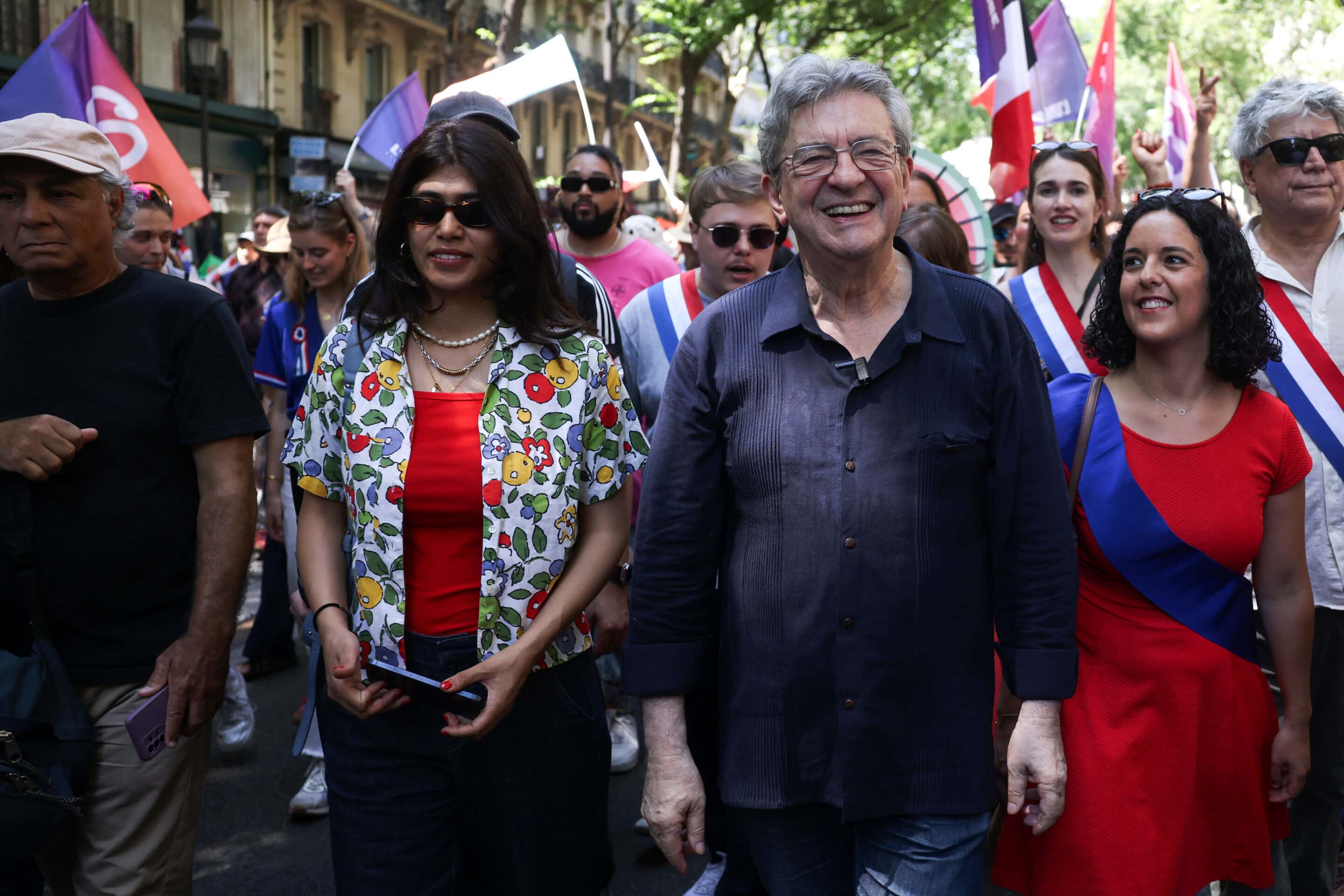
Jean-Luc Mélenchon wears the same shirt, for a radically different discourse.
With him, the guayabera is not a concession to the climate, it is a calling card. It designates Cuba, and through Cuba a whole imaginary: the island that holds out, the small against the large, the revolution that has lasted, Che Guevara and Fidel Castro. The revolutionary myth in perpetual motion. In September 2018, at the National Assembly, he called the American embargo an act of war. The shirt says the same thing, in silence, and to a wider audience. Mélenchon also knows how to choose his colours: neither blue nor white but black. He could have taken red, but that would have been too conspicuous. Black evokes anarchy, permanent revolution. As with Felipe VI, the colour is sign and symbol.
One must grant him, as one grants the king, a real mastery of the signal. The man who made the workshop jacket a campaign emblem knows exactly what a closed collar, a fabric or a cut say before he does. Nothing, with him either, is left to chance. He is, in France today, the best-dressed politician and the one who best masters the codes of the male wardrobe.
The same cloth, two maps
Here, then, is a shirt born in a rural corner of the Antilles, worn today by a Bourbon king and by a tribune of the French revolutionary left.
The first reads in it a continuity: the language, the Atlantic, five centuries of coming and going between Seville and Havana. The second reads in it a rupture: the revolution, the embargo, the permanent struggle.
Same linen, same mother-of-pearl, same alforzas. The same thread but two entirely different maps.
That is precisely why I pull this thread.
In Venice, where I write, we never needed ambassadors to know the state of the world. It was enough to go down to the Rialto and watch the fabrics being unloaded. The Turk, the Greek, the Armenian, the German of the Fondaco — each wore his map on his back, and the textiles always arrived before the news.
Four centuries have passed, but the method is still the same: clothes speak, and the shrewdest politicians know how to use them.
Cesare Vecellio
Cesare Vecellio (1521-1601) was a cousin of Titian. In 1590 he published in Venice a foundational work, Habiti antichi et moderni di diverse parti del mondo — a treatise, before the term existed, on the geopolitics of clothing. For Conflits, and from Venice, he analyses the garments worn by leaders and peoples in order to decipher their languages and their discourse.