
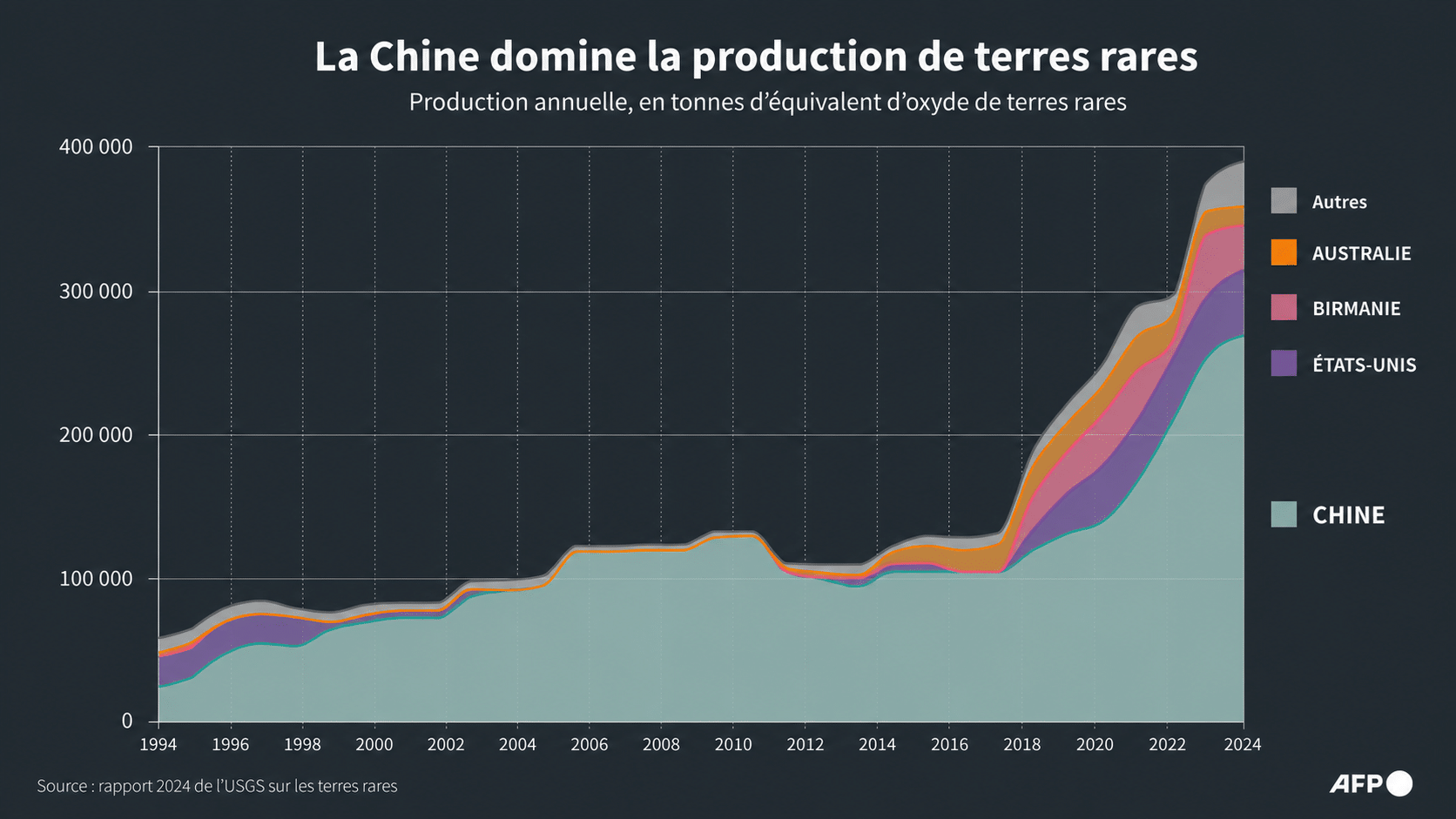




While no single producer holds more than 15% of the global oil trade, China has secured — in the space of some thirty years — around 70% of the world’s rare-earth mining.
It also controls at least 90% of refining and 95% of magnet manufacturing, two links indispensable to modern industrial miniaturisation.
This Chinese hegemony is only beginning to be challenged by the United States and the Europeans, who are struggling to make up for their investment shortfall.
This article appears in Issue No. 64 — China: a Challenge for Europe.
Rare earths are components frequently found in the Earth’s crust, but difficult to extract in large quantities. Neodymium, samarium, dysprosium… Rare earths are a group of 17 elements from Mendeleev’s periodic table. Their global market is worth no more than €8.5 billion, yet they have become irreplaceable across every advanced industry: solar, wind, lasers, batteries, magnets, defence, nuclear and medical. These elements are not rare in the Earth’s crust, but extracting and then refining them — separating out the various materials — are complicated and costly operations. They are also present on the seabed, but such deposits are seldom worked, being both complex and expensive to exploit, although Japan has just begun to do so on a still-experimental basis.
China deliberately built its monopoly
China today dominates the rare-earths market by a wide margin. First, through 35-40% of global reserves — estimated at 100 to 120 million tonnes — against 15-20% for Vietnam, 15-20% for Brazil and 10-15% for Russia. Together, the Western OECD countries, chiefly Australia, Canada and the United States, account for less than 7% of world reserves. China also supplied 68% of production in 2024, far ahead of the United States (11%) and Myanmar (8%), according to the USGS (the United States Geological Survey). But its dominance amounts to a near-monopoly when it comes to refining capacity, at more than 90% — an advantage it strives to protect by subsidising this vital stage and driving prices down to kill off or curb any potential competition.
In short, almost all the rare earths mined worldwide must pass through Xi Jinping’s country before they can be used in industry. China carried out — first on its own soil, then elsewhere in the world — the mining operations the West found intolerable because they are so polluting. In France, the La Rochelle plant, operated by Rhône-Poulenc and then Rhodia, and now owned by Solvay, sharply scaled back its separation activities from the 1990s and 2000s onwards, without ever closing its doors: it remained the main rare-earths site outside China. Since 2022, Solvay has been relaunching there the separation of rare earths destined for permanent magnets, and in April 2025 it inaugurated a first production line with the backing of the French state (an investment of around €100 million). But many conditions will have to be met over time for it to become competitive — such as securing floor prices, which may conflict with European competition rules.
Less spectacular than controlling a maritime strait, less bulky and less costly than oil supertankers, yet just as effective for commanding a chokepoint of the international economy.
For China positioned itself in this vital sector long ago, buying up companies — such as the American firm Magnequench as far back as 1995 — and thereby importing the necessary know-how through joint ventures, before assimilating and refining it to the point of securing outright leadership. It then moved up the value chain and built this indispensable position in the permanent-magnet segment. It is less spectacular than controlling a maritime strait, less bulky and less costly than oil supertankers, yet just as effective for commanding a chokepoint of the international economy.
Read also: China asserts itself in rare earths
Beijing allows exports only under licence, and very sparingly
In April 2025, when Beijing imposed strict licences on the export of seven categories of rare earths, entire sectors — automotive, energy, defence — found themselves in serious difficulty, owing to the shortage of the permanent magnets essential to the operation of electric motors and electromechanical applications. The rules Beijing adopted in 2025 remain the benchmark: a tightly framed system of approvals and controls resting on a clear strategy — preserving national access to resources indispensable to key sectors (semiconductors, electric vehicles, advanced electronics). Restrictions on rare-earth exports, a geopolitical and economic lever, strengthen the country’s bargaining power against the other industrial powers. This approach is part of a wider rivalry over technological sovereignty. The slightest restriction has immediate consequences for prices and supply chains. Manufacturers must anticipate potential disruptions, which heightens volatility and encourages the build-up of strategic stockpiles.
Japan was the first industrialised country to feel the effects. In 2010, during a territorial dispute between China and Japan over the Senkaku/Diaoyu Islands, China halted its rare-earth deliveries to Japan for the first time, bringing home to the entire West just how dependent it had become. This weapon continues to be used regularly. In January 2026, for instance, China imposed fresh restrictions on rare-earth exports to Japan, in response to comments by the Japanese Prime Minister, Sanae Takaichi, who had suggested that an attack on Taiwan would represent an « existential threat » for Japan.
Read also: Invisible gold: how rare earths are redrawing the world order
Faced with this rare-earths crisis, Europe can only lament its past, having long been at the forefront of permanent magnets. Ferrite magnets, devised by Japanese researchers and perfected by TDK and Philips, revolutionised many industrial sectors thanks to their multiple, large-scale uses. Rare-earth magnets later emerged, offering a higher magnetic field density. They made possible compact electric motors, miniaturised hard drives and cutting-edge medical equipment. Flagship names such as Philips, Siemens, Pechiney, Carbone Lorraine and Ugimag embodied this precious European know-how.
Will the Western response be enough to dent China’s dominance?
Faced with this Chinese dominance, the United States above all, along with Europe, have decided to react by rolling out policies to support exploration, production, refining and recycling. But the sums mobilised still fall short. There is no single official figure for China’s investment in this field, but solid estimates put it at $100 billion (direct public spending) and $500 billion (the total including state-owned enterprises). This includes mining subsidies, price controls, the financing of infrastructure abroad and massive support for state enterprises.
Production costs, inflated by the EU’s environmental and social standards, remain higher than the prices set by China and may undermine their economic viability.
These sums must be set against American funding, which various sources put at around $30 billion, covering all critical minerals; the share allotted to rare earths comes to $12-15 billion, comprising support for exploration ($2-3 billion), processing ($3-5 billion) and international alliances ($5-8 billion). Given that developing a single rare-earths mine can cost between $500 million and $2 billion, one can gauge how far there is still to go — all the more so as a good twenty of them need to be opened. As for the EU, through various mechanisms it has mobilised €3 billion for all critical minerals via the RESourceEU initiative, on top of €14 billion mobilised by the EIB (European Investment Bank). But financially backing projects, however strategic they may be for the Union, is not enough. Production costs, inflated by the EU’s environmental and social standards, remain higher than the prices set by China and may undermine their economic viability.
Read also: Countering China’s dominance and coercion over rare earths