





-
Saudi Arabia spreads Wahhabi/Salafi influence in southern Yemen through mosques, education, aid, and networks.
-
Some Sunnis accept this influence as protection against the Houthi movement, while others reject it as foreign and divisive.
-
The growth of Salafism increases Saudi soft power but risks worsening Yemeni social and regional tensions.
Since 2015, the Yemeni civil war has pitted a Sunni South recognized internationally against a Shiite North led by the Houthi rebels. Saudi Arabia, which has led a military coalition against the Houthis since 2015, has significantly expanded its presence in its southern neighbour. One of Riyadh’s vectors of influence is religion: the Kingdom seeks to export its model of a rigorous Wahhabi and Salafi Islam.
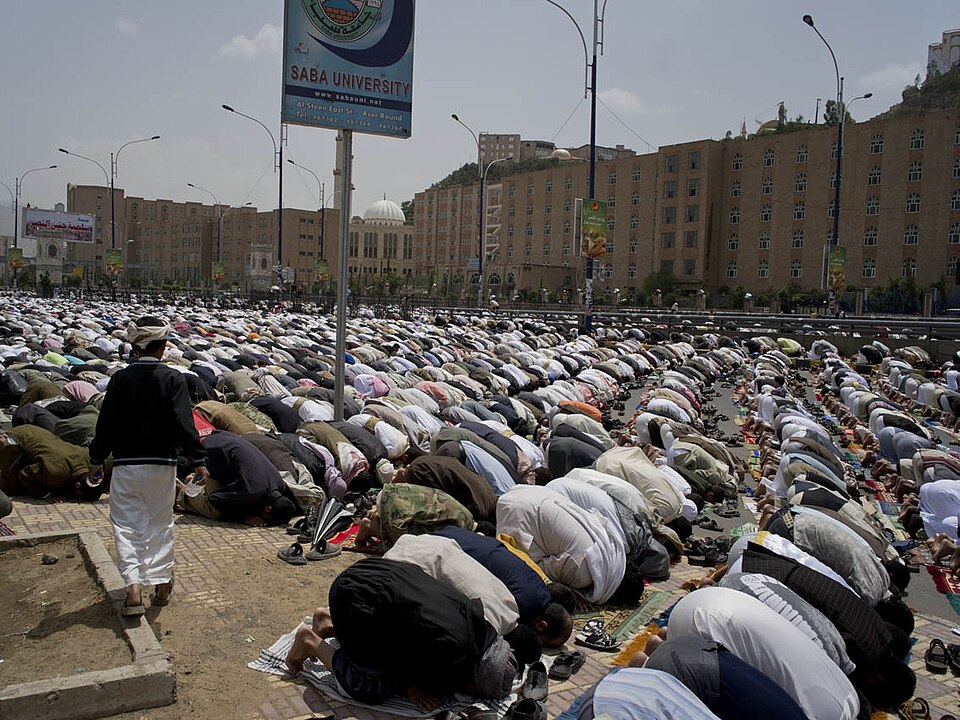
Yemen contains a wide diversity of religious traditions: Zaydi Shiism, Shafi‘i Sunnism, Sufism, and others. In this complex religious landscape, Saudi Wahhabism attempts to rally the country’s Sunni population (≈65%) by establishing religious networks aimed at spreading Salafi Islamic norms. This “low-noise Islamization,” overshadowed by the armed conflict, is a major soft-power stake for Saudi Arabia, but it produces uneven effects across Yemeni territory.
How Saudi religious influence operates in Yemen: methods and actors
Saudi Arabia has long sought to spread Wahhabism and Salafism in Yemen. As early as the 1980s, the Kingdom financed the construction of the Salafi religious centre Dar al-Hadith in the country’s north in order to counter Zaydism, a Shiite current.
With the war, the Aden-based government found itself in an extreme position of military and economic dependence vis-à-vis Saudi Arabia, leading to multiple forms of cooperation. Thus, the Saudi Ministry of Islamic Affairs and Yemen’s Ministry of Awqaf (Waqfs) signed agreements allowing Yemeni imams to receive training in Saudi Arabia[1]: academic conferences, joint workshops, and the “promotion of the thought of the middle way.” These programs enable Riyadh to set the tone on matters of religious doctrine.
Riyadh also uses humanitarian and development aid to fund projects with a religious dimension. Last month, Saudi Arabia announced the construction of a new mosque on the island of Socotra, named the “Mosque of the Custodian of the Two Holy Mosques,” referencing one of the Saudi King’s titles[2]. This construction is part of a broader $500 million development plan pledged by Riyadh to Aden.
The King Salman Humanitarian Aid and Relief Centre (KSRelief), established in 2015 to support reconstruction in Yemen—particularly of its schools—also distributes Qur’ans and school materials promoting a strict religious doctrine[3].
Beyond this economic assistance, another corollary of Saudi influence is the associative sector. Present since the 1990s, the Salafi associations al-Ihsan and al-Hikma have, since the outbreak of the war, taken part in rebuilding mosques in several southern cities and have organized large-scale charitable activities[4]. Although they are Yemeni organizations, they are funded by donors from the Gulf, particularly Saudis.
These associations also operate networks of Qur’anic schools and disseminate Salafi literature aligned with the Saudi Wahhabi vision. In addition, Salafi activists have founded media outlets to spread Wahhabi ideology and promote Saudi Arabia’s image, as in the eastern region of al-Mahra[5].
Finally, one can mention the military dimension, with the diffusion of Salafism within the armed forces. In 2023, the Yemeni government established an eight-battalion corps called the “Nation’s Shield,” led by the Salafi commander Bashir al-Madrabi[6]. This corps is placed under the direct authority of the head of the Presidential Leadership Council, Rashad al-Alimi, who owes part of his mandate to Riyadh’s influence. The “Nation’s Shield” has also played a key role in fighting southern separatist forces over the past two months[7].
Between adherence and rejection: Wahhabi transplantation yields mixed results among the population
The current civil war has been structured around sectarian oppositions between Shiites backed by Iran and Sunnis backed by Saudi Arabia. This opposition largely explains the positive reception of Saudi patronage. Many Yemeni Sunnis share an important confessional proximity with Saudi Islam. More broadly, Saudi Arabia and Salafi ideology appear to some as an identity bulwark against an assertive Zaydism[8].
Certain religious gatherings can take on a political character, as in Marib, where Sunni ulema and preachers met in 2018 to publicly support the Aden government[9]. In 2022, in the same city, Yemen’s Sunni clergy openly sided with Saudi Arabia, praising its efforts against the Houthi rebels[10].
Researcher Laurent Bonnefoy also notes the rise of Salafism among younger Yemeni generations. Many students and young people adopt a “quietist” Salafism, described by the researcher as a form of “cultural capital,” or even a “fashion” [11]. Saudi Arabia’s growing influence is therefore not viewed negatively by this segment of the population.
By contrast, the Houthis have systematically targeted Salafi institutions in areas under their control, particularly in Sanaa or Dammaj, where many mosques and institutions financed by Riyadh have been closed by the rebels. These centres are described as “intelligence tools for the Saudis” by Ali al-Bukhaiti, a spokesperson for the movement[12].
Only a few centres have been allowed to remain, such as the Ma‘bar Centre in Dhamar, with which the Houthis signed a “Coexistence Agreement” in 2014. Freedom of worship is guaranteed, and each side commits to renouncing sectarian rhetoric. Salafis must also renounce their links with Riyadh[13]. If Salafism persists in these areas, Saudi influence is effectively neutralized.
It is also important to note the mixed outcomes of Wahhabism’s spread in the southern zones, where the ideology is still far from consensual. Yemen has a long history with Sufism, a Sunni religious movement despised by Salafi currents. In this context, Zaydis and Sufis present themselves as more authentic and rooted in Yemeni identity, in contrast to Wahhabism, which is seen as imported from Saudi Arabia[14].
Moreover, some Yemeni regions have a distinct identity from the rest of the country, and Saudi policies aimed at spreading Salafism encounter resistance. This is the case in the governorate of al-Mahra, in the far east, whose governor publicly accused Riyadh in 2018 of encouraging the settlement of Salafi communities—an accusation that led to popular protests[15].
Similarly, the city of Taiz in the west, home to a strong Sufi community, has experienced rising internal tensions, with Salafi preachers denouncing Sufi practices such as religious chants[16]. In Taiz or Aden, the entrenchment of Salafis raises concerns, particularly among older generations, who fear the diffusion of strict norms such as the wearing of the Saudi-style niqab[17][18].
If the growth of Salafism and its Wahhabi form, supported by Saudi Arabia, enables Riyadh to increase its religious and political influence over Yemen, the rigorism of these ideologies also risks further fracturing Yemeni society—between North and South, but also between tribes. The chances of achieving a lasting peace would be diminished accordingly.
Read other articles in english
[1]« وزارة الأوقاف توقع اتفاقية شراكة لتعزيز قدرات كوادرها وتأهيلهم إدارياً وتربوياً ومهنيا », Saba Net, 04/02/2026
[2] Jerusalem Post, “Saudi Arabia pledges $500m over Yemen development projects in areas long-held by UAE, separatists”, 15/01/2026
[3] ALHASAN, Hasan; LONS, Camille, “Gulf Bailout Diplomacy: Aid as Economic Statecraft in a Turbulent Region”, IISS, 10/2023
[4] AL-MAQTARI, Bushra, “The evolution of militant Salafism in Taiz”, Sanaa Center for Strategic Studies, 17/09/2017
[5] GHANEM, Abdulkareem, “تأثير التدخل السعودي على المعايير الاجتماعية في المهرة”, Sanaa Center for Strategic Studies, 21/03/2022
[6] Sanaa Center for Strategic Studies, “Nation’s Shield Forces Bolster Al-Alimi’s Influence”, 09/03/2023
[7] CLOUGH, William, WHALLEY, Ned, “Military and Security: the Yemen Quarterly November-December 2025”, Sanaa Center for Strategic Studies, 02/02/2026
[8] AL-MADHAJI, Maged, “THE BATTLE OF MARIB HOUTHIS THREATEN YEMENI GOVERNMENT STRONGHOLD”, Sanaa Center for Strategic Studies, 10/04/2020
[9] Yemen News Agency, “Yemen’s religious scholars and preachers gathered in Marib”, 08/02/2018
[10] Saudi Press Agency, “Yemen Scholars Condemn Houthi Crimes, Praise Saudi-led Coalition Efforts”, 31/01/2022
[11] BONNEFOY, Laurent, Salafism in Yemen: Transnationalism and Religious Identity, London, Hurst & Company, 2011
[12] MUSSED, Fouad, “Salafism in Yemen and War Challenges”, 11/08/2021
[13] KHOSHAFAH, Amjad, “Houthi-Salafi Coexistence Agreements: Motives and Future Prospects”, Sanaa Center for Strategic Studies, 03/12/2021
[14] WEHREY, Frederic, “Islamic Institutions in Arab States: Mapping the Dynamics of Control, Co-option, and Contention”, Carnegie Endowment for International Peace, 2021
[15] GHANEM, Abdulkareem, “تأثير التدخل السعودي على المعايير الاجتماعية في المهرة”, Sanaa Center for Strategic Studies, 21/03/2022
[16] AL-MAQTARI, Bushra, “The evolution of militant Salafism in Taiz”, Sanaa Center for Strategic Studies, 17/09/2017
[17] Ibid.
[18] IMBERT, Louis, « Au Yémen, Aden à l’épreuve des seigneurs de guerre », Le Monde, 17/04/2022