

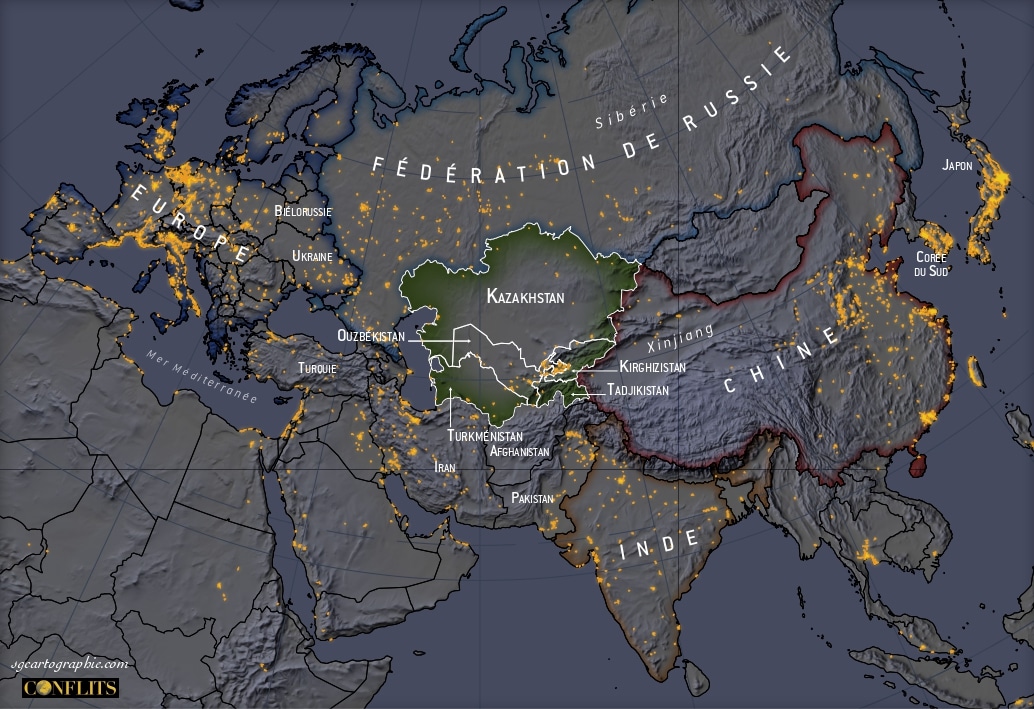



For the 35th anniversary of its independence, Kyrgyzstan is hosting in Bishkek both the World Nomad Games and the SCO summit — a showcase of the non-Western world.
Before Putin, Modi, Xi and Erdoğan, Sadyr Japarov is staging a state that has regained its stability: GDP multiplied by nearly 2.5 in four years, construction sites everywhere.
Growth boosted by re-exports to Russia — but a structural dependence, and European sanctions, leave the trajectory still to be confirmed.
by Denis Richard
As the Kyrgyz Republic celebrates 35 years of independence, the country finds itself in the spotlight of the non-Western world, hosting in Bishkek both the 6th edition of the World Nomad Games and the summit of the Shanghai Cooperation Organisation (SCO). An opportunity for this mountainous state, long regarded as politically unstable, to assert itself.
A spectacular opening ceremony
The World Nomad Games were created in 2014 in Kyrgyzstan with the aim of preserving and promoting the cultural heritage and traditional sports of nomadic peoples from around the world. Five editions have been held — the first three in Kyrgyzstan, then in Turkey and Kazakhstan.
The 6th edition has taken on Olympic airs and changed scale compared with its predecessors. In the Bishkek Arena, a brand-new stadium with a capacity of up to 51,000 spectators, 3,000 athletes from 104 countries paraded before the public and a record gathering of foreign leaders. Before Putin, Modi and Erdoğan, Kyrgyzstan staged the Kyrgyz nation in a grandiose choreography in which some 2,000 dancers and 300 horsemen brought the nomadic imagination back to life.
Bishkek, fleeting capital of the non-Western world
Fresh asphalt, a police officer every 50 metres along avenues closed to traffic. Most shops are shut. The capital is living to the rhythm of the annual summit of the Shanghai Cooperation Organisation.
This organisation, dominated by China and Russia, brings together several major powers of the Asian continent around security, economic cooperation and political coordination. While the organisation is often presented in the West as a counterweight to the established international order, never has an SCO summit gathered members so directly engaged in confrontation with Western powers: Russia at war in Ukraine, and Iran in military confrontation with the United States and Israel. The SCO leaders, moreover, chose to condemn explicitly the strikes directed against Iran in the summit’s final declaration.
« Never has an SCO summit gathered members so directly engaged in confrontation with Western powers. »
For Russia, Kyrgyzstan offers the opportunity to stage its Asian pivot and to dispel the image of an isolated country. Banned from most international sporting bodies, Russian athletes paraded under their own flag, saluted by their president, before Sadyr Japarov, the Kyrgyz president, announced that the next edition of the World Nomad Games would take place in Tatarstan, a Turkic republic of the Russian Federation. Vladimir Putin multiplied bilateral meetings. With Xi Jinping, he reaffirmed the solidity of the Sino-Russian partnership, while Masoud Pezeshkian hailed « a strategic relationship » between Russia and Iran.
The builder state
For Sadyr Japarov, these two large-scale international events serve as a demonstration of the country’s transformation since his rise to power in January 2021.
Since independence, Kyrgyzstan has gone through three revolutions — in 2005, 2010 and 2020 — each of which brought down the head of state. Sadyr Japarov himself owes his ascent to the last of them. Propelled to the top of the state amid the crisis of October 2020, then elected by a wide margin a few months later, he broke with the parliamentary model and had a new Constitution adopted in April 2021, recentring power around the presidency. The return of stability has become one of the hallmarks of his rule.
This political evolution has been accompanied by strong economic growth. The country’s nominal GDP rose from 9.2 billion dollars in 2021 to 22.6 billion in 2025. A progression that cannot be explained by inflation alone: the Kyrgyz economy has recorded four years of particularly sustained growth — 9% in 2022, 9% in 2023, 11.5% in 2024 and 11.1% in 2025. In four years, real GDP has grown by nearly half.
The financial capacities of the Kyrgyz state, for their part, have tripled. Budget revenues rose from 210 billion soms in 2021 to 673 billion in 2025. Over the same period, fixed-capital investment financed directly by the state rose from less than 5 billion soms in 2021 to more than 90 billion in 2025. The country is covered in construction sites. Projects once deemed beyond the reach of this mountainous republic are now being undertaken by the state, such as the China–Kyrgyzstan–Uzbekistan railway line or the vast Kambarata-1 hydroelectric complex.
| Indicator | 2021 | 2025 |
|---|---|---|
| Nominal GDP | $9.2 bn | $22.6 bn |
| Budget revenues | 210 bn soms | 673 bn soms |
| Public investment (fixed capital) | < 5 bn soms | > 90 bn soms |
| Tourists (recorded visitors) | 1.34 million | 5.31 million |
Kyrgyzstan nevertheless retains a light tax burden, and this enrichment is partly due to an increased capacity to collect taxes: the economy is becoming more formal and the administrations are going digital.
At the crossroads of new flows
One observation shared by all seasoned observers of the Kyrgyz Republic: the country has become a favoured destination for Russian and Western tourists. The number of visitors recorded by the tourism sector rose from 1.34 million in 2021 to 5.31 million in 2025. So many individuals who help make Kyrgyzstan known — and contribute to the country’s economic upturn.
Since 2022, Kyrgyzstan has also benefited from the reshaping of trade brought about by the war in Ukraine and Western sanctions against Russia. According to the IMF, the expansion of trade flows and re-export activities, accompanied by substantial capital inflows and financial transfers, has been one of the main drivers of Kyrgyzstan’s strong growth. The IMF estimates that in 2024 unrecorded re-exports alone represented the equivalent of 23% of Kyrgyz GDP, with a large share of the goods destined for the Russian market.
« Kyrgyzstan has managed to turn the disorders surrounding it to its advantage. »
Challenges ahead
If the country’s evolution appears positive, it remains to be seen whether Kyrgyzstan can stay on this trajectory.
Following the regional trend, Kyrgyzstan has managed to normalise relations with all of its neighbours, including Tajikistan, with which the common border was finally delimited in 2025. Yet trade frictions persist with Kazakhstan. Reinforced controls on the Kazakh side regularly produce long queues of lorries at the border, even though the two countries belong to the Eurasian Economic Union and its common market.
Next, political stability has yet to be tested. For five years, power rested on the tandem formed by Sadyr Japarov and Kamchybek Tashiev, the powerful head of the security services, long regarded as the country’s second man. Their alliance, which notably helped balance the elites of the north and south of the country, abruptly shattered in February 2026 when Japarov dismissed his former ally. Since then, the rupture has taken a judicial turn: accused of preparing a seizure of power by force, Tashiev was sentenced in July to four years in prison, together with a probation measure, before lodging an appeal. Time will tell whether this concentration of power serves or undermines Japarov.
The Kyrgyz Republic also faces growing pressure from the European Union. Judging that the risk of circumvention of the anti-Russian sanctions through Kyrgyz territory has become « systematic and persistent », Brussels has introduced sanctions against Bishkek. Several Kyrgyz banks, companies and financial platforms are targeted and, since April 2026, the export of certain machine tools and certain telecommunications equipment to Kyrgyzstan has been prohibited. Yet turning away from Russia is impossible: Kyrgyz dependence is structural. In 2025, financial transfers from Kyrgyz workers abroad still represent more than 14% of GDP, and more than 90% of the remittances received come from Russia.
A successful demonstration
Thirty-five years after independence and three revolutions later, Kyrgyzstan presents a new face: that of a state that is more stable, richer, and now capable of building, attracting and hosting. The Bishkek Arena is its most visible symbol: this stadium, raised from the ground in two years, does not merely serve as a backdrop for the World Nomad Games — it embodies the ambition of a country eager to present itself as a modern, open state, able to welcome the great powers. For a few days, the sports arena and the SCO meeting rooms placed this mountainous republic at the centre of part of the world.
Read also: Sommet de l’OCS : la Chine cimente sa domination en Asie centrale
Read also: L’Asie centrale, terrain de jeu de la rivalité sino-russe
Read also: Kirghizstan et Tadjikistan : les effets funestes de la militarisation des frontières
Read also: L’Asie centrale veut relier l’Inde en contournant la Russie et l’Iran
© Map: Central Asia, Conflits