


-
On 7 October, Israeli society had to make up for failing institutions. Since then, it has sustained a battered economy — yet one capable of remarkable successes — and is mobilising for the elections.
-
This energy makes neither the internal fractures nor the geopolitical deadlock disappear. Five changes illuminate the country’s recomposition.
Three years after 7 October, Israel is not measured solely by the results of its military operations. The catastrophe overturned its way of conceiving security, its relations with its neighbours and the balances of its own society. As the elections of 27 October approach, the country must choose which institutions to reform and what political future to give to its recovered power. But to understand this recomposition, one must return to the blindness that preceded it.
« They have eyes and see not, they have ears and hear not, » warned Jeremiah (V, 21). Israel did not lack technological eyes and ears. What it lacked was the ability to understand what it saw and heard.
From the summit of the state, a paradigm had imposed itself: Hamas was becoming bourgeois. Having become the government in Gaza, it had to administer, pay salaries, preserve its gains. It had more and more to lose and less and less interest in starting a war.
« Israel saw the preparations, but interpreted them within the framework that was bound to make them harmless. »
Hamas reinforced this conviction through its requests for work permits, its displayed interest in living conditions and its talks on the return of the few Israeli captives it held. Everything maintained the image of a movement with which one could do business. The repetition of suspicious activities, such as the activation of Israeli SIM cards, also blunted vigilance. Israel saw the preparations, but interpreted them within the framework that was bound to make them harmless.
As during the Yom Kippur War, fifty years earlier, the institutions failed and individuals — soldiers, police, reservists and civilians — rushed to fill the breach. This capacity to react when institutions fail recalls that in Israel the nation, the body politic, is older than the state and the army. And like that of 1973, the earthquake of October 2023 provoked significant changes. Five of them make it possible to gauge the scale of the transformation under way.
Intolerance of risk
The first change: intolerance of risk. For nearly two decades, Israel had favoured containment. In the south, it let Hamas govern and facilitated the funding meant to buy calm. In the north, it contained Hezbollah while avoiding war. The wager remained the same: an immediate confrontation would cost more than a threat believed to be under control.
7 October overturned this calculation. It is now the enemy’s capabilities, rather than its supposed intentions, that command the response. Even if it does not seem to want to use them today, it must be prevented from doing so tomorrow. From Gaza to Lebanon, from Syria to Iran and Yemen, Israel went on the offensive, even at the cost of accepting immediate risks in order to destroy the means of a future attack.
This shift entails operations in depth, the holding of forward positions and buffer zones, but also a revision of military preparedness. Border defence and preparation for an attack without warning must be strengthened. Technology remains indispensable, but can no longer replace men.
« It is now the enemy’s capabilities, rather than its supposed intentions, that command the response. »
The capabilities of several enemies have been severely hit. But to weaken Hamas does not mean to eliminate it, to strike Hezbollah is not enough to disarm it, and to damage Iranian resources does not guarantee the disappearance of the threat. Israel has demonstrated its ability to wage a long war on several fronts, far from its borders. It remains for it to prevent this superiority from leading to an indefinite succession of campaigns.
Israel’s Palestinian policy: who should govern?
The second change: Israel’s Palestinian policy. After the failure of Oslo and the discrediting of the « land for peace » paradigm, Hamas served Netanyahu a double purpose. It divided the Palestinians between Gaza and the West Bank, while its radicalism reinforced the argument of the absence of a credible interlocutor. The resolution of the conflict could thus be put off. 7 October ruined this logic without substituting a solution for it. Netanyahu promises to destroy Hamas, but refuses the return of the Palestinian Authority to Gaza. It therefore remains to be seen who should govern after the war and on what political basis.
In the West Bank, this deadlock is accompanied by an acceleration of faits accomplis: extension of the settlements, legalisation of outposts and reinforcement of Israeli control. Failing to decide with whom to negotiate, the ground is transformed to determine what can still be negotiated tomorrow.
Military successes do not automatically convert into diplomatic gains. The conduct of the war and the absence of a political horizon drive allies away, while common threats sustain other partnerships.
A double strategic realignment, under American dependence
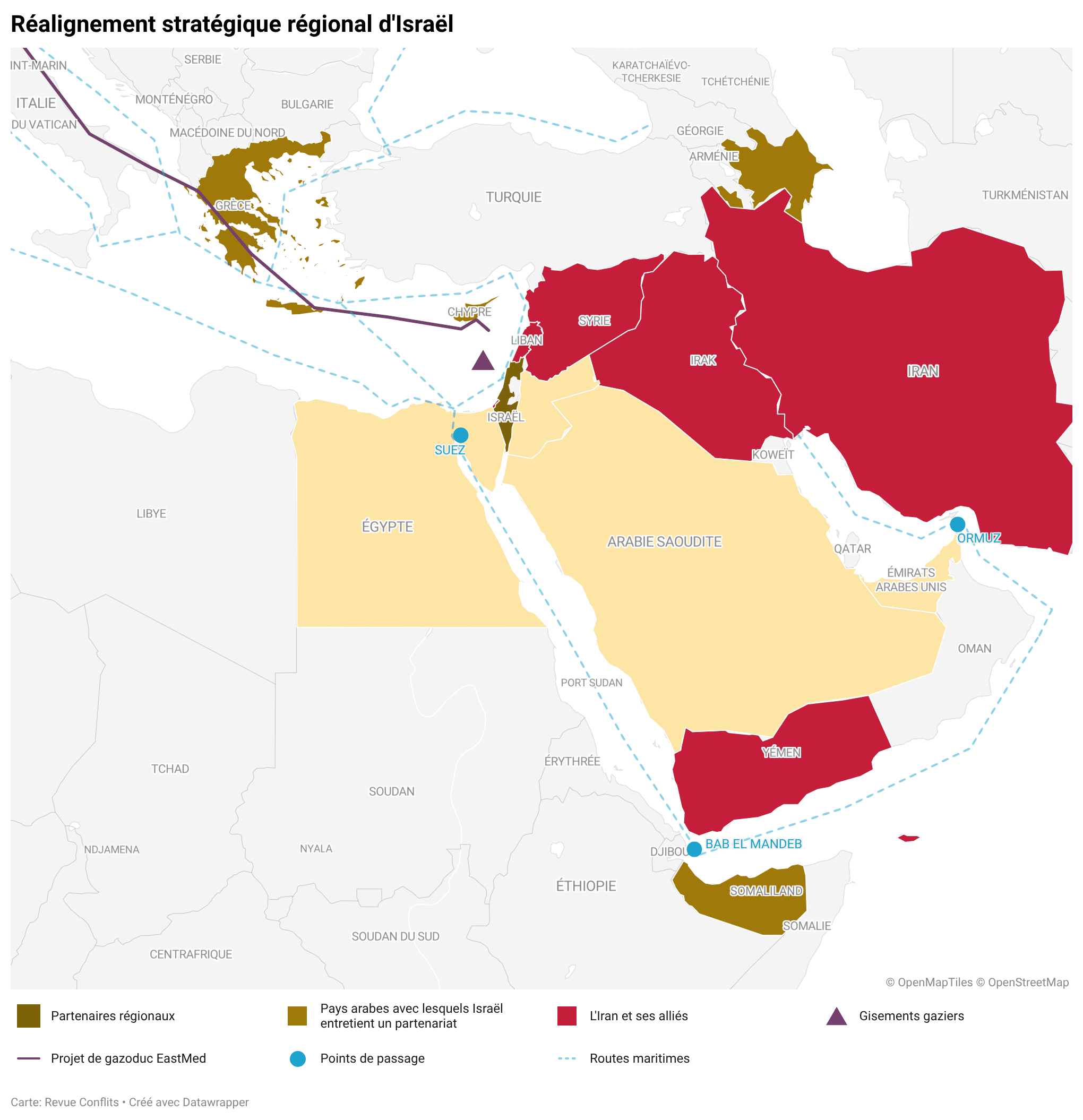
The third change: a double strategic realignment, under American dependence. To the south and east, economic interests and fear of Iran preserve the relationship with the United Arab Emirates. The rapprochement with Somaliland links maritime security to the fight against Tehran’s relays near Bab el-Mandeb. To the west, Greece and Cyprus strengthen military, energy and commercial cooperation. Further east, India remains a major partner.
These relationships do not replace the United States, whose supplies, military support and diplomatic umbrella condition operations. Yet American support for Israel is receding, notably among the young, while figures such as Zohran Mamdani embody a break with traditional support. This backing remains indispensable, but appears less assured.
These partnerships form a network of converging interests, without constituting a homogeneous alliance, nor resolving the disagreements with Washington, nor easing the concerns aroused by Israel’s Palestinian policy.
Sharing the military and economic burden: the ultra-Orthodox question
The fourth change: the sharing of the military and economic burden. This long, manpower-hungry war mobilises always the same people, disrupts their businesses and imposes repeated absences on their families. Since 1948, ultra-Orthodox yeshiva students had enjoyed deferrals of service leading to an exemption, in order to preserve religious study. Initially marginal, this regime concerned some 63,000 men of serving age in 2024. The question is therefore no longer only one of equality, but of the country’s capacity to sustain a prolonged effort without exhausting those who fight and produce the wealth.
The economy is holding up, but not without losses. According to the Bank of Israel, growth reached 2.9% in 2025, after 1% in 2024, without recovering its long-term trajectory. Public debt represented 68.5% of GDP at the end of 2025. The budgetary cost of the war over 2023-2026 was estimated at 350 billion shekels, before the decisions linked to the new campaign against Iran. Defence and reconstruction will long weigh on the resources devoted to education, infrastructure and social protection.
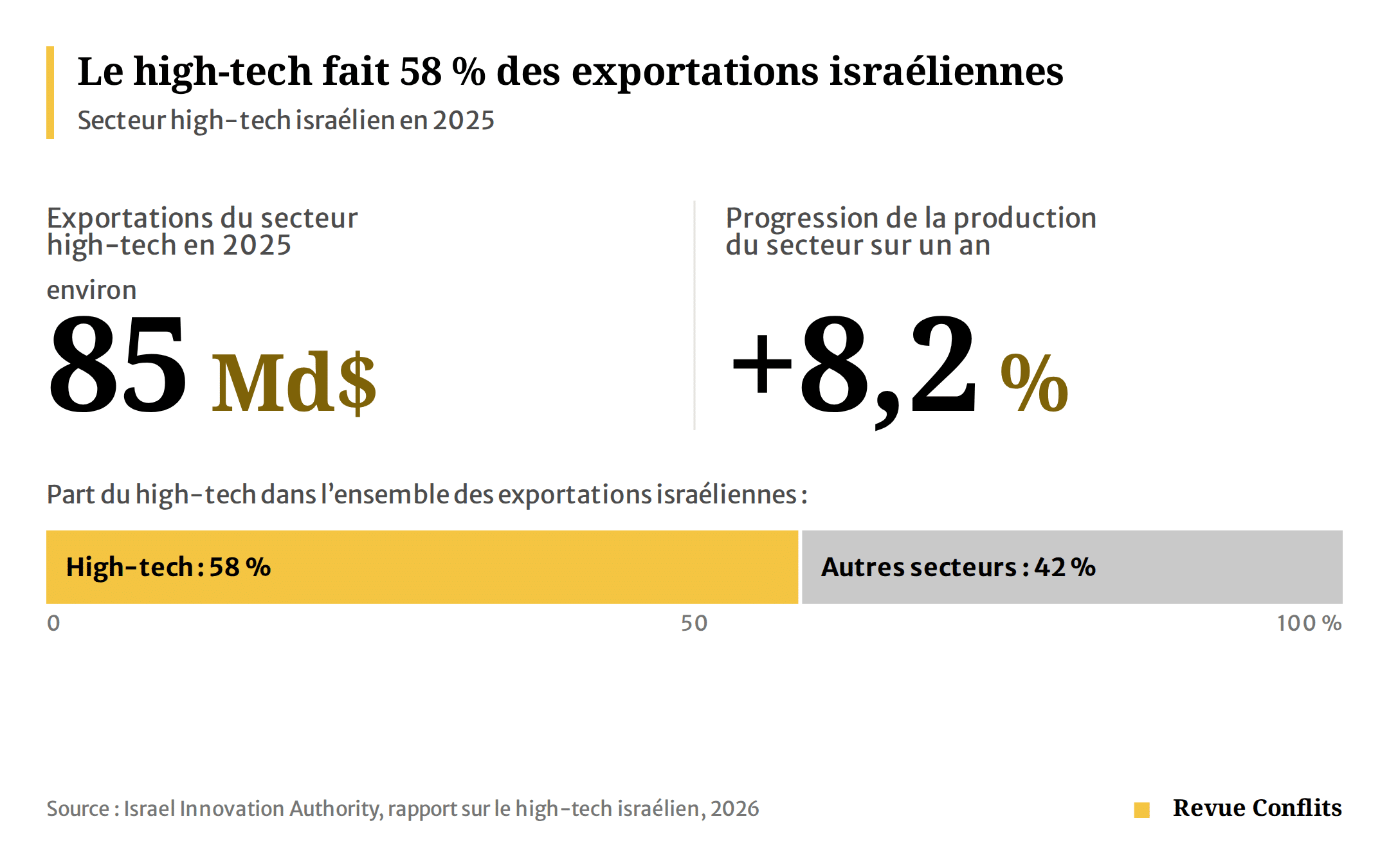
The technological engines nonetheless keep turning. In 2025, high-tech output grew by 8.2% and its exports reached about $85 billion, that is 58% of the Israeli total. New military export contracts rose from $13.1 billion in 2023 to $19.2 billion in 2025. The Israeli ecosystem thus transforms part of its security spending into investment. Skills circulate between the army, research and business; the needs of the field become innovations, exportable products and high-value-added jobs. These dividends do not, however, automatically offset the cost of the war. And the demographic trends are worrying, for population growth is particularly strong among the ultra-Orthodox. Too often kept in endless religious study and insufficiently prepared for skilled jobs, they take little part in the productive economy. Too narrow a share of the population cannot indefinitely finance social transfers and security while spending months under arms. The brain drain makes the equation more worrying still.
Behind the sharing of the burden lies, finally, a fundamental question. Israel has never adopted French-style secularism and finds itself facing a bloc of religious parties that pushes its advantage to the point of testing the primacy of liberal democracy over the religious institutions that control that bloc.
The protection contract between the state and the citizens must be rebuilt
The fifth change: the protection contract between the state and the citizens must be rebuilt. The mobilisation of 7 October revealed the strength of society, but it does not exempt the institutions from accounting for their responsibilities in the failure, nor from setting the conditions for a restored trust.
« Who should have the last word — the rabbi or the constitutional judge? »
The elections of 27 October thus bring together all the preceding changes. How far to push the offensive, and how to transform military successes into lasting security? Who will govern Gaza, and what future for the West Bank? How to preserve American support and the regional partnerships? Who should serve and bear the cost of the war? Who, the rabbi or the constitutional judge, should have the last word? These questions all lead back to that of power, of those who exercise it and of the limits imposed on them.
Solidarity in adversity has not erased the fractures. The conflicts over justice, religion and the territories overlap with disagreements on the war’s aims and the leaders’ responsibility. The trauma, the displacement of populations and the wearing-down of reservists’ families give them a depth that partisan categories alone cannot describe.
Three years after 7 October, Israel has a powerful army, a world-renowned defence industry, an innovative and robust economy and a society capable of mobilising. It remains for it to find the consensus needed to equip itself with a constitutional framework and to devise a balanced national security strategy. The ballot of 27 October will tell whether this collective strength can find a political expression equal to the ordeals it has been through.
Gil Mihaely is a journalist and holds a doctorate in history.