


Narendra Modi never wears Western clothing: his wardrobe comes down to a few typically Indian pieces, which he plays with through colour and texture.
Two Modis answer each other: the one of the international summits and the one who travels across his country, whose headwear draws a map of India and its diversity.
The photographs show two Narendra Modis: the one who meets the world’s other leaders, on his official visits, and the one who travels across his own country. When he is in India, his style is more Indian still. His headwear then becomes a map of India and its diversity.
Rashtrapati Bhavan, New Delhi, 5 October 2026. The Indian Prime Minister receives the President of the Swiss Confederation, Guy Parmelin, who has come for three days with a delegation to negotiate the trade agreement signed with the European Free Trade Association. The official photograph lines them up on the red carpet, before the cavalry of the presidential corps. Parmelin wears a midnight-blue suit and a polka-dot tie. Beside him, Modi wears typically Indian clothes, unknown in Europe. Unlike Xi Jinping, who alternates between Chinese and Western dress, Modi makes a point of wearing only pieces from his own country and culture.
Narendra Modi and Swiss President Guy Parmelin (Photo by Sonu Mehta/Hindustan Times/Sipa USA).
On top, a greyish-green sleeveless waistcoat, stopping at mid-hip, fastened by five metal buttons, with a standing officer’s collar and no lapels. This garment is called a sadri, or bandi depending on the Indian region. Europe knows it as the Nehru jacket, but Modi wears it too. It descends from the achkan and the sherwani, whose collar it keeps while removing the sleeves and two thirds of the length. In eighteenth-century Europe, men wore a roughly similar piece: a sleeveless, buttoned waistcoat, worn over the justaucorps, which came down to mid-hip.
Under the sadri, a white long-sleeved kurta, a loose tunic falling to mid-thigh and gathered by no belt. Then trousers that fall curiously over the thigh: a churidar. It is cut on the bias of the fabric, so it is naturally elastic, fitted at the calf, and cut longer than the leg so that the excess gathers above the ankle in a ring of tight folds. This drape and this build-up of fabric are deliberate; it is not the sign of a badly fitted garment, like over-long trousers. The name of the piece says as much: churi, the « bangle », and dar, « resembling ». The effect is indeed that of bangles stacked above the ankle.
But Modi also wears two Western pieces: black loafers and a pocket square, slipped into the pocket of his waistcoat. Pocket squares always chosen to match his outfit, proof of his style and of his taste for matters of dress.
A fabric chosen because it creases less
The story goes that in 1989 an official of the RSS¹, Narendra Modi, walked into a tailor’s shop near the Ahmedabad town hall and ordered white trousers with a short-sleeved kurta. He asked for poly khadi, a blend of polyester cheaper than hand-spun khadi, because this fabric creases less, and the man spent his life on coaches. The tailor’s name was Bipin Chauhan; he had opened his shop eight years earlier with his elder brother.
The short-sleeved kurta is not the traditional cut. It is a variant, born of a travelling constraint, and it today bears the name of its customer: registered as a trademark in 2006, sold at 25,000 units a year. Chauhan’s customer became Prime Minister of India, and his style, created somewhat by chance, to meet the technical constraints of travel, has established itself across the whole country.
« Born of a travelling constraint, the outfit of a customer who became Prime Minister now bears his name and has established itself across the whole country. »
Regional pieces
These pieces are Indian, but they are general. Yet Modi’s wardrobe also holds far stronger pieces, which come from the regions of India and which testify to his determination to bring together all his country’s diversity.
The safa, a turban he changes every 15 August for the Red Fort address and which he has never worn the same way twice in twelve years. A red Jodhpuri bandhej in 2014; a Rajasthani leheriya, with its multicoloured ripples, in 2019; in 2020, a saffron-and-cream safa accompanied by a stole that also served as a mask during the epidemic; in 2022, a white turban striped with saffron and green, in the colours of the flag, for the Har Ghar Tiranga campaign.
The dhoti, a length of unstitched cloth draped around the waist and passed between the legs, which he never wears day to day and brings out for targeted occasions, such as the Bengali-style dhoti-kurta at his party’s headquarters after a victory in Bengal.
The angavastra, finally, a rectangular stole draped over the shoulders, traditionally offered as a mark of respect to a host, an elder or a master, and normally worn with the dhoti.
There is, moreover, a very clear division in this wardrobe. Before a foreign head of state, at summits and official visits, Modi always wears the same clothing base, at once Indian and international. What changes are the colours and the textures, proof that Modi knows the language of clothes, that he masters it and that he has taste. He is always very elegantly dressed.
When he visits India, his clothes are far more distinctive, notably his headwear. A jaapi in Assam, a wide cone of bamboo and palm leaves usually used for shade in the rice paddies. A Naga hat in Nagaland. A Ladakhi cap with flaps. A saffron turban to sit at the langar of Dera Baba Nanak, in Punjab. A pagri from Karnataka on the tarmac at Bangalore.
Winter in Marseille
Marseille too can be cold. That is what Modi found during his visit of February 2025, which obliged him to wear warm clothes, but always with style.
Emmanuel Macron and Narendra Modi, 2025. Photo: Philippe Magon.
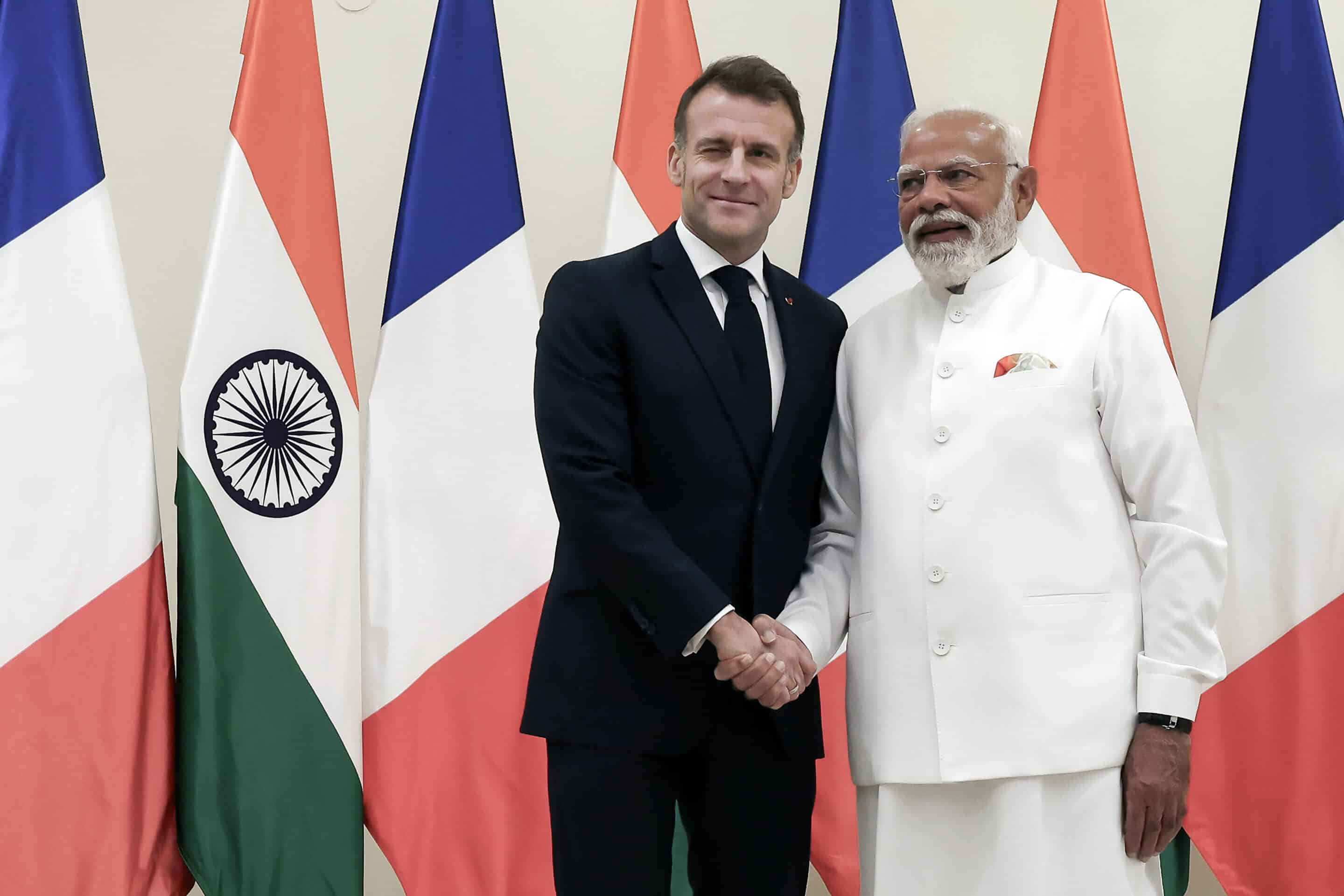
Narendra Modi and Emmanuel Macron inaugurated India’s new consulate general, and Modi went to the Mazargues cemetery, where Indian soldiers who died in France during the First World War are buried. On the airport tarmac, before the guard of honour, Macron wears a navy wool overcoat and Modi is in winter dress.
The base is the same as in Delhi, but in wool and longer: a white churidar, a slate-grey wool kurta slit at the sides falling to mid-calf and, over it, a sadri of the same grey, stopping at the hip, edged with a darker piping. To this are added three pieces against the cold: a dark-red wool scarf, a topi himachali and a pashmina shawl.
The topi himachali is a flat grey wool cap, with a wide red band on the front embroidered with geometric motifs in orange, green and white. It is made in the valleys of Himachal Pradesh. It is a mountain headdress, suited to the cold.
The shawl is ivory, embroidered in black thread. The field is scattered with small flowers; the borders carry large teardrop shapes with a curved tip, filled with scrollwork. This needle embroidery is called sozni and is practised in Kashmir.
The teardrop shape is called boteh. It is of Persian origin and passed into Kashmir, where it decorated the shawls the Mughal emperors gave one another. The East India companies imported it into Europe in the eighteenth century. The weavers of Paisley, in Scotland, began to imitate it around 1800, adopted the Jacquard loom after 1820, went from two to five then to fifteen colours, and dominated the European market until the 1870s. The motif took the name of the town: in English one says paisley. French kept the reference to the origin and says « motif cachemire » (Kashmir pattern), which is still found today on certain ties.
The two borrowings
But in these Indian clothes Modi always wears a pocket square, tucked into the pocket of his jacket. A detail that is, for once, typically Western. Proof that he also knows how to borrow from the West and turn it to account to enhance his attire. In every one of his outfits in which he meets heads of state, he wears a pocket square, of varied colour and style.
On his feet he wears loafers, most often black. They are black leather strap loafers, known as penny loafers, an American model that appeared in the 1930s. Here he wears neither jutti nor mojari, those closed and embroidered leather shoes that usually go with the kurta. The pocket square and the loafer are two borrowings from Western style.
Five photographs, a single silhouette
On 14 July 2023, Modi is the guest of honour at the Champs-Élysées parade, where a detachment of India’s three armed services marches down the avenue. Emmanuel Macron presented him the evening before, at the Élysée, with the Grand Cross of the Legion of Honour. He wears a navy sadri woven in a very tight houndstooth, over a white kurta.
Bastille Day parade, 14 July 2023. Photo: Éric Tschaent.
On 12 February 2025, in Marseille, it is slate grey and wool. On 17 February 2026, at the Gateway of India in Mumbai, he receives Emmanuel Macron for the opening of the Franco-Indian year of innovation. He appears dressed entirely in white: the sadri, the kurta, the churidar. One has to dare to present oneself like that! With a touch of orange-red thanks to the pocket square. Enough to give his outfit relief.
Bilateral meeting in Mumbai, 17 February 2026. Photo: Stéphane Lemouton/SIPA.
On 31 August 2026, in Bishkek, he wears this time a grey linen with an irregular weave over a cream kurta striped with fine vertical bands. On 5 October 2026, in Delhi, he opts for greyish green.
Narendra Modi and Vladimir Putin in Bishkek, 31 August 2026. Photo: Peter Kovalev.
Five photos, five times the same garment, but with very different colours and textures. Nothing like our politicians, who all wear the uniform of a navy suit, white shirt and black tie, often too tight and with lapels too narrow.
Modi varies the colours and knows how to combine them with charm and elegance. Let us say it plainly, he is one of the best-dressed political leaders.
With him, one sees every colour and every fabric: cotton, linen, wool, houndstooth, stripe, bright and dark colours and, magnificently, all-white. Even the pocket square is different each time, with orange, green, polka dots, pink, ochre: always a touch of colour and always well fitted. Hats off!
The neutral suit
One has to come back to Bishkek, because the photograph is worth more than the grey linen alone.
Modi shakes the hand of Vladimir Putin, in a black Western suit, white shirt and patterned tie. We are on the margins of the summit of the Shanghai Cooperation Organisation, founded to form a counterweight to the Western order. Yet the only one of the two wearing the clothing of the West is the Russian. Add to this the third man of that meeting, whose wardrobe this column has already examined: Xi Jinping, who reserves the Zhongshan for the most solemn moments and dons the suit and tie for his bilateral talks. Modi is the only one to carry the break in his choice of clothing. A Putin dressed like a seventeenth-century tsar — that would have class! His suits are always dull, probably a remnant of his Soviet and KGB upbringing.
« On the margins of a summit founded against the Western order, the only one of the three wearing the clothing of the West is the Russian. »
But in his own country Modi puts in even more variety, colour and panache. In his clothes, but above all in his headwear. We cannot reproduce the photos here, for copyright reasons, but follow the link of this article from an Indian newspaper.
There you will see 22 caps, hats and turbans, colour, different textiles, shapes, diversity. Literally, Modi wears the variety of India on his head and, above all, he dares to do it. One cannot imagine Emmanuel Macron wearing the traditional headdresses of the French regions, even if his passion for dressing up would not stop him.
With Modi we have « a good subject », who shows that clothing is a serious matter, that it is a political code, a language addressed to the other and a journey to discover and know a country. Always with variety and surprises.
Note
1. The Rashtriya Swayamsevak Sangh, « National Volunteers’ Association »: the Hindu nationalist organisation founded in 1925 in Nagpur by Keshav Baliram Hedgewar. It is the matrix of the Sangh Parivar, the nebula of which the BJP is the political arm. Modi joined it as a child, became a pracharak (a full-time, celibate worker, posted wherever he is sent) in 1971, and the RSS seconded him to the BJP in the mid-1980s, in Gujarat. In 1989 he organised the party in that state. The RSS has a uniform. It is called the ganvesh: white shirt, black cap, leather belt, dark-brown socks, black shoes, bamboo stick. It is changed by central decision: from khaki to white for the shirt in 1940, from canvas to leather for the belts in 2010. And in March 2016, the assembly of delegates meeting in Nagaur replaced the khaki shorts with long trousers, worn for the first time on the following 11 October in Nagpur before Mohan Bhagwat.