





The NSS 2025 marks a major strategic shift: prioritizing the Americas, redefining the U.S. global role, pressuring Europe to assume more responsibility, and adopting a more selective Indo-Pacific posture. This recalibration ushers in a period of profound uncertainty, forcing allies and rivals alike to rethink their assumptions.
The refocusing introduced by the NSS 2025 — prioritizing the Americas, homeland defense, and “America First” — profoundly reshapes the U.S. global posture. Europe is now urged to become less dependent, to invest in its own defense, and even to rethink the nature of its alliances. The Pacific remains a strategic concern for the United States, but within a less interventionist and more targeted framework, centered on national interest and allied cooperation.
A Refocus Toward the Americas
The NSS 2025 marks a significant shift in U.S. foreign policy by declaring the Western Hemisphere (the Americas) as the nation’s top strategic priority. The document embodies an “America First” doctrine: the United States commits to reducing certain global obligations, prioritizing homeland defense, economic security and domestic reindustrialization, national sovereignty, and the reduction of strategic dependencies (supply chains, sensitive technologies).
Within this framework, the U.S. presence abroad would be adjusted: the NSS mentions a “realignment” of global military forces, withdrawing from — or at least reducing — commitments in theaters considered “less essential” to American national security.
The NSS 2025 therefore signals a major turning point, placing the Western Hemisphere at the center of U.S. strategy. This shift comes with a “readjustment” of America’s military footprint worldwide: the U.S. envisions reducing or redeploying certain forces away from theaters deemed lower priority for direct national interests.
At the same time, the NSS 2025 expresses a sharply critical view of Europe. The document warns of a risk of “civilizational decline” on the continent, due, according to Washington, to migration policies, low birth rates, weakening national identities, loss of sovereignty through supranational institutions, and economic stagnation. The EU and some European states are portrayed as actors whose trajectories potentially undermine the reliability of the transatlantic alliance.
As a result, the NSS 2025 implicitly reframes the U.S.–Europe relationship — less as a partnership for global balance and more as a conditional alignment, often described as “burden-sharing,” under which Europe is called upon to take greater responsibility for its own security.
Implications for Europe
The new NSS has sparked political shock across the European Union. Several European leaders — notably European Council President António Costa — denounced what they see as a “threat of interference” in Europe’s political life. Washington’s tone (criticizing European institutions, immigration, and European sovereignty) revives fears of a profound transformation of the transatlantic relationship — no longer grounded in mutual trust, but in unilateral American interest.
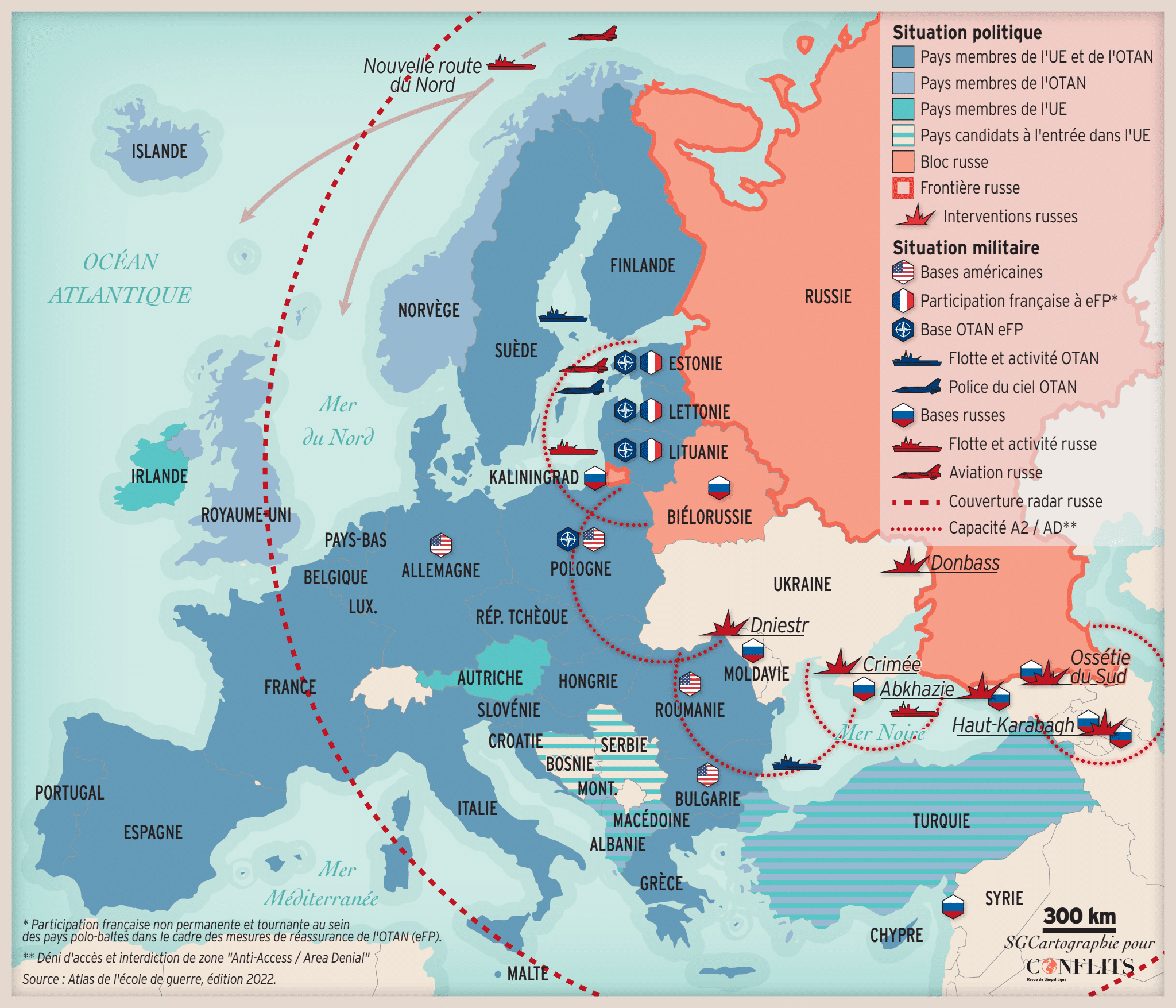
By promoting a “readjustment” of U.S. global presence, the NSS 2025 sends a clear message to European states: they must take greater responsibility for their own defense. In this context, NATO’s founding purpose — with the U.S. security umbrella — is being seriously questioned. Several analysts argue that Europe may need to rethink its strategic posture to guarantee its autonomy.
Some recent documents and analyses suggest that in the event of a major conflict — for example, a Russian attack on a European country — the United States may no longer automatically intervene to defend Europe. This possibility heightens the sense of abandonment among certain allies, who fear that continued dependence on the U.S. has become too risky.
It would be exaggerated to claim that the NSS 2025 calls for an immediate and total withdrawal of U.S. forces from Europe. However, the document, its tone, and the reactions it provoked strongly suggest a redeployment or gradual reduction of U.S. engagement on the continent. Several elements support this interpretation:
- The NSS explicitly mentions realigning military commitments, prioritizing the Western Hemisphere.
- The discourse on Europe is both political and ideological: the text downplays European priorities, which could translate into fewer resources dedicated to U.S. operational presence.
- Additional signals — leaks, Pentagon orientations, public statements — suggest that in a crisis, Europeans may no longer rely on automatic U.S. intervention.
Still, the NSS does not proclaim an immediate American military exit from Europe. Rather than a withdrawal, it outlines a redefinition of the U.S. role: less a “global policeman,” more a power centered on the Western Hemisphere, leaving Europe to assume greater political and military responsibility for its own security.
Europe will be forced — whether it wishes to or not — to accelerate its pursuit of strategic autonomy: rearmament, enhanced European cooperation, and stronger collective defense.
Transatlantic relations risk undergoing a major reconfiguration: greater pressure on Europe to take charge of its own security, accompanied by a climate of mistrust, as the American message is perceived as a challenge to European values and institutions.
In a crisis, Europe may face growing uncertainty regarding U.S. support, increasing the stakes of intra-European solidarity.
Impact on the Western Pacific
Even though the Pacific is no longer the top priority it once was, the NSS 2025 does not ignore it entirely: the document affirms that strategic interests remain, including the need to “deter China,” protect maritime routes, and maintain stability in crises — especially around Taiwan or the South China Sea. In other words: the Pacific is no longer at the center of U.S. doctrine but remains an important “area of interest.”
Allies in the Indo-Pacific (Japan, South Korea, Australia, etc.) are encouraged to strengthen their own capabilities, with greater emphasis on defense burden-sharing. This implies that the United States may rely less on its role as global security guarantor, while local allies assume more responsibility — potentially reducing the direct role of U.S. forces.
China is no longer presented as the primary threat or challenge to the United States. It is clearly relegated behind other national priorities. The implicit U.S. priority order now appears to be:
- Homeland security and border protection
- Stabilization of the Western Hemisphere (a clear return to Monroe Doctrine logic)
- Economic security and reindustrialization
- China and the Indo-Pacific region
China is no longer depicted as a central adversary, but rather as:
- an economic competitor,
- a risk to supply chains (while still being a trade partner),
- a regional actor whose dominance should “ideally” be prevented to protect U.S. economic interests.
For the first time, Washington implicitly acknowledges the possibility of being overtaken militarily by China. Deterrence over Taiwan is described as a “priority,” but no longer a “vital interest”; military superiority is presented as desirable but no longer guaranteed. The document suggests that if frontline allies do not significantly increase their contributions, Taiwan’s defense may become impossible due to an unfavorable balance of power.
Moreover, although the U.S. reaffirms its opposition to any unilateral change to the status quo in the Taiwan Strait, the gap widens between declaratory policy and what Washington seems truly willing to do.
This strategic realignment may progressively reduce certain U.S. capabilities or bases in the region if they are no longer considered priority assets. This could mean scaled-down permanent presence, less frequent rotations, or refocusing on theaters considered vital (the Americas, nuclear deterrence, homeland defense).
Conclusion
Trump has taken a major step by publishing his new National Security Strategy — at least on paper. It represents a substantial adjustment that acknowledges a basic reality: the United States no longer has the means to be the “world’s policeman.” The priority is now refocused on the Western Hemisphere.
But does Trump actually possess the levers needed to implement this revolutionary shift? That is far from certain. He will have to contend not only with resistance from what is often called the American deep state, but also with opposition from allied bureaucracies. The difficulties encountered in attempting to resolve the Russia-Ukraine conflict already reveal the scale of the obstacles.
Added to this is a strategic imperative: reducing economic dependence on China. Soybeans and rare earth elements remind Trump of the limits of U.S. autonomy. Maintaining the lead in technological competition is anything but guaranteed: in several fields, such as AI or green technologies, China is catching up — or has already surpassed the United States.
Implementing an updated Monroe Doctrine also requires acknowledging that China is now deeply embedded in the American “backyard” via the Belt and Road Initiative: the port of Chancay in Peru, expanding ties with Brazil (soybeans, BYD factories), cooperation projects with Argentina. Russia, for its part, has no intention of abandoning Venezuela.
The European Union, meanwhile, recognizes that it will be forced to acquire real strategic autonomy more quickly. Yet after decades of cultural, security, and political influence from across the Atlantic, it seems to have lost some of its ability to define itself independently — unless France regains the necessary ambition to shape its own destiny, and perhaps Europe’s as well.
In the Western Pacific, regional stability will depend on a more nuanced understanding of local dynamics. It cannot be reduced to strengthening traditional alliances: the geopolitical reality is more complex and demands a subtle approach. Promoting coexistence — at least a peaceful modus vivendi — with the region’s dominant power, China, is essential.
Finally, one notable feature of this new NSS is the near absence of the themes of “democracy” and “freedom.” The implicit message seems clear: this strategy is based primarily on the defense of concrete interests, not on an ideological crusade.
One thing is certain: the world after NSS 2025 will not resemble the world before it. Each actor will need to seize the opportunities opened by this historic document.
Conflits is a French geopolitical journal. It follows the tradition of the French school of realist geopolitics and brings together contributors from diverse backgrounds: academics, military officers, business leaders, journalists, diplomats—both French and international.
It publishes six issues per year as well as special editions. In addition to its magazine and website, it operates a YouTube video channel and a podcast channel.
Its readership is diverse: professors, students, senior executives, military officers, and anyone interested in geopolitics. Read more about us.