




Active since 2017 but marginal for nearly five years, the Middle Corridor only became a strategic object with Russia’s invasion of Ukraine in February 2022.
The European Union is pouring in growing investment: €10 billion announced in January 2024 under the Global Gateway programme to secure access to Central Asia’s critical raw materials, regardless of the infrastructure’s actual performance.
The shrinking of the Caspian Sea, which hit its historic low in 2025, directly threatens the ports where the transshipment operations the corridor cannot function without take place.
By Georgi Harutyunov
After Russia’s invasion of Ukraine in February 2022, the European Union drew up and coordinated economic and political sanctions against Russia. The aim was clear for European Commission President Ursula von der Leyen, who declared on 24 February 2022: « These sanctions are designed to take a heavy toll on the Kremlin’s interests and its ability to finance the war. » Between 2022 and 2023, the total value of EU imports from Russia fell from €63 billion to €11 billion. This fall in trade fed above all into a wider reflection on Eurasian connectivity and the dependencies it creates, since the majority of overland flows run along the Trans-Siberian railway, in place since the start of the twentieth century. Alternatives to the routes and corridors passing through Russia have therefore been studied ever more closely by the EU since 2022. Among them is the Middle Corridor, also known as the Trans-Caspian route or, more officially, the Trans-Caspian International Transport Route (TITR): an association coordinating the companies that handle the 4,250-kilometre rail and sea link connecting China to Europe via Kazakhstan, the Caspian Sea, Azerbaijan, Georgia and Turkey before reaching Europe. Designed in 2013 and operational since 2017, this corridor remains a strategic piece of infrastructure, but one whose performance is modest relative to its proclaimed potential. Since 2022, it has attracted a volume of rhetoric and investment out of all proportion to its real contribution to Eurasian trade.
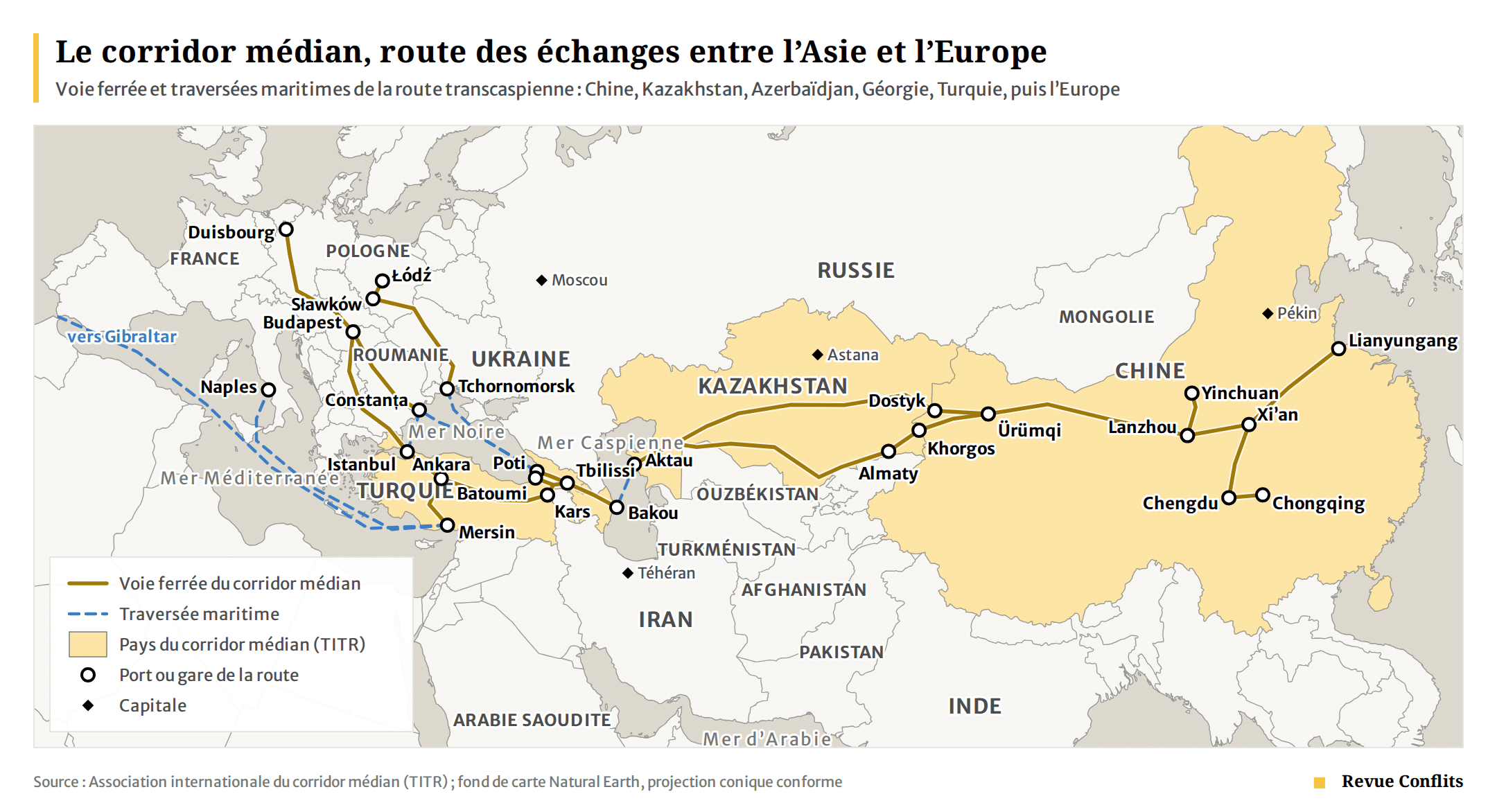
This imbalance calls for a hypothesis: the development of the Middle Corridor owes less to its accessibility and logistical performance than to the representation that has been built up around it since the war in Ukraine. By weakening the competing links, the current geopolitical imperatives have made the Middle Corridor an alternative deemed indispensable, while its Caspian crossing point deteriorates and dries up at the very rate at which its strategic reputation improves.
I. A high-potential alternative route?
The Middle Corridor is defined first of all by what it avoids. Its very name (« Middle ») makes sense only in relation to older itineraries: the Trans-Siberian corridor (the « Northern corridor »), running through Russian and Belarusian territory since the start of the twentieth century, and the Southern corridor, which links China to Turkey via Iran. Positioned between these two axes, the TITR long existed only as a fallback option: the coordinating association formed in 2013 in Astana by the Kazakh, Azerbaijani and Georgian rail operators predated the corridor’s actual commissioning in 2017 by several years. It should be stressed above all that the launch of the TITR coincided with that of China’s Belt and Road Initiative. Known in French as the « New Silk Roads », this project, launched the same year as the TITR, aims to create and finance new maritime and overland routes that serve both to develop China’s western regions and to secure the supply of trade routes for Beijing. Yet the TITR only joined this project in 2023, because China attached too little importance to this secondary corridor before Russia’s invasion of Ukraine.
That war shifted the status of the Middle Corridor. Western sanctions against Russia made the Northern corridor risky, both in terms of operators’ liability and of their commercial reputation. At the same time, Houthi attacks on merchant vessels in the Red Sea near the Bab-el-Mandeb strait from 2023 onwards eroded the competitiveness of the sea route linking China to Europe. The Middle Corridor then inherited part of the traffic abandoned by its two rival routes. Between 2021 and 2024, the volumes carried rose from around 500,000 to 4.5 million tonnes, an eightfold increase in three years.
The European Union quickly turned this momentum into an investment doctrine. The Global Gateway programme, launched in 2021 to mobilise up to €300 billion in external financing by 2027, made the Trans-Caspian corridor a priority axis of its connectivity strategy towards Central Asia. At the Brussels investors’ forum on 29 and 30 January 2024, the European Commission announced the mobilisation of €10 billion for transport connectivity in Central Asia. The following month the European Investment Bank signed memoranda of understanding worth €1.47 billion with Kazakhstan, Kyrgyzstan and Uzbekistan. This movement was confirmed at the Tashkent forum on 27 November 2025, where the EU reaffirmed the corridor as a flagship project of its connectivity strategy.
The scale of this financial effort stems above all from the European desire to secure its supplies of critical raw materials, formalised by the European Commission’s Critical Raw Materials Act, which came into force in May 2024. The main objective of this regulation is to secure the EU’s supply of critical minerals (such as lithium, cobalt and rare earths) essential for producing batteries, wind turbines and solar panels, in order to drive the green transition and maintain competitiveness in the digital and AI sectors. The regulation sets binding targets for 2030: extract at least 10% of the Union’s annual consumption on its own soil, process 40% internally, and depend on no single third country for more than 65% of any given material. It should be noted that the EU still depends on China for more than 80% of its overall supply of strategic metals and magnets. The text targets Central Asia precisely because it holds a significant share of the reserves: Kazakhstan alone accounts for around 40% of world uranium production (needed for both civilian and military nuclear power), and 64% of Kazakh shipments bound for European markets were already transiting via the TITR in 2023.
In November 2023, Emmanuel Macron’s visit to Astana marked the first visit by a French head of state to Central Asia since François Mitterrand in 1994. Made alongside the heads of Orano and EDF, this official trip illustrates how France’s loss of access to Nigerien uranium (following the July 2023 coup) precipitated the overhaul of European logistical and energy priorities around Kazakhstan. The Middle Corridor thus became the instrument of a diversification policy the EU has had to pursue since the start of the war in Ukraine over the short and medium term, and of its strategic competition with China over the long term.
II. A necessary but structurally unfinished corridor
The Middle Corridor faces several major limits to its development, both technical and environmental. These weaknesses stem first from a constraining geography. The TITR imposes two successive transshipments: one at sea, crossing the Caspian, the other by rail, at the junction between the Soviet gauge of 1,520 millimetres (in use in Kazakhstan, Azerbaijan and Georgia) and the standard gauge of 1,435 millimetres used in Turkey, China and the EU. The international station of Akhalkalaki in Georgia, where this bogie change takes place before entering Turkey, remains too cramped for the announced volumes. The sea crossing poses a problem of a different nature: the fleet available in the Caspian Sea remains negligible relative to the stated ambitions, just seventeen Kazakh vessels in 2024. As a result, over the first eleven months of that same year the corridor’s container traffic amounted to only 31,500 TEU, against 358,800 on the Kazakh-Russian-Belarusian Northern route alone. On this scale, specialists regard the Middle Corridor as substitute infrastructure for moving goods in urgent situations, but not as a route capable of carrying the volume of Eurasian rail trade on its own.
Bureaucracy also multiplies the delays. The corridor mobilises four sovereign states and their respective rail companies, without any supranational authority holding binding power over the whole system. The Middle Corridor Multimodal joint venture, bringing together the Kazakh, Azerbaijani and Georgian railways, only became operational at the end of 2024, without resolving either the question of unified pricing or that of managing traffic priorities during periods of saturation. The World Bank itself, in its 2023 report, listed ten priority actions to triple trade by 2030, from building a bypass line at Almaty in Kazakhstan to simplifying customs procedures: all projects still in their infancy.
These observations invite a reconsideration of the analyses and forecasts made about this corridor. If the infrastructure remains so incomplete three years after the invasion of Ukraine, what truly changed in 2022 was neither the route nor the corridor’s equipment, but the reading of it by its main financiers and the countries concerned. This shift may indeed arise from the geopolitical representations that states form of their own connectivity needs. It is a hypothesis that invites us to understand how each transit state builds its own vision of the corridor, according to its interests and its ambitions.
III. The differing representations of the corridor among the states concerned
The states the Middle Corridor crosses do not project the same meaning onto it, and three readings are overlaid on it. The first, pacifist and liberal, associates the corridor with a form of gentle commerce. Beijing, for instance, sees in it an instrument of economic expansion, drawing on the legacy of the second-century-BC Silk Roads to legitimise its drive for dominance. More recently, the United States and Armenia have put forward a project to join the Middle Corridor by opening a new route linked to the TITR itinerary: the Trump Route for Peace and Prosperity (TRIPP). Signed in August 2025, the memorandum concerning this passage is intended to pacify relations between Armenia and Azerbaijan after Armenian forces lost Nagorno-Karabakh in 2023, by establishing a route between the two states that is 74% owned by the United States. But this discourse of regional appeasement through trade tends to facilitate Washington’s containment of Russia and Iran, launching a strategic initiative in a region traditionally under Russian influence.
A second reading, ideological, mobilises Turkey and Azerbaijan around a pan-Turkic project: the Middle Corridor becomes, in the phrase adopted at the summit of the Organisation of Turkic States in Samarkand in 2022, the « backbone of a Turkic space » extended to Anatolia, the Caucasus and Central Asia. It should be noted that the influence of pan-Turkism in Turkish ruling circles has consolidated sharply since the 2016 alliance between Recep Tayyip Erdoğan’s AKP and Devlet Bahçeli’s ultranationalist MHP. This coalition, known as the « People’s Alliance » (Cumhur İttifakı), has allowed the gradual integration of Turkic nationalist representations into the official discourse of the Turkish state. In November 2021, Bahçeli went so far as to present Erdoğan with a map of the Turkic world depicting a vast space running from the Balkans to Siberia and China’s Xinjiang, also including Russian regions populated by Turkic minorities. This public staging, circulated by the MHP itself, gives material form to the geopolitical imaginary of Turan: a historical region straddling Central Asia and Siberia that has been home to Turkic peoples since the sixth century.
A third representation, functional, prevails in Kazakhstan and Georgia, where the corridor serves above all a logic of transit and diversification of partners. In Kazakhstan, the multi-vector policy, equidistant from Moscow, Beijing and Washington, was forged by former president Nursultan Nazarbayev during the 1990s. In Georgia, however, the pro-European political climate in place since 2003 shifted in 2024 after the contested victory of the pro-Russian « Georgian Dream » party in the presidential election. This situation forces the country to recast its connectivity discourse in a more functional tone, since the Georgian vision had until then centred on the need to create a logistical continuity with the European continent, with a view to joining the EU.
On the Russian and Iranian side, both actors apprehend and represent the development of the TITR as a dynamic of geopolitical isolation. They are investing instead in the International North-South Transport Corridor (INSTC), a 7,200-kilometre north-south itinerary linking Saint Petersburg to Indian ports via Iranian territory. In 2022 this axis already recorded traffic of between 14.2 and 14.5 million tonnes, and it is often cited as a corridor for circumventing European and American sanctions. Nonetheless, Moscow’s capacity to structure this alternative network is suffering the backlash of its own economic fluctuations. Marked by a recession contained at 2.1% in 2022, a GDP rebound of 3.6% in 2023, then a growth rate of around 3% in 2024, the Russian war economy artificially maintains the balance between supply and demand, but is not enough to structure its investments. For its part Iran, under American embargo since 1979 and constrained by the strikes of 2025 and then of February 2026, faces a shortage of capital to complete its national infrastructure, as with the Qazvin-Rasht-Astara rail section in the north.
IV. The uncertain prospects of the Middle Corridor
As shown, the Middle Corridor owes much of its success to a conjuncture of war in Ukraine and strategic competition with China, which suggests that nothing guarantees the durability of this advantage in the event of international political normalisation. An easing of Western sanctions against Russia, a hypothesis regularly floated as negotiations over Ukraine proceed, could restore the Trans-Siberian corridor’s structural pricing advantage: in 2023, the Eurasian Rail Alliance index put the transit cost at $2,943 per twenty-foot equivalent on the Northern route, against $3,797 on the TITR for a comparable Kazakhstan-Europe journey, an additional cost of around 30%.
But beyond political fiction, and even beyond the technical issues of differing standard and Russian gauges, administrative management and traffic flow, the most serious threat remains hydrological and climatic. The cartographic and satellite analyses used in this work, comparing the evolution of the coastline at the ports of Aktau in Kazakhstan and Alat in Azerbaijan between the mid-2010s and 2025, document a retreat of the shoreline that is particularly marked in the north of the basin. This trend has since been confirmed: in July 2025 the level of the Caspian Sea crossed the -29-metre mark below mean sea level, its historic low since instrumental measurements began, after an average fall of 30 centimetres a year since 2020, against 6 centimetres a year in the preceding decades.
« The Middle Corridor’s strategic centrality owes less to its material robustness than to the momentary absence of alternatives deemed safer. »
On 5 September 2025, before the enlarged summit of the Shanghai Cooperation Organisation meeting in Tianjin, Kazakh president Kassym-Jomart Tokayev described the situation of the Caspian Sea as « an environmental catastrophe in the making ». The average depth of the port of Aktau now stands at 4.5 metres, against the 6.5 to 7 metres needed for normal operation; the dredging operations begun in 2025 have so far restored only partial capacity, while the sea’s total surface area has shrunk by more than 34,000 square kilometres in under twenty years. According to the most pessimistic scenarios published in the journal Communications Earth & Environment, the drop could reach a further eighteen metres by the end of the century. This drying out is due mainly to global warming, which causes its waters to evaporate. The phenomenon is also amplified by the overexploitation of water resources: the main rivers that feed it, in particular the Volga in Russia, are subject to heavy abstraction for agricultural irrigation and industrial dams, depriving the sea of its natural replenishment.
This degradation sketches a paradoxical horizon. In the medium term, it mechanically worsens the corridor’s operating costs: each metre lost requires new desilting operations, lengthens delays and weakens the sole maritime link on which the junction between the Kazakh and Azerbaijani rail networks depends. In the very long term, a more speculative hypothesis could be formulated: a sufficiently pronounced retreat of the shoreline could free up, around the dried-out rim, spaces stable enough to build a railway and make the corridor’s itinerary entirely overland. Yet this prospect is no net benefit: it presupposes an ecological collapse comparable to that of the Aral Sea, whose near-total disappearance since the 1960s has produced salt and dust storms laden with industrial residues, along with the extinction of whole swathes of regional biodiversity. Such a scenario would doubtless transform the Middle Corridor’s hydrographic constraint, but at the cost of a disaster whose health, migratory and diplomatic costs would far exceed the logistical gain.
The gradual disappearance of the Caspian Sea therefore frees up no practicable room for manoeuvre for the decades to come. For the time being it confirms the structural fragility of a corridor whose strategic centrality owes less to its material robustness than to the momentary absence of alternatives deemed safer.
This article is drawn from a university research dissertation.