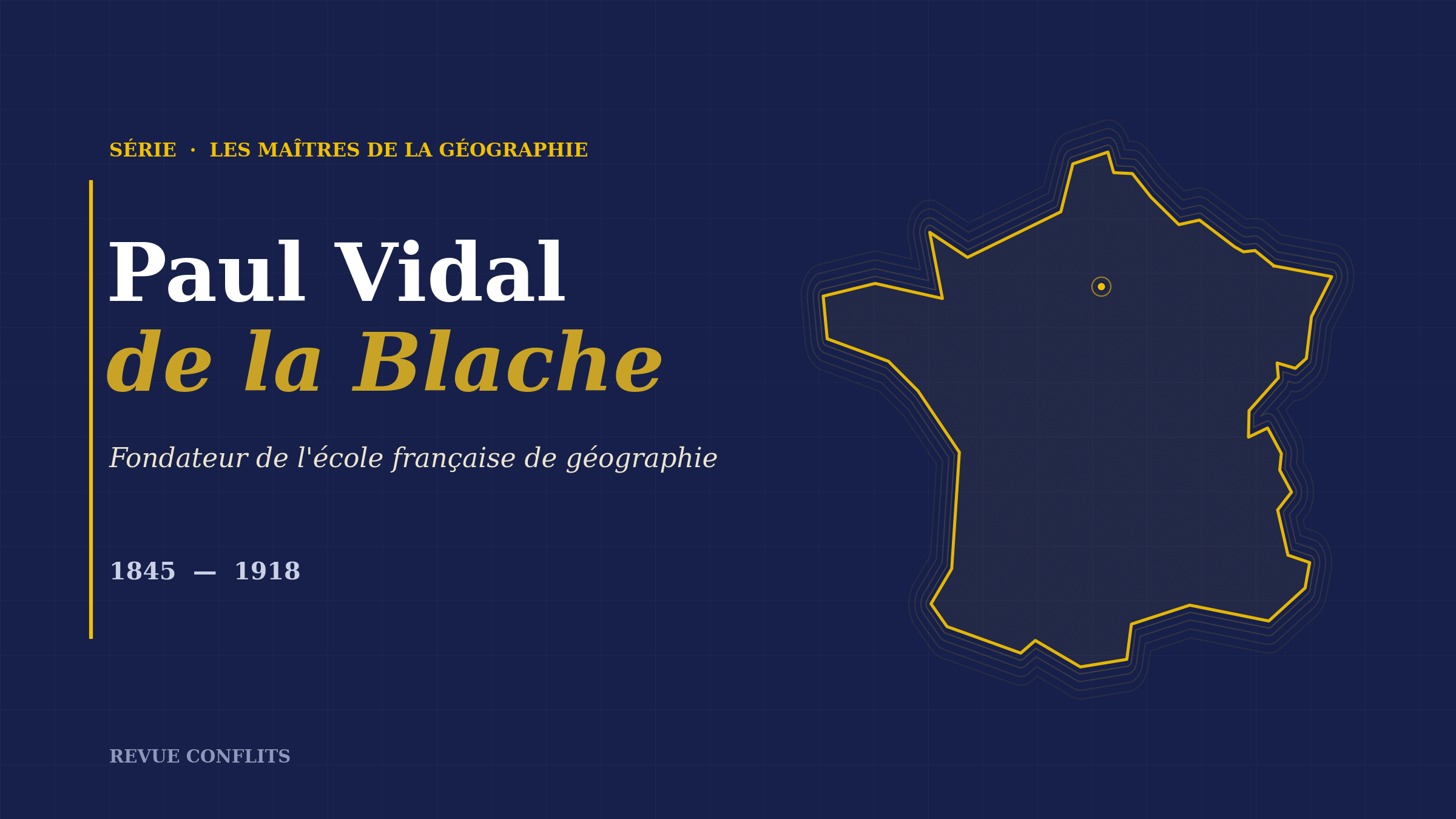




Founder of the French school of geography, Vidal de la Blache conceived the discipline as the autonomous science of combinations at the surface of the globe, attentive to connections rather than to isolated causes.
For him the landscape is a « living synthesis » in which relief, water, living things and the works of man become inseparable — a space neither purely natural nor purely artificial.
His fundamental thesis, which posterity named possibilism: nature opens up possibilities, and man slowly actualises them through his « ways of life » (genres de vie).
« No civilised country is the exclusive author of its own civilisation. Or at least it can engender only a limited civilisation — like a clock which, after running for a time, stops short. »
— P. Vidal de la Blache, Tableau de la géographie de la France, 1903
Founder of the French school of geography, Paul Vidal de la Blache (1845-1918) bequeathed less a system than a way of looking at the earth. His major methodological articles — Des caractères distinctifs de la géographie (1913), Les conditions géographiques des faits sociaux (1902), De l’interprétation géographique des paysages (1908) — and the celebrated Tableau de la géographie de la France (1903) sketch out a coherent conception in which geography is neither an appendix of geology nor a servant of history, but an autonomous science of the combination of phenomena at the surface of the globe. This conception entails an original answer to three questions that constantly recur in his writing: what is geography? what are landscapes? and how do nature and human action, the weight of the environment and the freedom of societies, fit together?
Here we would like to follow these three threads from the texts themselves. They lead to a thesis that posterity summed up — at the cost of a word Vidal de la Blache never used — under the name of possibilism: nature proposes, man disposes, and the landscape is the visible site of this dialogue.
Read also: Geographical traditions: Reclus, Vidal de la Blache, de Martonne
Geography, a science of combination and of places
Vidal starts from an observation: the very idea of geography is obscured by « misunderstandings ». Attached « without any doubt » to the group of natural sciences, it nonetheless « holds a place apart »[1]. The reproach levelled at it of « living on borrowings » obliges it to specify what sets it apart. His answer is clear: « In reality, as we shall see, geography does have a domain of its own. The essential thing is to consider what use it makes of the data on which it works. »
This domain rests first on a principle: terrestrial unity. Inherited from the geographers of Antiquity and then from Humboldt and Ritter, this principle posits « the idea of correspondence, of solidarity between terrestrial phenomena ». Geography does not fragment reality; it grasps it in its connections. Hence its own mission, which Vidal formulates by borrowing from the climatologist Hann:
« Geography, drawing like the neighbouring sciences on the idea of terrestrial unity, has as its special mission to seek how the physical or biological laws that govern the globe combine and are modified as they apply to the various parts of the surface. »[2]
The decisive word is combination. « This combination is the very form under which phenomena present themselves everywhere in nature, » he writes, quoting Buffon — « most effects depend on several causes combined in different ways » — and Henri Poincaré. Geography therefore does not study isolated causes but their « chains of connection » and their « correlation ». This point allows him to reject the antinomy, common in his day, between a « general geography » that would alone be scientific and a « descriptive » geography of regions: « From whatever angle one considers them, it is the same general facts, in their connections and their correlation, that command attention. »
The ground of this combination is the surface. Vidal de la Blache gives it a definition that has remained famous:
« The field of study par excellence of geography is the surface; that is, the whole set of phenomena that occur in the zone of contact between the solid, liquid and gaseous masses that make up the planet. »[3]
This surface is not a fixed state but the result of a history: « The appearance of the solid surface thus reveals itself as the result of modifications endlessly reworked from age to age; it represents a sequence, and not a state given once and reached all at once. » The present forms « are intelligible only if one considers them within the succession of which they form part ». Vidalian geography is thus profoundly temporal, but of a time — that of nature — which is not that of human history.
From this follows a double definition of the discipline. It is an « essentially descriptive » science: « To describe, define and classify, and from there to deduce »; but a reasoned description that leads to explanation. And it is above all a science of space, not of man: « Geography is the science of places and not that of men »[4]. This oft-quoted formula does not banish man from geography; it indicates the angle from which geography considers him — as inhabitant and transformer of places, not as subject of history.
There remains the notion that makes the junction between nature and life: the milieu. Vidal de la Blache is as wary of it as he uses it: « a notion whose vague appearance stems from the abuse made of it ». But he redefines it precisely. Natural forms, he says, never present themselves in isolation: they are « groups of forms obeying a collective action, linked by affinities ». The milieu is therefore not a mere sum of physical conditions; it is the web of relations that make those conditions interdependent. Hence the central equation:
« The idea of milieu, in these various expressions, takes shape as correlative with, and synonymous with, adaptation. »[5]
Adaptation: the word already announces that the milieu does not act in one direction only. Plants, animals and « even, up to a point, human groups » find in this « environment » — Vidal notes the English word — « the principle of a way of life ». The genre de vie (way of life), a key concept of his entire work, is born here: it designates the manner in which a human group organises its existence by coming to terms with the resources of a given milieu.
The landscape: a « living synthesis » of nature and human work
The question « are landscapes natural spaces or spaces shaped by man? » receives from Vidal de la Blache an answer that refuses the alternative. The landscape is precisely the place where nature and human action become inseparable. From the very opening of De l’interprétation géographique des paysages (1908), he defines it as an object of synthesis:
« This landscape forms a whole whose elements are linked and coordinated; its interpretation requires a reasoned perception of the living synthesis it sets before our eyes. »[6]
Interpretation proceeds in two stages: analysis, which « strives to distinguish the heterogeneous features that enter into the composition of a landscape » and « partakes somewhat of exegesis »; and synthesis, which grasps the whole anew. The « largest share » goes first to the study of the terrain: « They are the architecture of the landscape, sometimes the landscape itself ». But at once water, vegetation and man are added to it:
« In general, water, plant life and the works of man combine with the lineaments of the relief to compose the image framed by the horizon. »[7]
Man is therefore not external to the landscape he might contemplate: he is a component of it. Vidal de la Blache says so in a formula that answers our question directly:
« Through his works, through the influence he exerts around him on the living world, man is an integral part of the landscape. He modifies it and, as it were, humanises it. »[8]
« To humanise »: the verb is crucial. The landscape Vidal describes is almost never virgin nature, but nature worked upon, marked by centuries of settlement. Villages, crops and roads « order themselves » around man’s « fixed settlements », which « introduce an element of fixity into geographical relations » and constitute « a deposit that earlier generations leave to those that follow ». The landscape is thus a palimpsest: even ruins speak in it, for « there is […] a geography of ruins », and « the persistence they display […] is in itself a geographical fact ».
This humanisation of the landscape finds its finest expression in the foreword to the Tableau de la géographie de la France, where Vidal de la Blache says he sought to paint a France « deeply humanised, but not debased by the works of civilisation ». Its soil bears « the imprint » of a thousand-year coexistence. But to humanise the landscape is not to denature it: human work there prolongs nature rather than opposing it. This is why the plant constantly serves as a metaphor for the social: the human settlement is « a plant that spreads its roots ».
It should be stressed that, for Vidal de la Blache, the landscape is also an object of order, not a chaos. Plant associations — maquis, garrigues — compose « the normal aspect under which the physiognomy of the landscape presents itself and engraves itself on our eyes », each plant having « arranged itself with its neighbours so as to have its share of soil, light and nourishment ». Man inserts himself into this equilibrium, which he « incessantly disturbs or, as the case may be, sets right, by putting his hand to it »[9]. The landscape is therefore a living and unstable equilibrium, never an inert backdrop.
Read also: The thinkers of urban geography
From milieu to way of life: how nature and human action fit together
How, more precisely, do nature and human action command one another? Vidal grants nature a real weight. Man « is one of the powerful agents that work to modify surfaces. As such he ranks among the geographical factors of the first order ». But he is also subject, in return, to the conditions of the place. In Les conditions géographiques des faits sociaux (1902), he seeks to ground scientifically the study of these relations, beyond anecdotal « cases of intimate correlation ». The factor he judges most decisive is neither climate nor soil, but situation:
« The cause which, in our view, introduces the most differences between societies is position. According as a country is doomed to isolation, or is on the contrary open to the currents of general life, the relations of men among themselves are entirely different. »[10]
Isolation perpetuates clan life, the vendetta, distrust of the stranger; openness to the « currents of general life », on the contrary, favours exchange and social complexity. Vidal multiplies examples: the Saharan ksour where sedentary peoples and nomads interlock, the societies of Far Eastern rice cultivation, American civilisation shaped by « the extent of the surfaces ». In the case of rice, he goes so far as to assert a « cause-and-effect relationship between the mode of cultivation inspired by geographical conditions and the only truly popular form of social organisation » of these regions.
Should we see in this a determinism? Vidal de la Blache carefully guards against it. Geographical conditions « inspire » and « imprint », but do not decree. The vocabulary is telling: nature « inspires » a culture; the milieu « solicits » activities; fashioned objects « reflect habits that derive from the social state or that inspire it ». Influence flows in both directions. Above all, man remains an actor who can choose: Vidal de la Blache devotes fine pages to « willed, methodical, one might say Cartesian isolation » — that of the Mormons of Salt Lake, the Puritans of Massachusetts, the secluded religious communities, where it is human will that takes the initiative and bends the milieu to a project.
It is in the Tableau that the most accomplished formulation of this articulation is found. Posing the question « In what sense France is a geographical being », Vidal de la Blache rejects the idea of a France given in advance by nature — « It is not a thing given in advance by nature » — and offers his most famous image:
« One must start from the idea that a country is a reservoir in which lie dormant energies whose germ nature has deposited, but whose use depends on man. It is he who, by bending it to his use, brings its individuality to light. »[11]
The whole of possibilism is contained in this sentence. Nature « deposits the germ »; it offers virtualities, « energies » that « lie dormant », but « their use depends on man ». The country has no personality before man reveals it: « It is then that a country takes shape and becomes differentiated, and that in the long run it becomes like a medal struck with the effigy of a people. » The relationship is not one of mechanical cause and effect, but of potentiality to actualisation.
This relationship is also one of duration. In France, writes Vidal de la Blache, « Man was […] long the faithful disciple of the soil »; « An adaptation took place, thanks to habits transmitted and maintained in the places where they had arisen ». The « disciple » is not a slave: he learns from the soil, then partially emancipates himself from it through the accumulation of « habits » — that is, of ways of life. And these ways of life themselves become geographical forces: modern industry « brings […] a powerful cause of disturbance into human groupings ». Human history thus enters geography as one factor among others, capable in turn of reshaping the milieu.
Neither determinism nor chance: Vidalian possibilism
If a single sentence had to sum up Vidal de la Blache’s position in the debate between determinism and freedom, it would be the one from the 1908 article, where he explicitly traces his ridge line:
« Without falling into an excess of determinism that would be no less fallacious than its opposite, one may affirm that man’s groupings, cultures, movements and relations do not escape this network of causes and effects. »[12]
The formula is of remarkable balance. Vidal de la Blache refuses the two symmetrical excesses: geographical determinism, in the manner in which some explained « the spectacle of fallen civilisations » by mere « changes of climate » — hypotheses before which « one remains uneasy »; and its « opposite », a voluntarism that would make man a pure spirit freed from places. Between the two, he maintains a « network of causes and effects » from which man « does not escape », but within which he retains a margin of invention.
This position — which Lucien Febvre would christen « possibilism » in 1922, against the determinism of a Ratzel — is not a flight into compromise. It follows rigorously from the conception of geography set out above. Since phenomena always present themselves in unstable combinations, « the equilibrium that results from these combinations is in no way absolutely stable »; no natural condition ever, on its own, produces an unequivocal social effect. The multiplicity of factors « opens up an ample margin »: it is in this margin that the freedom of societies is lodged.
Vidalian possibilism is recognisable, finally, by its cautious causal vocabulary. Vidal de la Blache writes that geographical conditions « bring into play and into light […] properties, virtualities that without them would have remained latent »[13]. Geography does not create history; it reveals its possibilities. « England’s history is insular, France’s is torn between the sea and the continent; the finger of geography is marked on each. » The « finger of geography » orients without constraining: it marks, it inclines, it makes possible.
This openness explains Vidal de la Blache’s insistence on circulation. A country is never closed in on itself: « No civilised country is the exclusive author of its own civilisation. » France, a « country of great circulation » whose major routes « conform to the fundamental structural lines of the country »[14], shows how the natural structure creates possibilities of movement that man actualises into networks of exchange. Here again, nature lays out the thresholds and the corridors; history turns them into roads.
Read also: The great theoreticians of geopolitics: the geopolitics toolbox
Conclusion
Paul Vidal de la Blache’s geographical vision forms a coherent whole. For him, geography is the autonomous science of the combination of phenomena at the earth’s surface, attentive to connections rather than to isolated causes, at once descriptive and explanatory, a « science of places » that grasps man as inhabitant and transformer. The landscape is its emblematic object: a « living synthesis » in which relief, water, living things and « the works of man » are composed together — a space neither purely natural nor purely artificial, but nature « humanised » by centuries of settlement.
As for the articulation of nature and human action, Vidal de la Blache conceives it as an unequal but reciprocal dialogue, to which the formula from the Tableau — the country as « a reservoir in which lie dormant energies […] whose use depends on man » — gives the key. Neither determinism, which would make the milieu a destiny, nor indeterminism, which would cut man off from the earth: a « network of causes and effects » in which nature opens up possibilities and in which ways of life, slowly sedimented into habits, realise them and sometimes surpass them. It is this middle way — demanding and fertile — that human geography has retained under the name of possibilism, and which remains Paul Vidal de la Blache’s most enduring contribution to the thinking of space.
Notes
- P. Vidal de la Blache, « Des caractères distinctifs de la géographie », Annales de géographie, vol. 22, no. 124, 1913, pp. 289-299. ↩
- « Des caractères distinctifs de la géographie », op. cit. ↩
- « Des caractères distinctifs de la géographie », op. cit. ↩
- « Des caractères distinctifs de la géographie », op. cit. ↩
- « Des caractères distinctifs de la géographie », op. cit. ↩
- P. Vidal de la Blache, « De l’interprétation géographique des paysages », 9th International Geographical Congress (Geneva, 1908), Geneva, 1911, pp. 59-64. ↩
- « De l’interprétation géographique des paysages », op. cit. ↩
- « De l’interprétation géographique des paysages », op. cit. ↩
- « Des caractères distinctifs de la géographie », op. cit. ↩
- P. Vidal de la Blache, « Les conditions géographiques des faits sociaux », Annales de géographie, vol. XI, 1902, pp. 13-23. ↩
- P. Vidal de la Blache, Tableau de la géographie de la France, Paris, Hachette, 1903. ↩
- « De l’interprétation géographique des paysages », op. cit. ↩
- « Des caractères distinctifs de la géographie », op. cit. ↩
- P. Vidal de la Blache, « Routes et chemins de l’ancienne France », Bulletin de géographie historique et descriptive, 1902, pp. 115-126. ↩
References
Vidal de la Blache, P. (1902). « Les conditions géographiques des faits sociaux ». Annales de géographie, vol. XI, pp. 13-23.
Vidal de la Blache, P. (1902). « Routes et chemins de l’ancienne France ». Bulletin de géographie historique et descriptive, pp. 115-126.
Vidal de la Blache, P. (1903). Tableau de la géographie de la France. Paris: Hachette.
Vidal de la Blache, P. (1908). « De l’interprétation géographique des paysages ». 9th International Geographical Congress (Geneva), Proceedings of the Congress, 1911, pp. 59-64.
Vidal de la Blache, P. (1913). « Des caractères distinctifs de la géographie ». Annales de géographie, vol. 22, no. 124, pp. 289-299.