

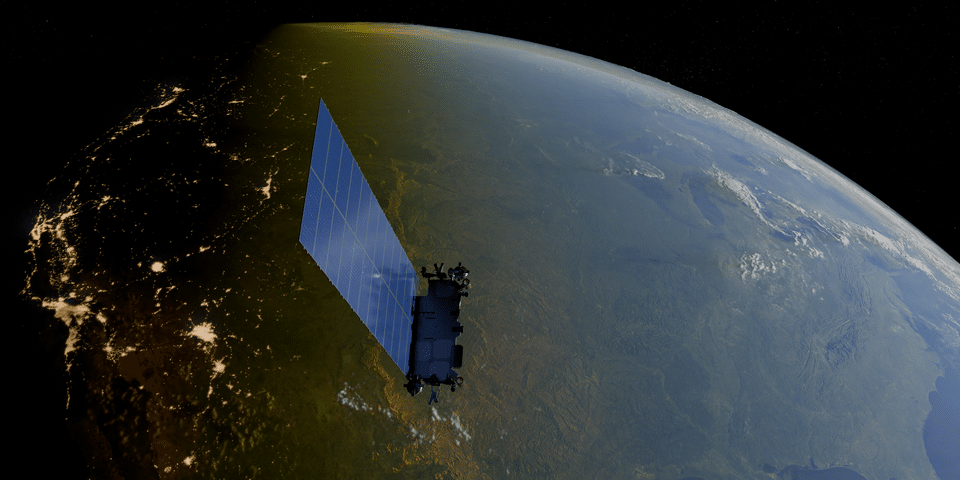




Since 2022, Elon Musk’s Starlink network has become indispensable to Ukrainian forces: communications, drones, intelligence, coordination.
Russia is hitting back with the Volna Kupol Garant, a jammer that directly targets satellites at 500 km altitude and temporarily « blinds » them.
Behind the weapon lies a war of equations — trigonometry, Fourier transform, optimisation — and an electromagnetic signature that gives the jammer away.
Since the beginning of the Ukrainian conflict, Elon Musk’s Starlink network has become an indispensable tool for Ukrainian forces. With its thousands of small low-altitude satellites, it allows a connection even when telephone infrastructure has been destroyed. The army uses it to communicate, pilot drones, share intelligence and coordinate its operations. In response to this technological advantage, Russia has just unveiled a new weapon: the Volna Kupol Garant system.
How does this jammer work?
Unlike traditional jammers that intercept ground antennas, this one directly targets the satellites at 500 kilometres altitude. It does not damage them (that would be too costly and would create debris that could prove dangerous), but blinds them temporarily. The system emits a high-frequency radio beam towards the Starlink satellites and floods their receivers. They no longer hear the signals from the terminals in the same area. It is like shouting so loudly into someone’s ear that they can hear nothing else around them.
« It is like shouting so loudly into someone’s ear that they can hear nothing else around them. »
The mathematics of targeting: geometry and trajectories
There is first a visibility problem to solve: the satellite travels at more than 27,000 km/h and is visible from a ground station for only a few minutes, so the system must track its exact position. This is a problem of spatial geometry: each time the satellite moves, the jammer must calculate the satellite’s angle and azimuth relative to the antenna. All these calculations are carried out in spherical trigonometry, because the Earth is round and the satellite is in a curved orbit. The farther the satellite travels, the more precise the beam emitted by the jammer must be: a deviation of a tenth of a degree can miss the target by several kilometres at that altitude. The satellite’s future trajectory must also be anticipated by solving the equations of motion, rather as a marksman calculates the wind and the speed of a moving target.
Read also: Space, at the heart of the Sino-Russian power strategy
Signal power and the inverse-square law
The power of the radio signal received by the satellite decreases in proportion to the square of the distance. In other words, if the distance between the antenna and the satellite doubles, the received signal is four times weaker. For a satellite at 500 km altitude, even a slight change in distance due to orbital inclination affects the received power. Consequently, the system must emit an extremely powerful signal to compensate for this loss. But this power comes at a price: the stronger the emission, the more visible it becomes. The active antennas of the Russian system then become easy targets to locate. It is a delicate balance between jamming effectiveness and discretion.
Saturating the receivers: the signal-to-noise ratio
Jamming rests on a basic mathematical principle: the signal-to-noise ratio. For a Starlink terminal to be detected by the satellite, its signal must be stronger than the ambient noise. The Volna Kupol Garant adds a parasitic signal whose power is greater than the useful signal. As long as the jammer keeps emitting, the signal-to-noise ratio remains low (that is, below the detection threshold) and the satellite can detect nothing. When the jamming stops, this ratio begins to rise, but it takes several minutes for the system to return to its normal state — rather as the human eye takes time to adjust after being dazzled.
Covering eight frequency bands: the shadow of Fourier
Starlink uses several channels to avoid interference. The Russian system can disrupt them at the same time. In practice, this requires a real-time analysis of the frequencies used. This is where the Fourier transform, one of the finest mathematical tools in signal processing, comes into play. Fourier showed in the 19th century that any signal, however complex, could be broken down into sine waves of different frequencies. And when the system is able to observe a Starlink transmission, it uses this decomposition to detect the eight frequency bands on which it operates. Once these frequencies are known, the jammer can create a parasitic signal whose spectrum (that is, the distribution of frequencies) is exactly that of Starlink. If the jammer misses a band, communications can pass through it. It is rather like trying to jam eight different conversations at once: you have to know which frequencies each of them is on, then emit a parasite on each frequency at the right intensity. The Fourier transform provides this spectral sorting in a few milliseconds.
Read also: Facing the United States, the Chinese anti-satellite threat
Optimising the jamming zone
The system can cover about 20 square kilometres. This is not chosen at random, but because the beam width and the distance to the satellite are set. The wider the beam, the larger the area covered, but the more the signal is dispersed and loses power. The system must therefore find a compromise between the size of the zone to be jammed and the intensity of the signal. It is an optimisation problem: for a given power, what is the best beam width? The six modules of the Volna can be placed on the ground, each covering part of the zone. Their placement must answer a question of geometric optimisation: how to arrange them to achieve coverage while avoiding natural obstacles?
Information theory revealed the system’s vulnerability
Military analysts note that the more powerful the system, the more waves it emits and the more detectable it is by enemy sensors. This is a classic trade-off in information theory and radar detection: the detection distance of an emitter increases with the fourth root of its power (Friis’s law). The six towed modules, each with two steerable antennas, form a coherent array that can be located by triangulation. The mathematics of the near field and the far field show that the Volna, despite its effectiveness, pays for its performance with a massive electromagnetic signature.
« The Volna, despite its effectiveness, pays for its performance with a massive electromagnetic signature. »
A set of equations with multiple unknowns
This system perfectly illustrates how modern warfare is played out on a board of equations: orbital trajectories, radiation patterns, power ratios, tracking algorithms. Russia has decided to attack the satellites rather than the receivers, but every act of jamming is a complex mathematical task. If the satellite changes its frequency, its gain or its pointing, the jammer must recalculate in real time with precision. Starlink, with its network of more than 1,000 satellites, is also redundant, making the mission much harder to accomplish. To neutralise a zone, all the visible satellites must be jammed simultaneously, which amounts to solving an extremely difficult combinatorial optimisation problem.
Read also: Ukraine: the industrial war of drones. An interview with Marc Grozel
A technological battle where mathematics is queen
As in any field of high military technology, every innovation calls for a countermeasure. Starlink can adapt its satellites by adjusting frequencies or increasing the power of its signals. But every adaptation has an energy cost, and the satellites are powered by solar panels. The engineers must solve energy-optimisation equations to maintain the connection while avoiding draining the batteries. On the other side, the Russians will have to adapt their jamming to Starlink’s changes, which requires new Fourier decompositions in real time. It is a war of algorithms and calculations in which each side tries to gain the upper hand over the other. One thing is certain: the war in Ukraine has become a large-scale laboratory for the weapons of the future, where space and mathematics — from geometry to the Fourier transform — have become a battlefield in their own right.
Read also: The conquest of space: a new geopolitical arena?
« The war in Ukraine has become a large-scale laboratory for the weapons of the future. »
Bibliography
U.S. News & World Report, « Russia Tries to Jam Musk’s Starlink Systems to Counter Ukrainian Drones » (8 July 2026).
TASS, « Russia’s cutting-edge system ‘blinds’ Starlink satellites by ‘parasitic’ signals — expert » (17 June 2026).
Kyiv Post, « Starlink Jammers, Fake Milk Trucks: Russia’s New Defense Against Ukraine’s Drone Campaign » (8 July 2026).
Rossiyskaya Gazeta, « Эксперт Лямин — о том, как система РЭБ «Волна Купол Гарант» вырубает Starlink » (17 June 2026).
Vietnam.vn, « The Russian Volna Kupol Garant EW system, a ‘Starlink killer’ of the US on the Ukrainian battlefield » (3 August 2026).
Vietnam.vn, « Russia deploys Garant electronic warfare system, a devastating blow that leaves Starlink ‘blind' » (17 June 2026).
Foreign Policy Research Institute (FPRI) — analysis by Rob Lee.
Ship Electronic Engineering, « Research on Starlink Countermeasures in the Russian-Ukrainian Conflict » (2025, no. 09).
Frédéric Rosard holds a doctorate in applied mathematics, works as a consultant in competitive intelligence and teaches, among other places, at Sciences Po Paris.