


30 September 2026 was to enshrine the return of Iraqi sovereignty, with the departure of the coalition and the disarmament of the Hashd al-Shaabi.
But reality catches up with Baghdad: it is only a stage of negotiation, in which the state treats as a belligerent those it means to subdue.
A date conceived as a syllogism
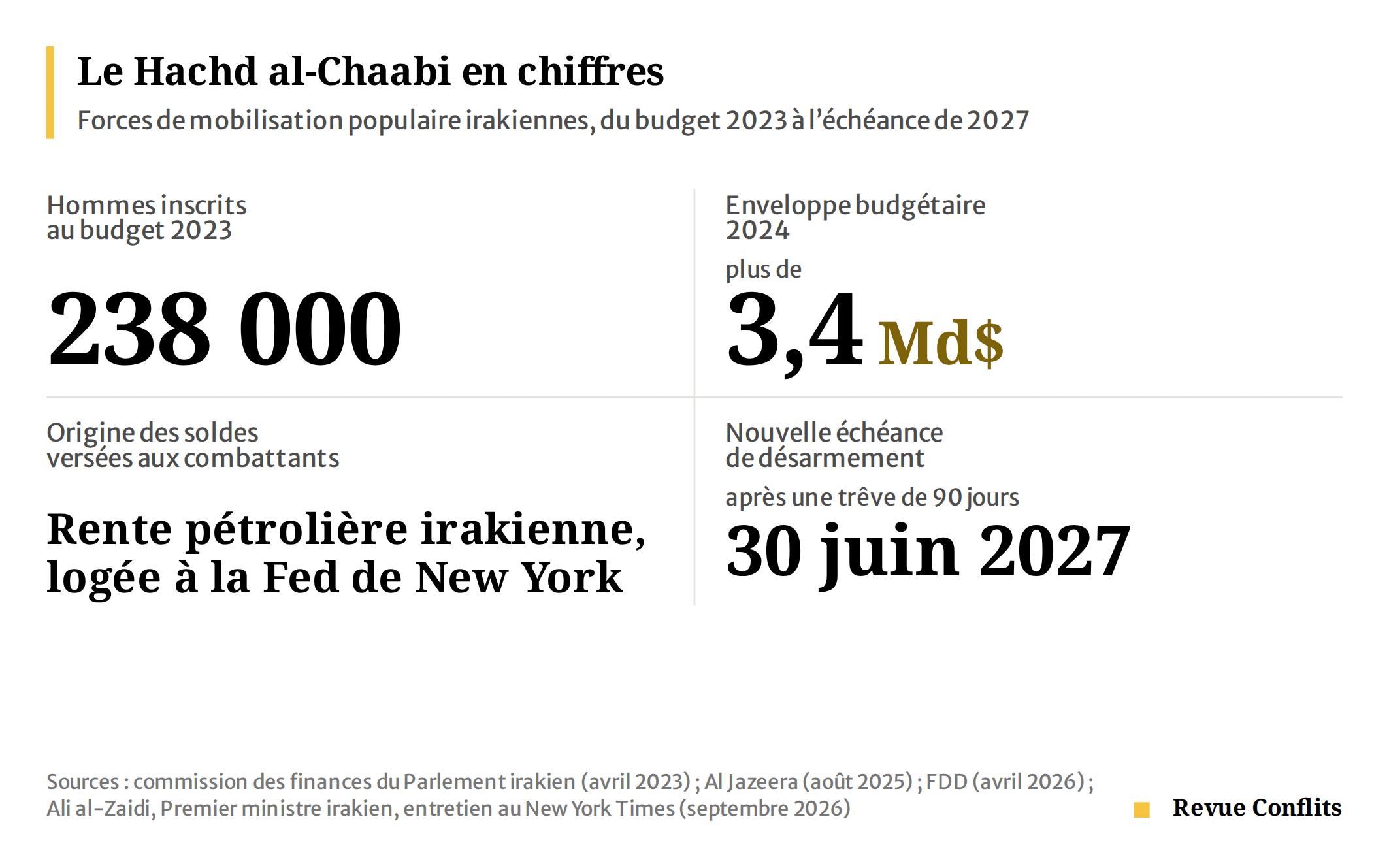
On 29 June, the government of Ali al-Zaidi, installed in May with Washington’s approval, set the deadline for the day the coalition’s mission against Daesh would end. The reasoning was a syllogism: the militias justify their weapons by the American presence; the Americans leave; the weapons have no further reason to exist. On 21 September, in New York, al-Zaidi nonetheless pushed the objective back to 30 June 2027, preceded by a ninety-day truce: the factions would cease their attacks, the American forces would refrain from striking them. In August, the government coalition was still promising the anti-terrorism law for any armed activity outside the state after the deadline. Yet a state does not conclude a ceasefire with a question of public order: it does so with a belligerent.
« A state does not conclude a ceasefire with a question of public order: it does so with a belligerent. »
The Hashd, a state institution that does not obey the state
Born of Ayatollah Sistani’s fatwa against Daesh in 2014 and integrated into the security apparatus by the 2016 law, the Hashd al-Shaabi (the Popular Mobilisation Forces) federates factions whose oldest components — born in Iran or in the resistance to the American occupation — have never renounced their autonomy. It numbers 238,000 men listed in the 2023 budget, and its envelope exceeded $3.4 billion in 2024. These salaries come from the oil rent lodged at the Federal Reserve of New York: American-controlled dollars pay fighters who target Americans. The Hashd is thus double: a salaried administration, chaired by Faleh al-Fayyadh, and a constellation of parallel chains of command, of which Kataeb Hezbollah and Harakat al-Nujaba are the most irreducible. That Iraqi officials have accused al-Fayyadh of having known in advance about the July strikes without warning the targeted factions says enough about the fracture between the institution and its components. To finance, from funds held by a third party, a force that others command — that is the very condition of the hostage state.
« American-controlled dollars pay fighters who target Americans. »
Pledges that lead nowhere
The factions’ word counts for little. Indeed, in July, more than thirty drones launched from Iraq targeted Riyadh and Saudi oil installations, provoking, on 28 July, American-Saudi strikes against the Hashd in seven provinces: at least twenty fighters killed, including five Iranians. In mid-September, two weeks before the deadline and despite Baghdad’s repeated commitments, drones launched from Maysan province struck the East-West pipeline, the artery that allows the kingdom to bypass Hormuz. On 17 August, Abbas al-Yaqoubi, head of Nujaba’s reconnaissance, arrested by the counter-terrorism service, was cleared two days later and welcomed as a hero; Kataeb Hezbollah promised « an eye for an eye ». The counter-terrorism videos proclaiming « We are ready » and the state media’s rebroadcasting of Sistani’s calls to reserve weapons for the state change nothing. The ninety-day truce rests on the good faith of actors who have never shown any…
The vice of the powers and the Kurdish lock
On 21 September, Marco Rubio and al-Zaidi agreed, according to the State Department, to dismantle the « terrorist militias » and to prevent any attack from Iraqi soil. The special envoy Tom Barrack sums it up: by the end of June 2027, only the state will hold force. He goes further. Invoking the Syrian precedent, where the Syrian Democratic Forces were merged into the army, he judges that integrating the peshmergas into the Iraqi army, with equal rights and benefits, would be « a very good thing »: an independent country knows only one military structure. Cruel irony, this is precisely what Kataeb Hezbollah and Nujaba demand — factions that hardened their conditions after the August visit to Baghdad of the head of the Quds Force, Esmail Qaani. The challenge is complete. Erbil has just unified its forces under its own ministry, with the Pentagon’s support, and refuses any link between its constitutional status and the fate of the Hashd. As long as Shia militias act in quasi-autonomy, no Kurdish leader will agree to give up the only guarantee that protects him from a state incapable of being obeyed.
For its part, Paris is not a mere spectator of the situation. After the death of Chief Warrant Officer Arnaud Frion, killed by a drone near Erbil on 12 March, France has just agreed with al-Zaidi to extend its military cooperation beyond the coalition; economically, TotalEnergies claims $12 billion of investment in the country. The geopolitical situation in Iraq has a direct bearing on that of our soldiers and our interests.
Three scenarios
The first, the most probable, is a negotiated Hezbollahisation: the lasting coexistence of a legal state and an armed force holding a veto, on the Lebanese model. The parliamentary factions, led by Asaib Ahl al-Haq, hand over light weapons and symbolic depots; the Hashd absorbs the docile units into its salaried structure; the irreducibles freeze their operations without dissolving their chains of command or handing over drones and missiles. Baghdad proclaims victory, Washington obtains a lull around its bases and Tehran keeps the essential: an armed lever at the heart of the Iraqi state, activable at will. But the ballistic potential remains intact, the truce becomes a permanent state of mutual deterrence, and Kurdistan, noting the incompleteness, keeps its peshmergas outside any federal tutelage. The problem is frozen — and with it part of Iraqi sovereignty.
The second, plausible, is internal confrontation. One strike too many against the Gulf, or the resumption of the Iranian-American war leaving factions orphaned and radicalised, would push Baghdad to apply the anti-terrorism law. The Counter-Terrorism Service, an elite force trained by the Americans and loyal to the Prime Minister, backed by the regular army, would then wage a decapitation campaign: simultaneous arrests of commanders, seizure of arsenals, sealing-off of headquarters. It would be the night of the long knives of post-2003 Iraq, with a major risk: an intra-Shia war, with Hashd units switching against the state, or an indirect Iranian intervention.
The third, the least probable in the short term, is disarmament by exhaustion. An Iranian-American compromise would lead Tehran, seeking economic respite, to order itself the demobilisation of its Iraqi relays, as it knew how, in the past, to suspend their attacks when its interests required it. Deprived of strategic depth, of Quds Force advisers and of parallel revenues drawn from the border crossings, the factions would negotiate their political reconversion and the individual integration of their fighters. Iraq would recover the monopoly of legitimate violence without combat, but by the grace of a foreign decision. The heavy weapons would be returned under international supervision, the brigades dissolved or poured into the army. It is the hypothesis most favourable to Iraqi sovereignty, and the least in Baghdad’s hands.
Four signals will decide between these trajectories; they will have to be watched in the coming months: respect for the truce by the end of December, the Hashd’s line in the 2027 budget, the regularity of the dollar deliveries and Erbil’s attitude.
« 30 September will not be the day the state recovered its weapons, but the day it acknowledged that it still had to negotiate for them. »
A graduate in international relations of the Institut d’études politiques de Bordeaux, the author is a specialist in Iraq and its minorities (Kurds, Eastern Christians, and others).
Read also: « Iran makes perfect use of the Shiites’ difficulties and of local conflicts to create militias in the East ». An interview with Fabrice Balanche
Read also: Iraq: a nation in search of itself. An interview with Shathil Nawaf Taqa
Read also: Iraq after the Iranian shock: secondary front or strategic pivot?
Read also: Qassem Soleimani, sentinel of the Islamic Republic