



On 19 July 2026, Spain won its second men’s World Cup: it now holds, for the first time ever, both the men’s and women’s world titles.
This supremacy owes nothing to chance: it rests on an ecosystem — training, coaches, style — built up over several decades.
Stadiums renovated for 2030, media weight, public diplomacy: football has become, for Madrid, a genuine instrument of power.
From victory to victory
By winning its second men’s football World Cup on 19 July 2026, Spain did not merely add a star to its shirt: it also enshrined a sporting model that has become a genuine instrument of power. Now the simultaneous holder of both the men’s and women’s world titles (a first in the history of the game), it also dominates youth competitions, exports its coaches, modernises its stadiums and turns its successes into economic and diplomatic dividends. This supremacy, however, is due neither to chance nor to the sudden emergence of an exceptional generation, but to an ecosystem built up over several decades.
A second star in the firmament
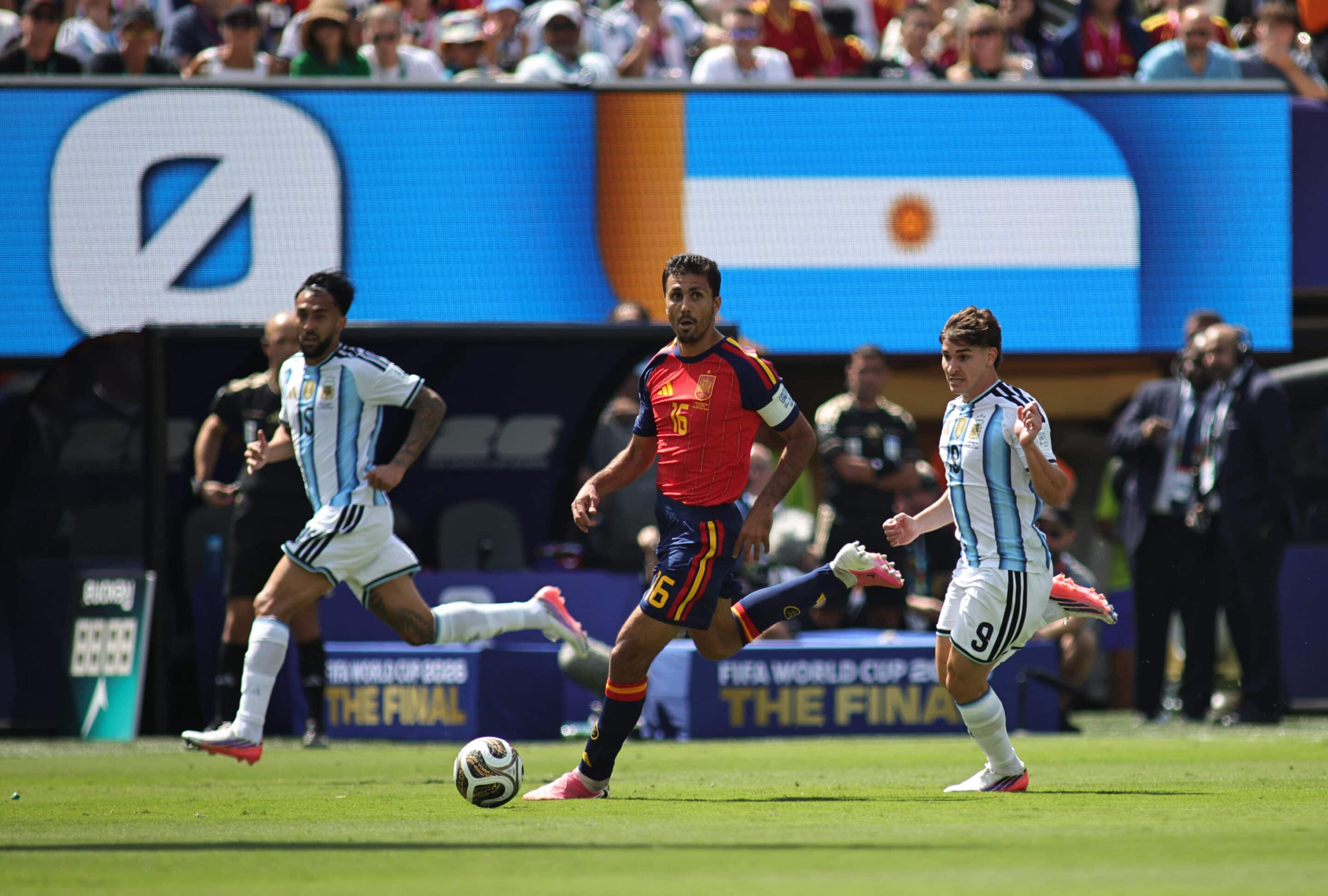
At the MetLife Stadium in New York-New Jersey, the 2026 World Cup final pitted the world’s top two nations in the FIFA ranking against each other: Spain, the reigning European champion, and Argentina, the reigning world and South American champion. For 120 minutes, Luis de la Fuente’s Roja imposed a clear superiority, with twenty shots to only two for its opponent. The Argentine goalkeeper Emiliano Martínez did, admittedly, long delay the outcome with twelve saves, but he finally gave way in the 106th minute. From a Pedro Porro cross, Nico Williams headed the ball back to Ferran Torres, whose half-volley gave Spain the win (1-0).
The sending-off of Enzo Fernández, shown a second yellow card at the end of normal time, had certainly weakened Argentina, but it is not enough to explain Spain’s grip on the game. Over the whole tournament, Spain conceded only one goal in seven matches. Rodri, moreover, was named the World Cup’s best player, while the national side extended its unbeaten run to 38 matches, setting a new international record. To this sporting reward was added a $50 million bonus paid by FIFA (out of a total prize pot of $871 million).
It should be said that the Spanish triumph rests above all on the combination of experienced senior players (such as Rodri and Aymeric Laporte) and young talents like Lamine Yamal and Pau Cubarsí. Above all, it reveals the country’s ability to renew its squad without sacrificing its collective identity.
Read also: Sport, a matter of prestige
A style in full evolution
The Spanish winning cycle began well before 2026. Between 2008 and 2012, the teams of Luis Aragonés and then Vicente del Bosque achieved an unprecedented treble: Euro 2008, won 1-0 against Germany after 44 years of famine; the 2010 World Cup, won by the same score against the Netherlands thanks to a goal from Andrés Iniesta in extra time; then Euro 2012, concluded with a demonstration against Italy (4-0).
After several years of transition, the Nations League title won in 2023 against Croatia ushered in a new era. At Euro 2024, moreover, Spain completed a perfect run, crowned on 14 July in Berlin by a 2-1 victory over England, with goals from Nico Williams and Mikel Oyarzabal. Two years later, the world title confirmed this renaissance. With four European Championships (1964, 2008, 2012 and 2024), Spain now holds the continental record and belongs today to the select circle of nations that are twice world champions.
Its game has nonetheless evolved. The famous juego de posición (or tiki-taka), based on possession, technical mastery and the rational occupation of space, has not disappeared but has shed the slowness that could once make it sterile. The Roja now combines it with the speed of wingers such as Nico Williams and Lamine Yamal, with greater verticality and with immediate pressing after losing the ball. It has thus kept its grammar while enriching its tactical vocabulary.
« It has kept its grammar while enriching its tactical vocabulary. »
Spanish football changes gender
It must be added, however, that this power is no longer conjugated in the masculine alone. On 20 August 2023, the women’s team won its first World Cup, beating England in Sydney (1-0) thanks to a strike from Olga Carmona. It then won the first UEFA Nations League, in February 2024, against France (2-0).
This progress owes much to the women’s team of FC Barcelona, which has become a European benchmark, as well as to a remarkable concentration of talent. The Ballons d’Or won by Alexia Putellas and then Aitana Bonmatí gave an international face to this revolution, while Salma Paralluelo, Vicky López, Claudia Pina and Patricia Guijarro embody its generational depth. Holding both World Cups at once therefore gives Spain a form of global hegemony without precedent.
Read also: Spain, a big-screen power: how Spanish cinema conquered the planet
Red shoots for a golden harvest
The successes of the senior teams are in fact fed by a particularly productive nursery. In 2024, Spain won both the men’s and women’s Under-19 European Championships, before its men’s Under-23 team took gold at the Paris Olympic Games. It also co-holds, with five titles, the record for wins at the Under-21 Euros, and remains a regular presence in the final stages of Under-17 competitions.
This continuity is favoured by the application of common principles across all age categories, sometimes from the Under-15s onwards. When they join the first team, Gavi, Pedri, Yamal and Cubarsí thus already know the tactical demands of the national side. The great canteras (training academies), such as La Masia at Barcelona, La Fábrica at Real Madrid, Zubieta at Real Sociedad, Lezama at Athletic Bilbao and Mareo at Sporting Gijón, prioritise reading of the game and decision-making rather than physical qualities alone. Moreover, the reserve teams, allowed to play in the lower divisions, ease the early transition to senior football.
Coaching is another decisive advantage for our Iberian neighbour. Spain has about 2,140 coaches holding the UEFA Pro licence and 12,720 holders of the UEFA A level, that is, more than 15,000 highly qualified technicians. The European comparison is eloquent:
| Country | One Pro coach per… | A-licence cost | Pro-licence cost |
|---|---|---|---|
| Spain | 21,824 inhabitants | €1,100 to €1,200 | €1,200 to €1,500 |
| Germany | 80,523 inhabitants | ≈ €530 | up to €19,000 |
| England | 263,515 inhabitants | ≈ €4,300 | ≈ €11,600 |
This density, the highest in Europe, is largely explained by the affordable cost of Spanish training: where a Pro diploma can reach €19,000 in Germany, it remains ten times cheaper in Spain.
Read also: Sport and geopolitics
From playing fields to fields of influence
As the 2030 World Cup approaches — co-hosted with Portugal and Morocco — Spain is also transforming its infrastructure; it is due to provide eleven of the tournament’s stadiums. Supported notably by the LaLiga Impulso programme and the CVC fund, this effort includes the metamorphosis of the Santiago Bernabéu stadium (now fitted with a retractable roof and an underground pitch-conservation system), as well as the reconstruction of the Camp Nou, whose capacity is set to exceed 104,000 seats. The Metropolitano (Madrid), San Mamés (Bilbao), La Cartuja (Seville), the Reale Arena (San Sebastián), Balaídos (Vigo) and the Nou Mestalla (Valencia) also take part in this modernisation.
Read also: The Moroccan Africa Cup of Nations, or the assertion of an African sporting diplomacy
The stakes, moreover, go beyond the sporting venues, since urban transport, digital connectivity and hotel infrastructure are set to benefit from the investment thus committed. The World Cup consequently becomes an accelerator of regional development, but also an international showcase.
Let us add that, according to the work of the Elcano Royal Institute (the main think tank across the Pyrenees), football alone accounts for about 33% of the coverage devoted to Spain in the world press. Together with the other disciplines, sport further accounts for 50% of its international media presence. Thus, during the week of the 2026 title, Google searches associated with the word « Spain » rose by 250%. Such visibility explains the integration of sporting diplomacy among the priorities of the 2026-2028 public diplomacy strategy: Rodri, Yamal, Aitana Bonmatí, Unai Simón and Ferran Torres have indeed become the ambassadors of a Spain that is young, diverse, innovative and competitive.
« Football alone accounts for about 33% of the coverage devoted to Spain in the world press. »
A power that knows how to count its goals
Spanish sport generates activity estimated at €44.839 billion, or 3.28% of gross domestic product, and supports more than 635,000 direct or indirect jobs. And football is its locomotive. By way of example, the Real Madrid brand is valued at €1.525 billion and occupies first place in the world among football clubs, with a brand-strength index of 94 out of 100 and an AAA+ rating from the rating agencies. FC Barcelona, for its part, keeps third position, while eight Spanish clubs feature among the fifty most valuable brands, for a total of €4.145 billion.
The national teams’ victories further reinforce LaLiga’s appeal and its bargaining power for the sale of audiovisual rights, notably in North America and Asia. Spanish influence is measured, finally, by the export of its coaches: Josep Guardiola, Mikel Arteta, Xabi Alonso, Unai Emery, Luis Enrique and Roberto Martínez hold, or have recently held, major posts in the clubs and national teams of the Old Continent.
Read also: Geopolitics of a Spain straddling several worlds
Spain has thus made this discipline far more than a national sport. By linking grassroots training, tactical excellence, the rise of women’s football, private investment and public diplomacy, it has managed to build an almost complete chain of power. By 2030, its main challenge will therefore no longer be to win occasionally, but to preserve a model of supremacy.
« Its main challenge will no longer be to win occasionally, but to preserve a model of supremacy. »
Nicolas Klein holds the agrégation in Spanish and is a former student of the ENS Lyon. He teaches in preparatory classes (classes préparatoires). He is the author of Rupture de ban – L’Espagne face à la crise (Perspectives libres, 2017) and of the translation of Al-Andalus : l’invention d’un mythe – La réalité historique de l’Espagne des trois cultures, by Serafín Fanjul (L’Artilleur, 2017).