

Romanitas marks time and place, cultures and ways of life, and still manifests itself in politics and in mental representations.
Not only has the Roman Empire not disappeared: its shadow still stretches far and its heart still beats, from Moscow to Washington.
Civilisation, culture and geographical permanence — romanitas is one of the major concepts for reading today’s balance of power.
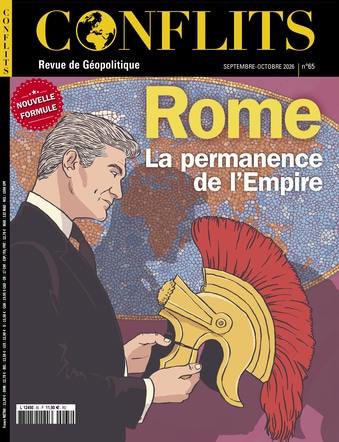
An article from Issue 65 of Conflits — « Rome: the permanence of the Empire ». by Jean-Baptiste Noé
Not only has the Roman Empire not disappeared: its shadow still stretches far and its heart still beats. Romanitas is one of the major concepts of geopolitics, a key for reading political action, ways of life and balances of power. Moscow takes itself for the third Rome; Donald Trump casts himself now as pope, now as emperor; the limes remains a perpetual scar running through the heart of the two Germanies; Roman ways of life live on across varied cultural spaces; and Rome is omnipresent in culture — in literature, in cinema, in video games. The debate over the fall of Rome is closed: Rome never disappeared, its empire lives on. It has mutated, transformed itself, undergone major evolutions of geographical expansion and contraction — but the Roman Empire is still there, carried by Catholicism.
Read also: La romanité structure l’espace mondial
What romanitas is
Romanitas is at once a civilisation, a culture, a projection, a permanence. It is a way of living, of seeing the world, of thinking about life and death, of inhabiting the earth. It is geographical and it is political. Geographical, since it is present in many countries and cities — in Europe, in the Americas, in the Maghreb and in the East. It is romanitas that unites Buenos Aires and Paris, Tangier and Beirut, San Francisco and Trieste. Political, since it is a very particular way of thinking about social life, of viewing the world and man’s place within it, of conceiving social, legal and human relations. Romanitas is founded on law; it is a conception of the city, a certain idea of man. The geographer Paul Vidal de La Blache (1845-1918) speaks, in his Tableau de la géographie de la France (1903), of the manner of inhabiting territories, of having a genre de vie — a way of life. These geographical definitions suit the analysis of romanitas perfectly. It is indeed a genre de vie, a custom, a way of being, of inhabiting the world and of bringing the land to fruit. It developed and exported the Mediterranean triad: the vine, wheat and the olive. There is no romanitas without wine, and without the literature and art that wine made possible. Wherever there is the vine, there is romanitas; wine is the drink of the Romans, sanctified by the Church, which placed it at the heart of its worship. Romanitas unites, even unknowingly and even unwittingly. It unites places, persons and times. Romanitas is a possession — and that possession founded a way of being.
Rome’s specificity is to have very little that is original: it is not a cradle but a crucible. It did not invent; it ate, digested, synthesised. Roman voracity devoured the East, Jerusalem and the prophets; Greece, Athens, the islands and the philosophers; Egypt, the pyramids and the pharaohs; the Etruscans and the Celts alike. Rome was founded by a Greek of Troy who passed through Carthage, Aeneas — as much as by a she-wolf and two twins born of kings, of gods and of the local soil. That is Rome’s true originality, its specificity in relation to all other cultures and peoples: to have taken Easterners, Hebrews, Greeks, Egyptians, Etruscans and Celts to produce a universal and original empire. In the heart of Rome, in its ontological constitution, pluralism, liberties and cultures are in dialogue. That is why romanitas today is found as much in the Mediterranean as in the North Sea, in the Tropics as at the poles; because, ontologically, romanitas is rooted in a soil while being projected towards others. The specificity of romanitas is curiosity: it is the only one to take an interest in other cultures and other peoples, to seek to decipher their languages, to understand their ways of living and thinking — to be curious. And curiosity is the foundation of science and of new, original thought; it is what makes invention and innovation possible.
« One must start from the idea that a land is a reservoir where energies lie dormant, of which nature has planted the seed, but whose use depends on man. »
Evoking the Beauce and the Seine valley, Vidal de La Blache analyses man’s development of these territories. A formula that sums up the spirit of romanitas: in nature lie dormant the energies, the reservoirs, the seeds; but it falls to man — through his action, his intelligence, his curiosity, his spirit of invention — to set them in motion in order to create. Man is a creator through the use of his reason, through the distinction drawn between logos and myth, through the rivalry of the political sphere. This is what gave the Roman world its technological advance, its capacity for innovation and invention, as much in the realm of science and matter as in that of thought and art. Romanitas unites matter and idea, spirit and body.
Persons and places
Speaking of romanitas makes it possible to move beyond the sterile confrontations surrounding « the West », a concept so difficult to define and ultimately so limited. Romanitas embraces East and West, both shores of the Atlantic and every time zone.
Read also: L’Occident : primauté de la personne et de l’état de droit
Among its great figures stands Alexander, who carried Hellenism into Asia and as far as India, opening the way, a few centuries later, for the apostle Thomas, first evangeliser of India, whose Syro-Malabar Christians are the spiritual descendants. King David too was a forerunner of romanitas — he whose hand wielded the sling and the strings of the harp, making war and art alike an instrument of the city’s survival, with the Temple at its centre. Octavian, heir of Caesar and thus of Aeneas and Venus, was another of the builders of romanitas; he pushed back the limits of the Empire and fixed, for eternity, the figure of the Emperor. If David was at once soldier and artist — for he composed the psalms still sung today — Alexander and Octavian were accompanied, the one by Aristotle, the other by Virgil, testifying in their turn to the union of action and thought. It is no accident that it was under Octavian that Christianity was born — the faith that would, three centuries later, take up the inheritance and ensure the survival of Rome and of romanitas.
If Rome and romanitas have been able to endure for two millennia, weathering defeats, the sackings of the city and the declines, it is because romanitas has known how to evolve — changing the accessory in order to preserve the essential. This tradition in motion is the very principle of modernity.
The other factor in its survival is its culture of combat. It is not enough to have a way of life, a culture, a vision: one must also defend it, defeat the adversary and be ready to fight to ensure its survival. David did not hesitate to face Goliath, Alexander the Persians, and Octavian secured his greatest victory at Actium. Later came the crusades, Lepanto, the defence of Vienna against the Turks, the expansion into the Americas, the Africas and Asia, and navigation on every sea of the world. The thirst for discovery and knowledge accompanies the culture of combat, which Saint Paul summed up in a famous sentence of the Epistle to the Ephesians: « Put on the whole armour of God, that you may be able to withstand when the evil day comes, and having done everything, to stand firm. » This culture of combat has as its corollary reflection on war, the definition of the just war, and the work of dialogue and negotiation to bring about peace by means other than the sword.1 The culture of combat is not violence and brutality, but strength of soul — knowing when the sword must be drawn and when it must be sheathed; the art of war and the art of diplomacy.
Transmission
The passage from one Rome to the next, so that Rome might remain, was ensured by transmission. Aeneas carried his father on his shoulders to save him from Troy and then to found a new city. Alexander handed his empire to his generals — which did not prevent them from tearing one another apart. David was able to pass Jerusalem on to Solomon, an inheritance received from his fathers. Heritage is not a burden, a ball and chain that prevents one from living; on the contrary, it is a security, a means of joining up the thread of time. In their turn, it was the Fathers of the Church who gathered up the inheritance and ensured the transmission of romanitas: Origen in Egypt, the brothers Basil of Caesarea and Gregory of Nyssa in Asia, Ambrose of Milan and Augustine of Hippo in the West, to name but a few. They were joined by formidable war leaders, such as Clovis and Belisarius. Centuries later came the Italian condottieri, Hernán Cortés, the generals of Africa.
Wars, explorations and the thirst for elsewhere allowed the peopling of the world by populations of European origin, extending the frontiers of romanitas to the scale of the globe: Australia, New Zealand and Latin America are but a few cases of this expansion. The expeditions of Bougainville and La Pérouse, those of Henry de Monfreid and Arthur Rimbaud, are expressions of romanitas, embodied in curiosity for others and the thirst for discovery expressed in travel.
Read also: La romanité, une opportunité pour la France et l’Italie
But romanitas has also known retreats and ebbs. The most telling case is the emergence of Islam which, by annexing the southern shore of the Mediterranean, broke Roman unity and created a border where none had existed. Henri Pirenne’s thesis on Charlemagne and Mohammed and this geographical and civilisational fracture remains valid to this day. Much later, the end of the Ottoman Empire followed by the ethnic cleansings, the expulsions carried out by Nasser after 1956, and the Christians driven from Syria and Iraq from 2000 onwards signed the end of the Roman presence in a plural East grown ever more uniform. This was not only a human and cultural loss, but an economic and political one. Egypt has never recovered from having driven out its industrious and intellectual populations, and it is hard to see today what future awaits the countries of the Levant and the Near East, mired in communal wars.
Romanitas transcends peoples, particularisms and communities — not by erasing or suppressing them, but by preserving them while proposing something greater and higher. By developing the concept of subsidiarity and by recognising the distinction between the religious, the political, the intellectual and the economic, without opposing or compartmentalising them, it allows the expression of a genuine unity and a common denominator that guarantees and preserves local particularisms and distinct cultures. That is why romanitas builds peace and concord — a pax romana that has now become a pax romanitas. Romanitas is not a long dream of history, but a human construction woven through the ages that continues to mark and structure the space of geopolitics.
Read also: Funérailles de François : l’Église catholique et la romanité
1 Jean-Baptiste Noé, La Culture du combat de l’Église catholique, 2025.
© Photo: Pixabay