




At the Auto China 2026 show in Beijing, 2,000 companies from 21 countries exhibited 1,451 vehicles, including 181 new models, confirming the centrality of the Chinese market.
In 2025, Chinese consumers bought nearly 30 million cars, twice as many as Americans, generating economies of scale that crush manufacturing costs.
Chinese brands now account for 6% of the European market and are aiming for 14% by 2030, putting Western manufacturers on the defensive.
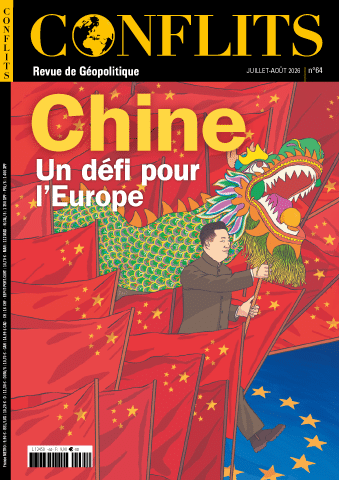
This article appears in Issue No. 64 — China: a Challenge for Europe.
By Jean-Jacques Netter, Conflits special correspondent in Beijing
To try to understand what is happening on China’s car market, you had to go to the « Auto China 2026 » show in Beijing. The show hosted 2,000 companies from 21 countries, with 1,451 vehicles on display, including 181 new models and 71 concept cars.
In 2025, Chinese consumers bought nearly 30 million cars, twice as many as Americans. These production volumes generate considerable economies of scale, which sharply reduce manufacturing costs.
Chinese brands now account for 6% of the European market. Every Chinese group is stepping up its offensive in Europe. To grow as fast as possible, they are willing to make little money in the short term in order to invest in the future. They pay their dealers generously and offer longer warranties. China is even ready to launch a major offensive in motorsport: for Chinese manufacturers, it is a matter of building global renown through Formula 1.
In China, electric cars are already cheaper than combustion cars
Chinese exhibitors do not simply present models, but systems. Today’s car is no longer merely a model, but a model plus systems — such as a car driven by an artificial-intelligence system. All this leads to the fact that, in China, electric cars are already cheaper than combustion-engine cars.
At the big manufacturers (BYD, Chery, Geely), what is on show is their capabilities in electric power and in intelligent systems. Around a hundred brands are waging a price war. To be profitable, they must find export outlets, with Europe as the priority.
It is no longer merely a model, but a model plus systems — such as a car driven by an artificial-intelligence system.
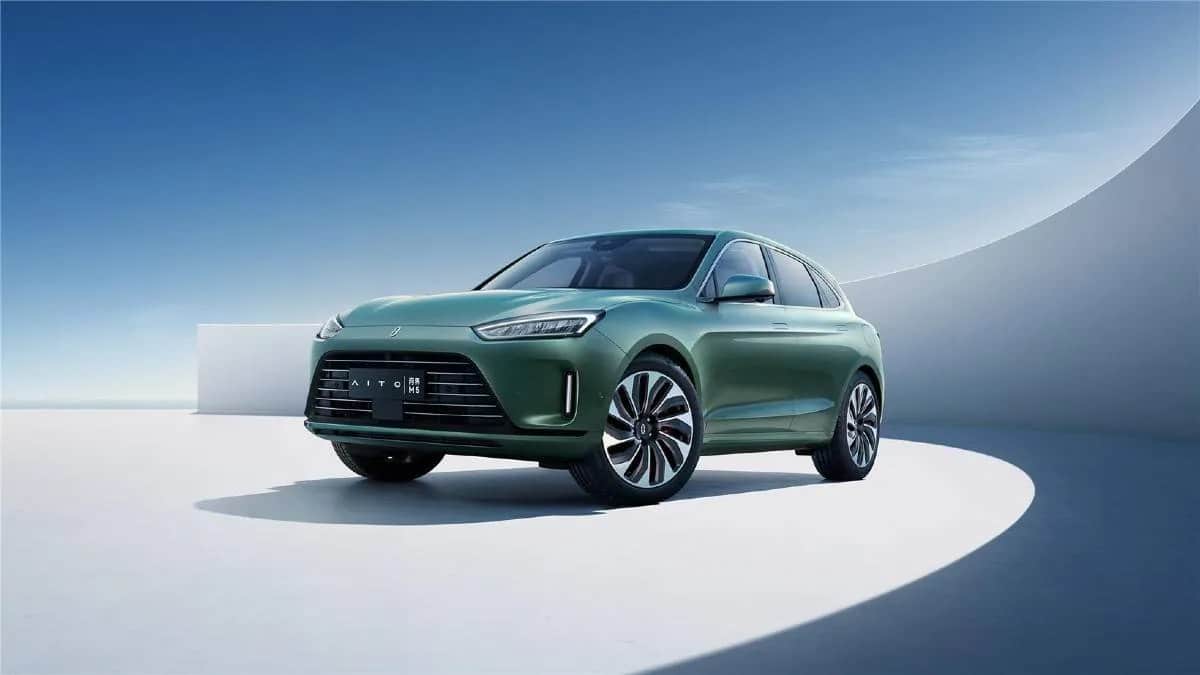
Huawei, originally a phone maker, has become a carmaker selling under the Aito brand.
XPeng has specialised in robotaxis. Permits to run trials in Guangzhou have already been obtained. The company hopes to sell 10,000 robotaxis in 2027. Driverless vehicles are the leading application of physical AI. In parallel, production of humanoid robots has been launched, and the company hopes to sell 10,000 of them in 2027. XPeng has allied itself with Volkswagen.
Read also: China’s assault on the self-driving car
BYD, the world’s leading maker of electric vehicles ahead of Tesla, unveiled its N9 model — heavily inspired by Ferrari — sold from $40,000. The company has launched its new premium brand, Denza, which is betting on technology and charging speed to win over customers.
Two models were recently presented at the Paris Opera: the Z9GT and the D9 DM-i, by Stella Li, accompanied by her husband Wang Chuanfu — together the most powerful duo in the global car industry today. Denza cars are fitted with lidar, cameras and radar for autonomous driving. This year, BYD is due to open its plant in Hungary. BYD intends to export 1.5 million cars in 2026, whereas its forecast last January was 1.3 million. BYD might even enter Formula 1 to build global renown. The company — whose results fell 53% year-on-year in the first quarter — hopes to make half its sales outside China by 2030. On plug-in hybrids, price gaps can reach 30%. BYD had, however, made a false start three years ago.
Read also: A record for BYD
Geely has grown rapidly with the launch of Zeekr and also holds stakes in other brands, such as Volvo, Manganese Bronze — the maker of London’s black cabs — and Proton in Malaysia, which owns the English marque Lotus. It also controls 50% of Smart, bought from Mercedes. The cars once built in France are now produced in China. It also owns 9.69% of Mercedes. The group is likewise allied with Renault in Brazil and Korea. The brand has just entered France. The Hangzhou-based group is betting on affordable premium to establish itself in Europe. Geely aims to sell 6.5 million cars in 2030, up from 3.4 million in 2026.
Chery started out with the Omoda & Jaecoo brand before launching a marque under its own name. Next year it will launch the Omoda 2, a model designed specially for Europe at €25,000. The company explains that, in the age of the electric car, quality is no longer measured by mechanical parts but by the battery, the software and data security.
SAIC, the Shanghai state-owned group, sold 211,000 cars under the MG brand. In 2025, 35,000 cars were sold in France.
Leapmotor, Stellantis’s ally, will assemble its electric crossover in the former Opel/Stellantis plants in Zaragoza. There it will build its B10 model, the cheapest compact electric SUV on the market. With this European industrial deal, Leapmotor will be able to go from 600,000 vehicles sold worldwide to one million next year.
Dongfeng Motor Corporation is a manufacturer involved in joint ventures with foreign brands such as Stellantis, and produces a wide range of vehicles.
NIO, more recent, is known for its electric vehicles and has quickly built a reputation.
Chinese manufacturers have set out to conquer every market in the world. They are also signing deals to assemble vehicles directly in Central Asian countries such as Kazakhstan and Uzbekistan. They ship kits for assembly, which partly avoids customs duties.
CATL, the world’s leading battery maker, is showcasing its new generation of batteries across 1,500 m². The company sits at the heart of the ongoing revolution in this field. It is preparing to produce sodium-ion batteries in large quantities. Battery storage is now growing almost as fast as renewable energy.
European manufacturers are struggling
China’s rise poses serious challenges to European industry. Europe is applying adjusted customs duties to restore what it hopes will be fair competition. For European carmakers, Chinese competition is very hard to contain in electric vehicles. Chinese manufacturers hope to account for 14% of the European market by 2030.
Volkswagen is consolidating its ties with Chinese makers of AI-based ecosystems. These systems will feature on every VW vehicle sold in China. They will be able to perform complex tasks across several systems at once. Volkswagen has a joint venture with FAW, one of the oldest carmakers in China.
BMW is pursuing the same strategy. Oliver Zipse, its chairman, has announced active partnerships with Alibaba and Momenta.
Porsche unveiled its first electric Cayenne. The company took the opportunity to announce that it was withdrawing from Bugatti’s capital.
Stellantis could open the doors of its plants to China’s Dongfeng, which had come to its rescue in 2014 when the French carmaker was on the brink of bankruptcy. Talks are also under way with XPeng and Xiaomi. One of the avenues being explored by Mr Elkann’s group to cut costs is to negotiate partnerships with other manufacturers.
Dongfeng, which came to Stellantis’s rescue in 2014 when the French carmaker was on the brink of bankruptcy, could now use its plants.
Peugeot has announced its return to China with Dongfeng. The company presented two concept cars in Beijing: a saloon and an SUV. It marks the return of a brand that had left China under Carlos Tavares, its previous boss. These models are the first elements of a future range produced in China at Dongfeng’s Wuhan site, for both the domestic market and export. The partnership with Dongfeng — which now owns 1.56% of Stellantis — has been strengthened to build Peugeots and Jeeps in China.
Read also: « China has taken a significant lead » in the car industry — an interview with Serge Cometti
Asia is a buoyant market
In Vietnam, more electric vehicles were sold than in Great Britain. Vinfast shares, listed on the Nasdaq, rose 127% over the past twelve months. Growth is also very strong in Thailand and Indonesia. In Thailand, BYD sold more cars than Toyota for the first time. In the Philippines, BYD’s showroom in Manila is never empty.
The future of European carmakers is therefore very complicated, but they are still fighting. Their future does not lie solely in partnerships with China aimed at preserving their industrial base by importing kits from China to avoid part of the customs duties.
The progress made by Japanese and Korean manufacturers is also impressive, especially in mid-range models. But all those seeking to compete with the Chinese run up against the fact that Chinese suppliers give priority access to their most sophisticated products to Chinese carmakers.