


In Ceuta and Melilla, Europe does not look at Africa: it touches it. Two enclaves, a few rocks — and the entire southern border of the EU.
Madrid invokes continuous historical titles; Rabat sees the « occupied presidios » of a colonialism still to be liquidated. The UN refers the matter back to bilateral talks.
The migration crisis of summer 2026 — up to 80,000 crossings into Ceuta — has tipped the dispute into the « grey zone » and hybrid warfare.
Two worlds face to face
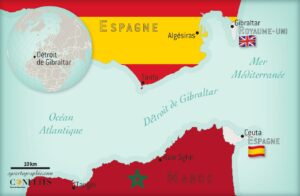
In Ceuta and Melilla, Europe does not look at Africa from the opposite shore: it touches it. For Madrid, these cities and the Spanish rocks along the Moroccan coast are inalienable portions of the national territory; for Rabat, they represent the last vestiges of colonialism. Behind a few square kilometres, what is at stake is the solidity of the southern border of the European Union (EU), as the migration crisis of summer 2026 has just reminded us.
« In Ceuta and Melilla, Europe does not look at Africa from the opposite shore: it touches it. »
A great deal of history for so little land
Ceuta covers 18.5 km² at the entrance to the Strait of Gibraltar, and Melilla 12.3 km², some 400 kilometres further east. On 1 January 2025, they had 83,567 and 87,067 inhabitants respectively. As for the Spanish « places of sovereignty » (plazas de soberanía), they comprise the Chafarinas Islands (three islands totalling 0.52 km²); the Peñón de Vélez de la Gomera (0.019 km²), connected to the mainland since 1934 by a tongue of sand forming an 85-metre international border; and the Peñón de Alhucemas (0.015 km²). To these should be added Perejil Island, 200 metres off Morocco, uninhabited since an armed confrontation in July 2002. Further offshore, finally, lies Alboran Island (0.071 km²), administratively attached to the Andalusian province of Almería and less directly involved in the Spanish-Moroccan dispute.
| Territory | Area | Population (1 Jan. 2025) | Under Spanish control since |
|---|---|---|---|
| Ceuta | 18.5 km² | 83,567 | 1415 (Portugal), Spanish in 1668 |
| Melilla | 12.3 km² | 87,067 | 1497 |
| Peñón de Vélez de la Gomera | 0.019 km² | — | 1564 |
| Peñón de Alhucemas | 0.015 km² | — | 1673 |
| Chafarinas Islands | 0.52 km² | — | 1848 |
| Perejil Island | — | uninhabited (since 2002) | disputed |
| Alboran Island | 0.071 km² | — | province of Almería |
To justify its presence in these territories, Madrid insists on history: Ceuta, conquered by Portugal in 1415, remained Spanish after the Portuguese secession that followed the break-up of the Iberian Union (1580–1640), a choice confirmed in 1668. Melilla, for its part, was taken by Castile in 1497; Vélez de la Gomera was definitively occupied in 1564; Alhucemas in 1673; and the Chafarinas in 1848. None of these territories was included in the Moroccan protectorates established by Spain in 1912 and abolished in 1956. The Spanish authorities therefore infer continuous sovereignty, rather than a colonial administration that would require the European power’s departure.
Two cities in a class of their own — and outside VAT
Since 1995, Ceuta and Melilla have also had an assembly and a statute of autonomy (without, however, enjoying the full range of powers of the seventeen autonomous communities that make up the rest of the country). Their inhabitants are consequently Spanish and European in legal terms. Christians, Arab or Amazigh Muslims (as well as small Jewish and Hindu minorities in Melilla) coexist there, though inequalities in employment, training and housing persist.
Members of the European Union, the two cities nevertheless remain outside its customs territory and outside the scope of VAT, since they apply the IPSI (a more advantageous local tax) and benefit from tax rebates. Public-sector jobs carry great weight there and, until the 2010s, the atypical trade in goods carried daily to Morocco (or from that country) by porteadoras generated 600 to 700 million euros a year. The closure of the Melilla customs post in 2018, followed by the end of this portering in 2020, destroyed that model. The limited reopening of customs in 2025 has not lifted the uncertainty — hence the two cities’ conversion towards the digital economy, tourism and closer links with the Iberian Peninsula.
To each its own law, to each its own strait
Rabat invokes geographical continuity, territorial integrity and the ancient allegiance of the Rif tribes to the sultan in order to claim these territories. These « occupied presidios » are, from its point of view, colonial positions destined to rejoin the rest of the Sherifian Kingdom. In this context, the parallel with the British overseas territory of Gibraltar is a formidable one: can Spain claim that tongue of land while retaining enclaves in Africa? Morocco nevertheless avoids opening formal negotiations on the subject and does not treat their limits as ordinary international borders.
Madrid counters with its ancient titles, the Spanish-Moroccan treaty of 1860 (concluded after a first armed conflict), the exclusion of the enclaves from the protectorate, and the will of populations (who elect their Spanish and European representatives) to remain within the Spanish whole. Legally, the 1978 Constitution protects national unity, and the 1995 statutes of autonomy attach the cities to Spain.
At the UN, these territories do not appear on the list of non-self-governing territories — unlike Gibraltar and Western Sahara. Morocco did request their inscription before the Committee of Twenty-Four (notably in 1975), without success. They therefore escape the UN decolonisation procedure, but this absence does not amount to a judicial decision in Spain’s favour: in the eyes of the United Nations, the dispute remains strictly bilateral.
Read also: Ceuta : une crise migratoire annoncée, et un gouvernement pris de court
An Atlantic shield with a hole in the south
Ceuta enables Spain and its allies to monitor the Strait of Gibraltar, the vital passage between the Atlantic Ocean and the Mediterranean Sea. The Legion, regular troops, naval assets, the Civil Guard and the national police protect there (together with Melilla) the European Union’s only land borders in Africa, and fight irregular immigration, drug trafficking and jihadist networks.
NATO’s coverage of the two cities nevertheless remains uncomfortable and incomplete. Article 6 of the Washington Treaty specifically covers allied territories « in Europe or North America », Turkey and certain islands north of the Tropic of Cancer — whereas Ceuta and Melilla (continental and African) are not expressly mentioned. An attack on Spanish forces, vessels, aircraft or lands in the Mediterranean Sea would, however, fall within its scope, and Article 4 of the treaty would allow consultations within the Alliance. These autonomous cities thus enjoy neither an absolute exclusion nor a crystal-clear guarantee.
Beneath the sea, the dispute touches bottom
In the Alboran Sea (the westernmost part of the Mediterranean), the proximity of the Spanish and Moroccan coasts imposes a bitterly negotiated delimitation. Rabat disputes that the aforementioned Spanish rocks generate vast maritime spaces, and the Montego Bay Convention limits the rights of lands unfit for autonomous economic life. At stake are fishing, biodiversity, submarine cables and possible hydrocarbons.
The Tropic Seamount, located south-east of the Canary Islands, perfectly illustrates the problem: rich in cobalt, nickel, tellurium and rare earths, it is the subject of a separate dispute. In 2014, Spain requested an extension of the Canary continental shelf beyond 200 nautical miles in order to include it, while Moroccan laws 37-17 and 38-17 of 2020 incorporate the waters bordering Western Sahara and create possible overlaps. The UN can hardly settle the matter: it may study the local geology, but it is in no position to rule on the sovereignty of the lands in question or to fix a border.
Read also: L’Espagne au cœur de la géopolitique migratoire de l’Europe
When the border springs a leak
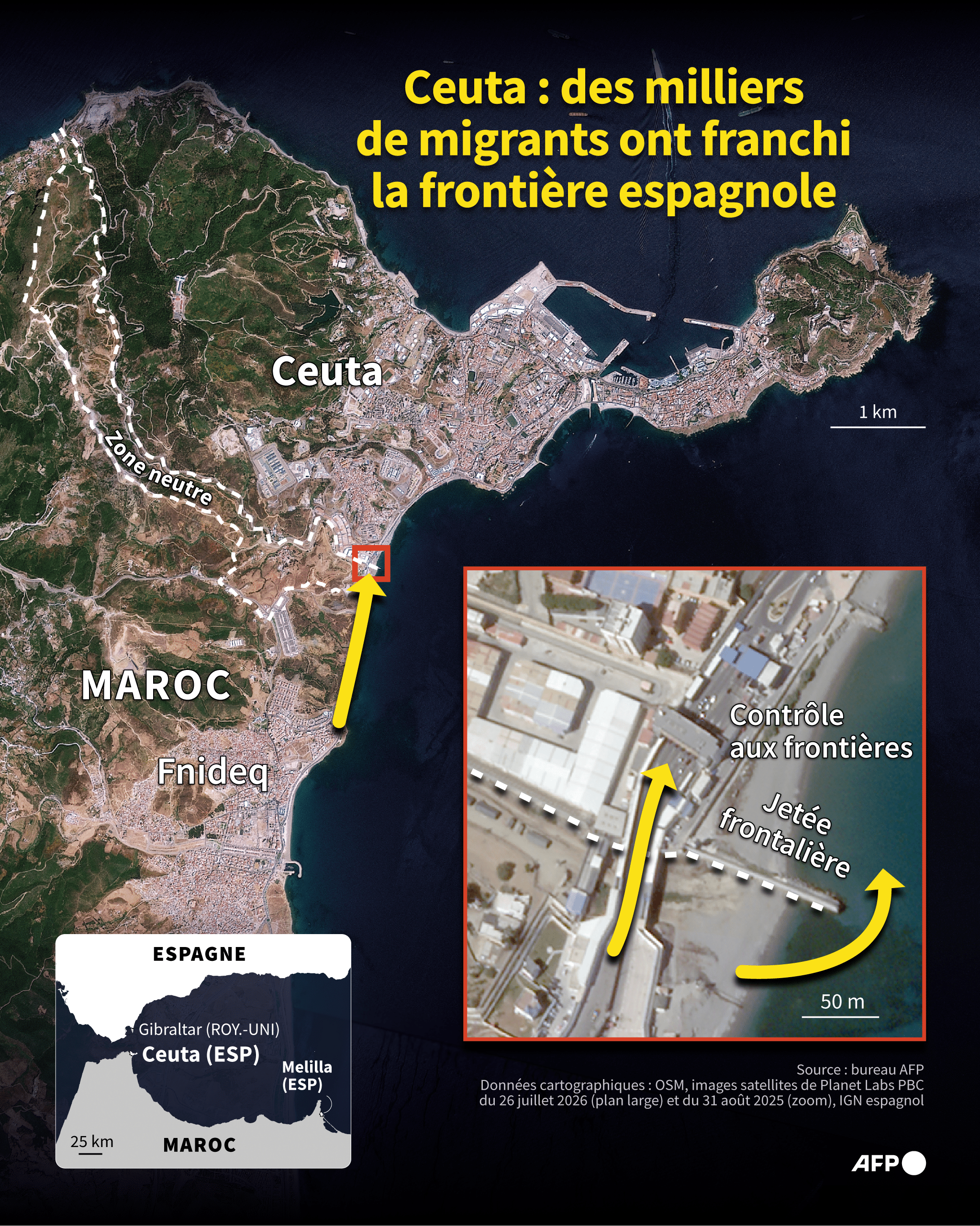
Against this backdrop, the events of 30 and 31 July 2026 changed the scale of the problem. With estimates ranging between 50,000 and 80,000 clandestine crossings by Moroccan migrants into Ceuta (almost as many as the local population), the autonomous city found itself overwhelmed. Admittedly, around 90% of the arrivals quickly returned to Morocco, but 7,000 to 9,000 (including some 2,500 minors and as many potential asylum seekers) are reported still to be on the spot, swamping the city’s reception and processing capacities.
Viral messages announcing the opening of the Spanish-Moroccan border had drawn thousands of young people towards Fnideq in the days before the mass crossing. Smugglers also distorted a ruling of the Spanish Supreme Court of 8 July, which excluded the immediate rejection at the border of migrants intercepted at sea — without, however, creating any right of residence. Madrid ended up deploying the army on the spot to reinforce maritime surveillance and installed a pneumatic barrier near Tarajal beach. Rabat, for its part, facilitated the return of its nationals, but the saturation from which Ceuta suffers and the presence of the minors have prolonged the emergency on the ground.
At the same time, panic spread to the EU: Italy reinstated for one month controls targeting non-European travellers arriving from Spain, and twenty-two member states demanded an extraordinary meeting as well as the strengthening of the external borders. For Ceuta is European, but its remoteness turns any local crisis into a test for the Schengen area and Frontex.
« Ceuta is European, but its remoteness turns any local crisis into a test for the Schengen area. »
From migratory pressure to the « grey zone »
The precedent of May 2021 (more than 10,000 crossings into Ceuta during the Spanish-Moroccan quarrel sparked by Spain’s hosting of the leader of the Polisario Front), the closure of the customs posts and the brief occupation of Perejil Island in 2002 by a Moroccan detachment all feed the idea, north of the Pyrenees, of a « hybrid war » waged by Rabat. No public evidence establishes that Rabat organised the 2026 influx, and Spanish intelligence speaks rather of a relaxation of control exploited by digital networks. The idea of a conflict waged in the « grey zone » (that is, on a territory lying on the physical, legal and strategic border between Europe and Africa, whose status is subject to controversy) is nevertheless beginning to take hold in Spanish minds and to alarm the authorities.
Moroccan rearmament is heightening this concern. According to SIPRI, the Sherifian Kingdom devoted 6.3 billion dollars to its defence in 2025, up 6.6% in one year, and became Africa’s leading arms importer over the period 2021–2025. The modernised F-16 fighter jets, the drones and the Apache helicopters are aimed first at Algeria and Western Sahara, but they necessarily alter the regional balance. For their part, Tanger Med, Nador West Med and Dakhla Atlantique compete with Spain’s cargo ports.
Read also: L’Europe face à la pression migratoire
How to settle the dispute?
What this analysis shows, in the end, is that the stability of Ceuta and Melilla will be won neither by the fence alone nor by the invocation of rights on either side. It requires an economy less dependent on Moroccan goodwill, explicit European solidarity, an unambiguous defence doctrine and bilateral cooperation able to withstand crises. Between Spain and Morocco, the border is short — but the shadow it casts over Europe keeps growing longer.
« Between Spain and Morocco, the border is short — but the shadow it casts over Europe keeps growing longer. »
Read also: « Les murs ne servent à rien » mais tout le monde en construit !
© Photo: Ceuta, AFP