





Russia has never given up on nuclear power: through Rosatom, it sells turnkey plants and holds a near-monopoly over a global market that France has neglected.
Small reactors and floating power plants are to electrify the isolated mines of eastern Siberia, rich in resources the whole world needs.
Producing electrons through nuclear power frees up gas for export; tomorrow, floating barges could supply Africa.
By Samuel Furfari — interview conducted by Tadéo d’Orsay
The geopolitical context of Russian civil nuclear power
Can you remind us of the geopolitical context in which the development of Russian civil nuclear power takes place?
Russia, like the other great nations, committed to nuclear power very early. I recently learned that in 1969 India already had nuclear reactors, well before France. After the 1950s, everyone went in for nuclear power, and Russia has always been in the front line on this subject.
Even today, it is a step ahead of France, which has become, in a way, a subcontractor to Rosatom. Rosatom sells turnkey nuclear power plants, which France does not do. France retains great capabilities, notably in automation and plant management, areas where it is ahead of the Russians; but on the sale of plants, it is indeed Russia that leads.
Why, as with other resources abundant on Russian territory such as gas or coal, was nuclear power favoured?
Because it is plain common sense: one must diversify. In a world where energy is so crucial, you cannot stake everything on a single source. This is a point many people struggle to grasp: in energy matters, you need both electrons and molecules. Electrons are electricity, and they can be produced by nuclear power. Molecules are not (the crisis in the Strait of Hormuz, for example, stems precisely from this need for molecules).
To produce electrons, two cheap solutions exist: coal, which the Russians have in abundance, and nuclear power. In the 1950s and 1960s, nuclear power was a genuine revolution, rather as renewable energies are today. With this difference: that the nuclear revolution endures, whereas solar and wind are, in my view, something more transient. Russians, Americans, Japanese, Canadians, Chinese, and later the French, all took it up: it is a logical response to a need for energy and electricity.
It seems there was already a strategy of large-scale deployment, including with small reactors such as the RBMK reactors, which were inexpensive, in a drive to extend the network of plants across the whole territory.
That is also true. But one must never lose sight of the fact that the United States first, then Russia and even India, worked on the production of nuclear weapons, which required plutonium and enriched uranium. That is the great ambiguity of nuclear power: originally, it had a strong military dimension, which has not, in fact, disappeared (that is what is at stake today with Iran, whose civil nuclear programme would also provide the means to make weapons).
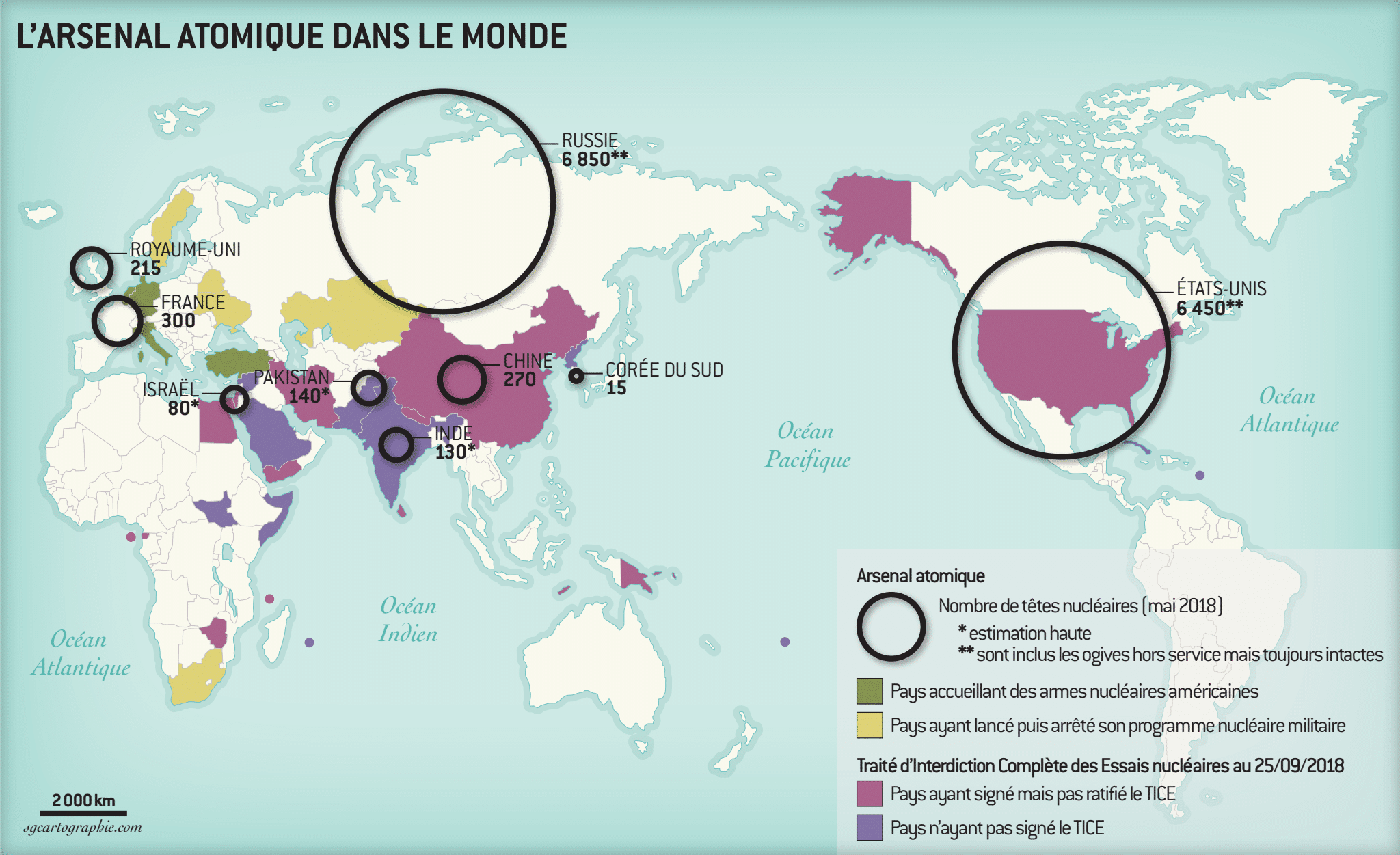
Russia has never held back on this front: it is also ahead in the number of nuclear weapons, which exceeds that of all other countries.
Read also: The great rebound of Russian nuclear power
Rosatom’s commercial strategy
I would like to come back to Rosatom: what role does this company play in the Kremlin’s overall industrial and diplomatic strategy? You mentioned that, unlike France, Russia exports its nuclear power.
Yes, because Russia has never abandoned nuclear power, unlike France, which neglected it for several years (we recall that Édouard Philippe initiated the closure of Fessenheim). Nor has China ever given up on nuclear power. While France dithered, Russia advanced, carried by excellent scientists.
But beyond technical progress, the Russians above all developed a formidable commercial policy. They persuade certain countries, not always democratic, to buy Russian plants: they sell the technology, build the plant, supply the fuel and the financing, take their remuneration from the electricity produced, and take charge of waste treatment. It is a complete service, with very little risk for the client countries. This is the case in Turkey, Mongolia and Egypt: these countries take no risk and enjoy competitively priced electricity.
This allows Rosatom to hold a near-monopoly on the market. I am not saying the company makes a lot of money — in this field one is doing politics above all — but this strategy gives Russia a central role in world nuclear power.
Read also: Is French nuclear power still under threat?
Do you have any idea of Rosatom’s clients?
They are more or less everywhere: Turkey, Mongolia, Vietnam, Egypt, among others. Many projects are announced; some are under construction, because it always takes an enormous amount of time. The Turkish plant, for example, announced for years, is now under construction. It is the same in Egypt. Nuclear power takes about a decade between the moment it is first considered and the moment the plant actually produces electricity.
The Siberian revival and mining
I would like to refocus the discussion on Siberia. On the Russian side we observe factual shortages of certain minerals, an economy feeling the strain of the recent years of conflict, and much infrastructure inherited from the USSR left unused, with deposits never opened. What do you know of this desire for a Siberian revival, and of the role that current energy strategy plays in this context?
I wrote an article about two years ago on this subject; I will summarise it from memory. There are immense mineral deposits to be exploited in north-eastern Siberia, so much so that the Russian government is preparing the exploitation of all of them. Now, that requires electricity, in remote areas, very far from everything.
One of the solutions consists in bringing this electricity via floating nuclear power plants, or via small reactors installed near the mines. So one must organise things in eastern Siberia to guarantee the electricity these operations need. It is not a matter of supplying a city like Paris or Moscow, but of meeting the needs of these mining deposits, which produce resources the whole world needs, not only Russia.
It is with this logic that the Akademik Lomonosov was installed at Pevek, in north-eastern Siberia, about five years ago. It supplies Pevek, but a whole strategy aims to multiply this type of installation to supply the future mines.
In your view, is this strategy more linked to the loss of European outlets since 2022, or does it stem from an older dynamic of mining-energy revival?
No, it is much older. The Akademik Lomonosov (commissioned in 2019) has nothing to do with the post-2022 context. It is part of a long-standing Russian strategy aimed at having plants capable of operating in isolated areas, because energy needs do not concern only urban areas.
The Russians did not, moreover, start from scratch: they draw on long experience acquired with nuclear submarines and icebreakers, which makes it possible to master the technology and minimise the risks for floating plants. It is the same pattern as in the United States, except that the Americans have no icebreakers: civil nuclear power, even there, was born of military nuclear power, with the need for powerful reactors for aircraft carriers and submarines.
That is also the case in France, which went through the military before the civil. But it is interesting to see that the Russians adapted this small-modular-reactor capability, initially designed for limited needs, to land-based uses linked to minerals. Is there a priority among nickel, rare earths and uranium in this nuclear electrification, or is the aim to cover the widest possible range of resources?
In my view, it is above all for the mining sector that this electrification is urgent and important. For cities, one can always fall back on a small gas- or coal-fired plant. The value of modular reactors really lies in isolated areas. And the Russians already have them in numbers, whether on icebreakers or submarines: you just have to install them where the mines are. This practice can only multiply.
Are there environmental, climatic or logistical constraints that have so far held back the exploitation of Siberian deposits? Does decentralised nuclear energy represent a real advantage in this context?
There is a real advantage in having a lot of energy, and that goes for everyone, not just the mines. The advantage sought is the cheapest and most available energy possible. That is precisely what Europe refused to understand: it focused on decarbonisation while neglecting the principle of abundant, cheap energy, which had nonetheless been the engine of the European Union for sixty years. The Russians, for their part, remain faithful to this logic of abundant, cheap energy, which comes either from coal or from nuclear power.
Read also: For abundant energy: let us learn the lessons of history
In your view, does Russia have more interest in favouring floating plants like the Akademik Lomonosov, mobile by nature, or in developing land-based modular units, which imply a wider network and longer-term dependence?
Originally, the Akademik Lomonosov was aimed above all at supplying Pevek and its surrounding industry. But to develop the mines further, the Russians will not necessarily go via the Siberian sea: they will rather install reactors directly on land. I see no reason for it to remain systematically floating. The need is for plants dispersed across Siberia, suited to the needs of each area.
Are there not security risks linked to the establishment of these reactors in remote, lightly monitored areas, notably for small mining operations located outside the core of the Russian security apparatus?
There is no area in Russia where a nuclear plant, even a small one, would be left unmonitored, to the point that anyone could break into it. Security systems necessarily exist, as for any plant, moreover, because cutting the energy supply would paralyse the whole mine and the whole area. That kind of argument does not convince me.
Extending the networks with smaller reactors nonetheless implies more staff deployed over wider areas, and therefore additional logistical constraints.
Of course, that implies more oversight. But one must not imagine that fifty of them will be installed: that is not the aim. The number will grow, but not at the pace of solar panels or wind turbines.
Read also: The irresistible rise of nuclear energy
China, the Arctic and trade routes
You mentioned China in your introduction. In the diplomatic ties maintained in recent years, is it more a partnership or a competition in access to the Siberian resources being made exploitable?
No, it is every man for himself. China communicates very little about small reactors. I have seen nothing from them on this segment: they work mainly on large reactors, and even on breeder reactors, but I have not observed among them the same strategy as the Russians, consisting in exploiting mines using small nuclear plants.
Read also: The Northern Sea Route: a complementary supply solution for China
A more forward-looking question on Russian Arctic strategy: from a purely mining perspective, does this type of technology make sense as a selling point for the next ten years?
I took a great interest in this subject some fifteen years ago, to the point of devoting an entire chapter to it in my book Guerres et énergies fossiles, published in 2014. But I have since set the question aside. There is so much abundant energy everywhere in the world — why go looking for resources in areas so hard to reach? The Russians themselves had at one point considered the Shtokman field, in the Barents Sea. Ten to fifteen years ago, everyone spoke of it as the new El Dorado, so large did its gas and oil reserves seem. Then the project was abandoned.
Why embark on projects of such complexity, in areas where it is permanently dark and cold, when you can find oil and gas in abundance elsewhere, in Africa in particular? One must, I believe, forget the Arctic for this century. Perhaps one day, once the easy resources are exhausted, we will return to it, but for now it makes no sense.
There would nonetheless be an interest in terms of trade route, independently of the Arctic resources themselves.
The trade route is another matter. That is where the Russian nuclear icebreakers come in, making it possible to use the Northern passage. On that score, yes — but not on the resources.
Read also: Map: the maritime routes of the Arctic
In that case, would there be an interest for the Russians in reviving the Siberian economy by relying on this energy question, ahead of a wider opening, or is the aim really limited to reviving the mines?
The interest is solely maritime. Russia is a geological scandal: it won the lottery of the world’s creation. It has oil, gas, coal, uranium, hydroelectricity, timber — it has everything. Why would it produce elsewhere, when it already cannot sell all that it has in abundance at home? One must forget the Arctic as far as resources go; we talk about it mainly to keep up appearances. The maritime route, on the other hand, is perfectly coherent: it is already being used thanks to the icebreakers, and it will continue to be.
« Russia is a geological scandal: it won the lottery of the world’s creation. »
Long-term prospects
A final, also forward-looking question: is there a scenario in which Russia integrates durably into the world economy through nuclear power, or do we rather observe a growing dependence on foreign partners such as China?
No, Russia will continue to develop its nuclear power to the full, precisely in order to be able to sell more gas and oil. The more nuclear electricity you produce, the less gas you burn, and the more you can sell on the international market. This is exactly the logic followed by the United Arab Emirates with the Barakah nuclear plant: they have all the gas they want, yet they chose nuclear power in order to save that gas and sell it elsewhere. Saudi Arabia, moreover, is considering the same approach.
Nuclear power serves above all to produce electrons. If you manage to produce those electrons through nuclear power, you no longer need to do it with gas, which can then be sold on the international market. It is an intelligent strategy.
A postscript: Africa as a future market
Africa’s great cities are often located along the oceans, and it would therefore be relevant for the Russians to develop floating nuclear plants there, positioned off the major metropolises to supply them with electricity.
Fifty per cent of the African population is not connected to the electricity grid, and those who are often have electricity for only a few hours a day. It is a dramatic situation. I had, in fact, written a book a few years ago on the urgency of electrifying Africa. African countries are aware of this and are building coal- or gas-fired plants, but they do not have the capacity to build nuclear plants on their own territory, which is in itself much more complex to implement.
On the other hand, if Russia builds floating barges in its ports, like the Akademik Lomonosov, and brings them, for example, off Kinshasa, it could then provide cheap electricity while being paid for the service.
Read also: The African paradox: threats and prospects
That would therefore mean a real democratisation of the export of the nuclear plant as a product. But in terms of cost, could it really be advantageous for the client countries?
Of course it is worth it, for the buyer countries. They take no risk: a cable links the country to the ship, and the ship supplies the electricity. You simply buy electricity, without having to operate the infrastructure yourself, since it is a service.
I wrote about this several years ago now. It will take time, but I am convinced it will eventually come about. And the first player to commit to it will win a considerable advantage — whether China, which communicates little but could act before the Russians, or Russia itself. That, in my view, is Africa’s energy future, far more than solar panels.
Samuel Furfari is professor of energy policy and geopolitics at ESCP Business School (London campus); he taught the subject at the Université Libre de Bruxelles (ULB) for 18 years. An engineer and doctor of Applied Sciences (ULB), he was a senior official at the European Commission’s Directorate-General for Energy for 36 years.